• ABOUT
  • BIRDING 2018
  • Birding 2019
  • BLOG POSTS
  • Butterflies 2018
  • Resources

earthstar

~ a celebration of nature

earthstar

Tag Archives: Cosmeston Lakes Country Park

348/366 Cosmeston treasure hunt

13 Sunday Dec 2020

Posted by sconzani in wildflowers, winter

≈ Leave a comment

Tags

British wildflowers, Cosmeston, Cosmeston Lakes Country Park, December wildflowers, winter wildflowers

This was hard work! The paddocks at Cosmeston Lakes Country Park get shaved of all vegetation at least once each year, usually in autumn, and that process happened late this year, just two weeks ago. So, it took me three visits, covering almost every inch of the site, checking the field boundaries in particular, searching for any wildflowers the tractor’s blades might have missed.

I’m actually amazed I managed to find this many species still flowering: Bramble, Carline thistle, Creeping buttercup, Creeping thistle, Daisy, Herb Robert, Hogweed, Oxeye daisy, Sweet violet, Wild radish, Winter heliotrope, and Yellow-wort.

Like Loading...

312/366 Deformed

07 Saturday Nov 2020

Posted by sconzani in birds

≈ Leave a comment

Tags

bird with deformed beak, birding, birdwatching, British birds, Cosmeston Lakes Country Park, Herring gull, Herring gull with deformed beak, juvenile Herring gull

This juvenile Herring gull that I spotted amongst the gull flock at Cosmeston Lakes Country Park a couple of days ago had an interesting beak deformity. Presumably it can eat okay and it was preening but still looked scruffy, so I guess the twisted beak doesn’t work well for grooming.

201107 herring gull (1)

201107 herring gull (2)
201107 herring gull (3)
Like Loading...

303/366 Ring-necked ducks

29 Thursday Oct 2020

Posted by sconzani in birds

≈ Leave a comment

Tags

Aythya collaris, birding, birdwatching, British birds, Cardiff Bay, Cardiff Bay birding, Cosmeston Lakes Country Park, Ring-necked duck

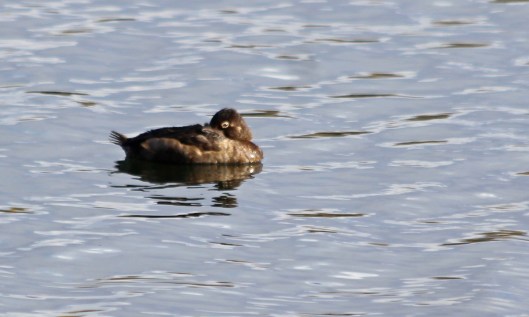
I can count on one hand the number of times I’ve seen a Ring-necked duck (Aythya collaris) so I was delighted when, ten days ago, a juvenile female was spotted at Cosmeston Lakes Country Park, and I managed to get a very distant view of it on 18 October.
201029 ring-necked ducks (1)

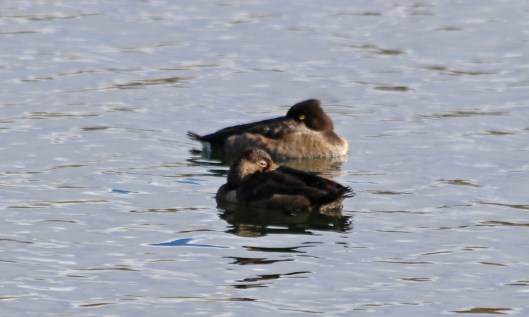
I’m the first to admit I would not have been able to identify this bird without the local, much more experienced birders sharing their photos on social media. When its head is tucked in, which seems to be most of the time, only its pale eye ring distinguishes this bird from the female Tufted ducks that surround it, at least to my inexperienced eye.
201029 ring-necked ducks (2)

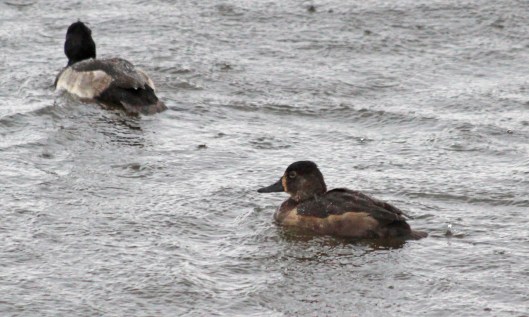
Late last Sunday, 25 October, the exciting news came that a second Ring-necked duck had been sighted at Cosmeston, this one a 1st winter drake, so I headed along on Monday for a look. I got much closer views of the first bird, the juvenile, but couldn’t find the other – turns out, it had flown over to Cardiff Bay. This is a common phenomenon during the winter months – the various duck species fly regularly back and forth between the lakes and the Bay.
201029 ring-necked ducks (3)

So, for yesterday’s exercise walk I headed down to Cardiff Bay where, in spite of occasional heavy rain showers, I managed to locate both Ring-necked ducks, though this time the drake kept its head tucked in throughout my visit. That’s the juvenile braving the weather in the photo above, and the 1st winter drake below. If I manage to see the drake again and get a photo of it with its head up, I’ll be sure to share.


201029 ring-necked ducks (4)

Like Loading...

300/366 Four-spotted orb weaver

26 Monday Oct 2020

Posted by sconzani in spiders

≈ 5 Comments

Tags

Araneus quadratus, British spiders, Cosmeston Lakes Country Park, Four-spotted orb weaver

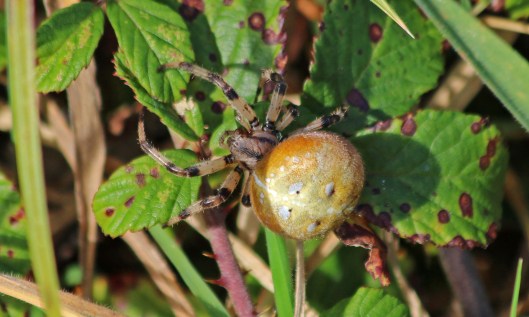
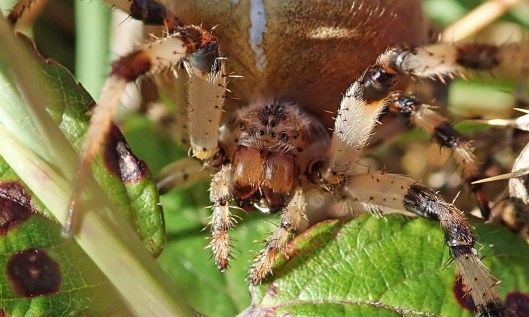
If you suffer from arachnophobia, look away now! This spider, found recently in one of the outer fields at Cosmeston Lakes Country Park, was the biggest spider I’ve seen in Britain. That’s still not big when compared to Tarantulas or Huntsmen or other large species but it was big enough to make me feel both a teeny bit freaked out and totally fascinated at the same time.

201026 four-spotted orb weaver (1)

This is a female Four-spotted orb weaver (Araneus quadratus), a species that’s apparently quite common in Britain and can be found in a variety of habitats, from grassland and bogs to gardens and woodlands. As with many spiders, females are larger than males. In this species, females can grow to 17mm long, while the males are only half that size.

201026 four-spotted orb weaver (2)

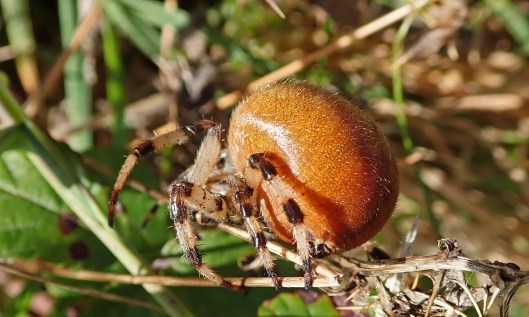
This beauty was slowly making her way through the long grass at the edge of a bramble patch. Because of the size of her body, she was struggling to stay upright, and several times overbalanced. But those long striped legs are obviously quite strong and she easily managed to pull herself upright again.

201026 four-spotted orb weaver (3)

I spotted this orb weaver because her apricot colour stood out from her surroundings but, according to the Naturespot website, adult females are like chameleons, able to change their colour to coordinate with their surroundings, though that process can take about three days to complete. Fascinating!

201026 four-spotted orb weaver (4)

Like Loading...

296/366 A gull’s history

22 Thursday Oct 2020

Posted by sconzani in birds

≈ Leave a comment

Tags

birding, birdwatching, British birds, colour-ringed gull, colour-ringed Lesser black-backed gull, Cosmeston, Cosmeston Lakes Country Park, Lesser black-backed gull

Yesterday’s inbox contained an email with the life history of this ringed Lesser black-backed gull I found at Cosmeston Lakes Country Park and reported to the BTO’s ringers on 5 October. This bird was first ringed on Flat Holm Island, in the Bristol Channel off the south Wales coast, on 1 July 2017. A couple of months later, on 6 September, it was spotted at Cosmeston, and then it headed 1200 kms south to Matosinhos, a port and fishing town in Portugal, where it was seen twice in October 2017, on the 27th and again on the 31st. The bird wasn’t seen again until my recent report so it’s anybody’s guess where it’s been for the past three years.

201022 ringed lesser black-backed gull

Like Loading...

294/366 Goldeneye

20 Tuesday Oct 2020

Posted by sconzani in autumn, birds

≈ Leave a comment

Tags

birding, birdwatching, British birds, British ducks, Bucephala clangula, Cosmeston, Cosmeston Lakes Country Park, diving ducks, Goldeneye

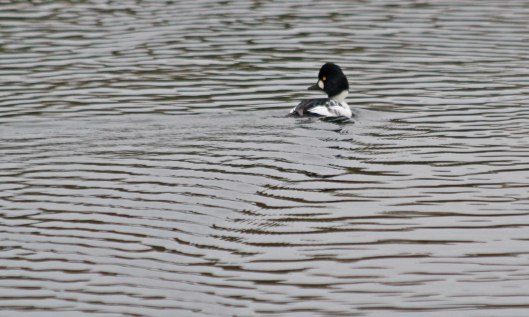
No, I’m not blogging about a James Bond film, though our recent visitor to Cosmeston Lakes Country Park is almost as exotic, and certainly as handsome as any of the many James Bonds. This is a drake Goldeneye (Bucephala clangula), a diving duck that’s a little smaller than a Mallard.

201020 goldeneye (1)

This drake was first picked up by our best local birder last Friday evening so I strode along to the lakes early Saturday morning and had distant views of it on the west lake. The Goldeneye appeared to have left Saturday afternoon, as another local birder couldn’t find it, but I was back at Cosmeston early Sunday, sitting quietly on a bench next to the east lake, when Mr Goldeneye popped out from the vegetation right in front of me and I was able to get these closer photos of him.

201020 goldeneye (2)

Though Goldeneye are known to spend their winters in small groups on reservoirs and inland lakes, and in sheltered coastal bays, they are not a common sight in my part of south Wales, so it has been a treat to have the chance to see this stunning bird.

Like Loading...

290/366 A host of hawkers

16 Friday Oct 2020

Posted by sconzani in autumn, insects

≈ Leave a comment

Tags

Aeshna mixta, British dragonflies, Cosmeston Lakes Country Park, dragonfly, Migrant hawker

You might think, as I certainly did, that the much cooler overnight temperatures we’re now experiencing here in south Wales would mean an end to the hawking flights of dragonflies over our fields and along our hedgerows but I was rather dramatically proved wrong during yesterday’s meander around Cosmeston Lakes Country Park. I didn’t spot just one or two Migrant hawkers but seven (!), the most I’ve seen in one day ever. These are three of them, two of the males and the solitary female. A delight of dragonflies!

201015 migrant hawker (1)201015 migrant hawker (2)201015 migrant hawker (3)

Like Loading...

282/366 Saffron surprise

08 Thursday Oct 2020

Posted by sconzani in autumn, insects

≈ Leave a comment

Tags

British butterflies, butterfly, Clouded yellow, Colias croceus, Cosmeston Lakes Country Park

After the strong winds and heavy rain of recent days the last thing I expected to see at Cosmeston yesterday was this Clouded yellow butterfly (Colias croceus). I was initially surprised at what good condition it was in but, in his Life Cycles of British & Irish Butterflies, Peter Eeles writes that ‘In good years, this species can produce up to three broods in the south of England, with the third brood emerging in late September and October.’ Presumably, this is also true for south Wales and, as several other butterflies have had additional broods this year, I wonder if this saffron beauty is one of a newly emerged third brood.

201008 clouded yellow

Like Loading...

274/366 Another extra brood

30 Wednesday Sep 2020

Posted by sconzani in autumn, insects

≈ Leave a comment

Tags

Aricia agestis, British butterflies, Brown argus, butterfly, butterflying, Cosmeston Lakes Country Park, Lavernock Nature Reserve, second brood Brown argus

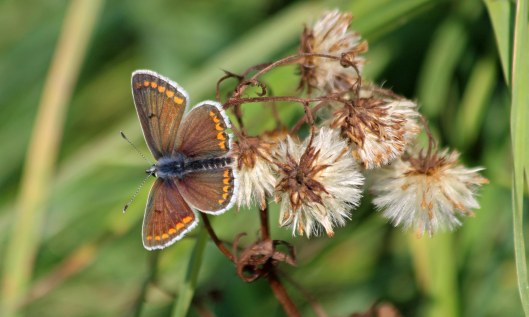
This year I saw my first Brown argus butterfly (Aricia agestis) on 11 July and thought I’d seen my last on 26 August, a short but very sweet season of sightings. Then, to my astonishment and absolute delight, I discovered two more on the same day, 16 September, one at Lavernock Nature Reserve and the other at Cosmeston Lakes Country Park.

200930 brown argus (1)

These had to be the product of the first brood of butterflies breeding and so were a second brood, not something I’d seen before with this butterfly. As the local populations of Dingy skippers have also produced a second brood and the Small coppers a third brood this year and nothing has changed in their environments, I can only assume this has been caused by the warmer climate.

200930 brown argus (2)

I haven’t managed to find the Lavernock Brown argus again but the Cosmeston butterfly was still in the same spot last week. A late summer-early Autumn treat!

Like Loading...

257/366 Ragwort inspection

13 Sunday Sep 2020

Posted by sconzani in autumn, insects

≈ Leave a comment

Tags

British butterflies, British insects, Common ragwort, Cosmeston Lakes Country Park, importance of ragwort as food plant, insects on ragwort, Ragwort

My title says ‘inspection’ but I was tempted to invent a new word and write ‘insection’, as my inspection was really a personal challenge to see how many different insects I could find on the copious number of Common ragwort plants currently in bloom at Cosmeston Lakes Country Park. All except three of these photos were taken during one 45-minute period on Wednesday – the Small copper and two flies were seen the following day. The broad diversity of species just shows how important Ragwort is as a late summer food plant for insects.

200913 bee buff-tailed bumble
200913 bee common carder
200913 bee honeybee maybe
200913 butterfly large white
200913 butterfly meadow brown
200913 butterfly small copper
200913 butterfly small white
200913 cranefly
200913 dock bug
200913 fly sp (1)
200913 fly sp (2)
200913 hoverfly eristalis nemorum
200913 hoverfly eristalis sp
200913 hoverfly helophilus pendulus
200913 hoverfly helophilus trivittatus
200913 hoverfly sp
200913 hoverfly Sphaerophoria sp
200913 hoverfly syrphus sp
200913 nettle tap moth
200913 spider
Like Loading...
← Older posts
Newer posts →

About me

sconzani

sconzani

I'm a writer and photographer; researcher and blogger; birder and nature lover; countryside rambler and city strider; volunteer and biodiversity recorder.

View Full Profile →

Follow earthstar on WordPress.com

Enter your email address to follow this blog and receive notifications of new posts by email.

Recent blog posts

  • Birch polypore January 30, 2026
  • The Marl Med gull January 29, 2026
  • Recording Grey squirrels January 28, 2026
  • Jimmy Wren January 27, 2026
  • Millipede: Nanogona polydesmoides January 26, 2026

From the archives

COPYRIGHT

Unless otherwise acknowledged, the text and photographs on this blog are my own and are subject to international copyright. Nothing may be downloaded or copied without my permission.

Fellow Earth Stars!

  • Unknown's avatar
  • Unknown's avatar
  • Unknown's avatar
  • Unknown's avatar
  • Unknown's avatar
  • Unknown's avatar
  • Unknown's avatar
  • Unknown's avatar
  • Unknown's avatar
  • Unknown's avatar
  • Unknown's avatar
  • Unknown's avatar
  • Unknown's avatar
  • Unknown's avatar
  • Unknown's avatar
  • Unknown's avatar
  • Unknown's avatar
  • Unknown's avatar
  • Unknown's avatar
  • Unknown's avatar
  • Unknown's avatar
  • Unknown's avatar
  • Unknown's avatar
  • Unknown's avatar
  • Unknown's avatar
  • Unknown's avatar
  • Unknown's avatar
  • Unknown's avatar
  • Unknown's avatar
  • Unknown's avatar
  • Unknown's avatar
  • Unknown's avatar
  • Unknown's avatar
  • Unknown's avatar
  • Unknown's avatar
  • Unknown's avatar
  • Unknown's avatar
  • Unknown's avatar
  • Unknown's avatar
  • Unknown's avatar
  • Unknown's avatar
  • Unknown's avatar
  • Unknown's avatar
  • Unknown's avatar
  • Unknown's avatar
  • Unknown's avatar
  • Unknown's avatar
  • Unknown's avatar
  • Unknown's avatar
  • Unknown's avatar

Blog at WordPress.com.

Privacy & Cookies: This site uses cookies. By continuing to use this website, you agree to their use.
To find out more, including how to control cookies, see here: Cookie Policy
  • Subscribe Subscribed
    • earthstar
    • Join 670 other subscribers
    • Already have a WordPress.com account? Log in now.
    • earthstar
    • Subscribe Subscribed
    • Sign up
    • Log in
    • Report this content
    • View site in Reader
    • Manage subscriptions
    • Collapse this bar
 

Loading Comments...
 

You must be logged in to post a comment.

    %d