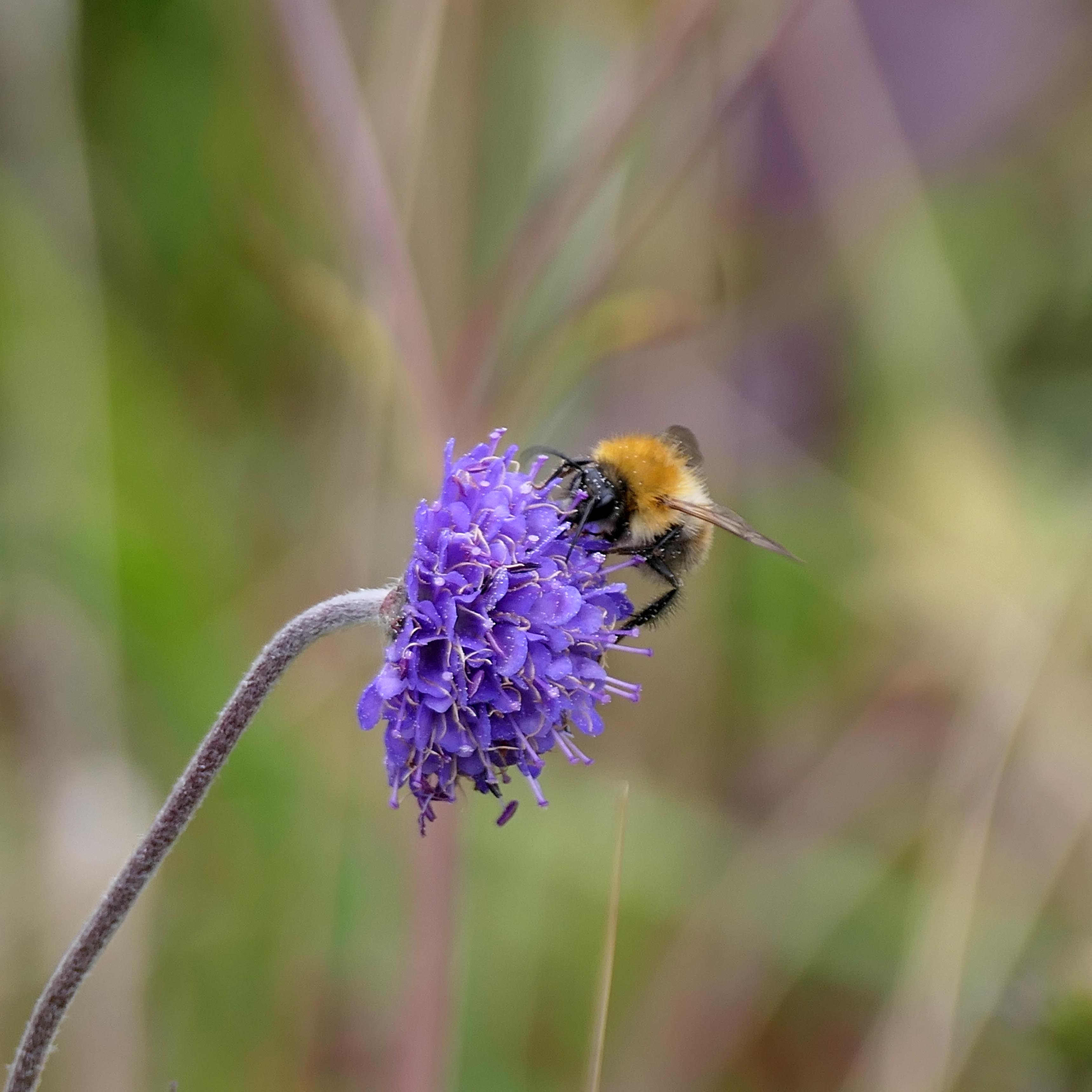
This has been such a strange year for flora and fauna. Usually, in mid autumn, I’d be checking what insects I could find on the Devil’s-bit scabious flowers, as they are one of the last sources of nourishment for many of our flying insects. Not this year. The summer drought seems to have led to a lot of our local insects either failing to breed second and third generations or, perhaps, just dying off earlier than usual due to a lack of food, and the Devil’s-bit scabious flowers are nowhere near as lush as they normally are. When I walked through a local nature reserve this week, I found just one Common carder bee on the scabious … just one! It will be very interesting to see what effect this changing climate has on next year’s flora and fauna when they begin to grow and emerge.
Monday’s blog featured the typical late summer/early autumn sight of a Meadow brown feasting on Devil’s-bit scabious. It’s one of the few plants that flower in abundance at this time of year at Cosmeston Lakes Country Park and, as you can see below, the east paddock is a sea of purple.
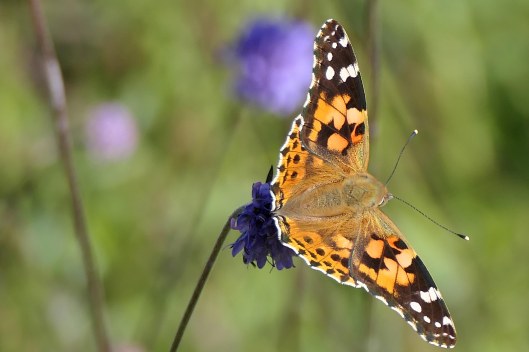
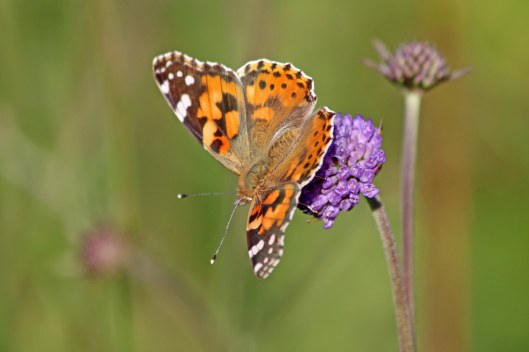
On Wednesday I noticed that the previous week’s heat had brought a small influx of Painted ladies, and counted four during my walk along one edge of the paddock. I’m sure there were, in fact, many more.
And, during Friday’s wander, the migrating Red admirals were pausing in the field to fuel their journey with slurps of scabious nectar. It’s such a valuable plant for the insects at this time of year.
Nothing says late summer/early autumn to me more than a Meadow brown butterfly on Devil’s-bit scabious. This is a typical sight now at my local country park.
Presumably as a result of our lingering hot dry weather, the wildflowers at Aberbargoed Grasslands NNR were neither as prolific nor as exuberant as I’ve seen in previous years. The Bluebells had already gone over, the Heath spotted-orchids were looking as frazzled as I was soon feeling but there were some floral highlights I enjoyed seeing.
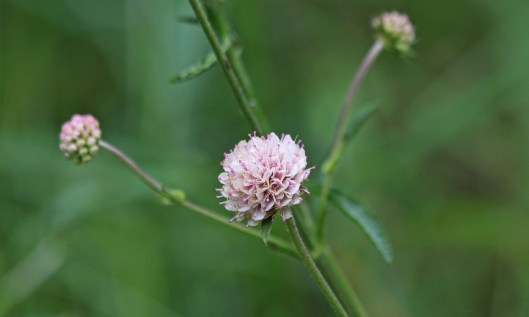
Devil’s-bit scabious (Succisa pratensis)
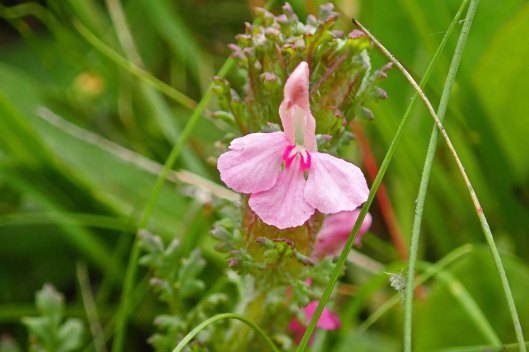
Marsh lousewort (Pedicularis palustris)
Common Milkwort (Polygala vulgaris)
Ragged-robin (Silene flos-cuculi) and butterfly friend (Small pearl-bordered fritillary)
One of the side benefits of searching the scabious for rare bees (see yesterday’s piece, Searching the scabious, 1) is that my search also revealed how many other insects were enjoying the essential late summer-early autumn food supply provided by the beautiful wildflower, Devil’s-bit scabious. Amongst them were these five butterflies and a moth: Large white, Red admiral, Small copper, Small tortoiseshell, Small white and a Silver Y.
And also these five hoverflies: Eristalis intricarius, Helophilus trivittatus, Sericomyia silentis, Volucella pellucens and Volucella zonaria.
In recent weeks, when the weather has been fine and the air relatively still, I’ve been spending time searching the Devil’s-bit scabious for bees. Not just any bees, but four scarce and endangered bees. This is part of Buglife’s ‘Searching for Scabious’ project, which
aims to improve our understanding of the distribution and conservation status of some of Wales’ rarest and most threatened solitary bees – the Large Scabious Mining Bee (Andrena hattorfiana) and its associated cuckoo, the Armed nomad bee (Nomada armata), and Small Scabious Mining Bee (Andrena marginata) and its cuckoo, the Silver-sided nomad bee (Nomada argentata).
I wasn’t familiar with these bees and am not very good at bee identification in general but Liam Olds, Buglife’s local conservation officer, has put together an excellent explainer video, which can be accessed on YouTube, so I thought I’d join the search.
Unfortunately, I haven’t managed to find any of the scarce bees at the two local sites where Devil’s-bit scabious grows in abundance (and neither has Liam, which was reassuring for me re my search skills but bad news for the bees). The bees I did find most commonly were the appropriately named Common carder (Bombus pascuorum) (below, left) and the Buff-tailed bumblebee (Bombus terrestris) (below, right).
Liam very kindly helped to identify the other small bees I found. These lovely little furrow bees are either the White-zoned furrow bee (Lasioglossum leucozonium) or the Bull-headed furrow bee (Lasioglossum zonulum) – the two species are too similar to tell them apart without closer examination.
I also found several of these more distinctive individuals, the Wood-carving leafcutter bee (Megachile ligniseca). You can find out more about them, and watch a little video of their nest-building skills, on the BWARS website. Meantime, I’m heading back to the scabious for another look.
I’ve mentioned before here on the blog the white flowers of the usually pink-flowered Common centaury (Small and white, July 2020) and the blue flowers of the usually orange-red-flowered Scarlet pimpernel (The Pimpernels, July 2017). Today, I have another couple of wildflower oddities for you.
Pink Devil’s-bit scabious (Succisa pratensis)
As I’m sure you’re aware, the flowers of Devil’s-bit scabious are usually somewhere in the lilac, blue-mauve range but, at Lavernock Nature Reserve, there are quite a number of plants with pink flowers. I’ve read this is a natural variation but I don’t know if there is something specific that triggers the alteration in colour. At Lavernock, the pink-flowering plants grow right next to those with lilac flowers, so it’s certainly nothing to do with the soil.
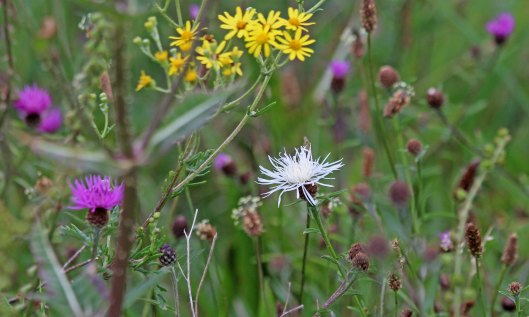
White Common knapweed (Centaurea nigra) Also at Lavernock Nature Reserve, I recently found Common knapweed with stunning white flowers. This plant, of course, usually has flowers in the pink-purple range. Once again, plants with purple and white flowers were growing right next to each other, which presumably rules out soil composition as a factor. It’s a mystery, but a rather lovely mystery, to be sure!
I keep coming back to the Devil’s-bit scabious, I know, but it’s just so lovely and so full of life now that many of the other wildflowers have gone over. Bumblebees, in particular, seem to love feasting on it. I think these are Buff-tailed bumblebees and Common carders but don’t quote me!
It looks a bit like a wasp but this black-and-yellow-striped minibeastie is a hoverfly with the rather tongue-twisting name Sericomyia silentis. Perhaps Bog hoverfly would be easier but, in my opinion, its common name doesn’t do this little beauty justice.
I spent a couple of hours today at Lavernock Nature Reserve, where the Devil’s-bit scabious is looking simply stunning and is attracting myriads of insects. I took lots of butterfly photos but thought to post one of the other little critters today. The Devil’s-bit is usually a lilac colour but some at Lavernock are this subtle shade of pink instead. Its nectar obviously tastes just as good!
At this time of year, the delicate lilac tinge of Devil’s-bit scabious casts its imperial purple shadow across the meadows at Cosmeston and at Lavernock. I love it, and I’m not the only one.
It’s proving extremely popular as a late-summer early-autumn source of nectar for all manner of bees, butterflies and hoverflies. Here are a few I’ve seen in recent days …










 earthstar
You must be logged in to post a comment.