• ABOUT
  • BIRDING 2018
  • Birding 2019
  • BLOG POSTS
  • Butterflies 2018
  • Resources

earthstar

~ a celebration of nature

earthstar

Tag Archives: hoverflies

Signs of spring: minibeasts

03 Tuesday Apr 2018

Posted by sconzani in insects, nature

≈ 6 Comments

Tags

bees, bumblebee, flies, hoverflies, ladybird, minibeasts, signs of spring

‘If all mankind were to disappear, the world would regenerate back to the rich state of equilibrium that existed ten thousand years ago. If insects were to vanish, the environment would collapse into chaos.’
~ E. O. Wilson (1929 – ), American biologist, environmentalist, author

OLYMPUS DIGITAL CAMERA
180401 minibeast (4) Honey bee
OLYMPUS DIGITAL CAMERA
180401 minibeast (6) fly
180401 minibeast (7) fly
OLYMPUS DIGITAL CAMERA
180401 minibeast (9) Eristalis tenax
OLYMPUS DIGITAL CAMERA
Like Loading...

Sitting on the fence

12 Thursday Oct 2017

Posted by sconzani in insects, nature

≈ 2 Comments

Tags

Black darter, Common Darter, dragonflies, flies, hoverflies, Myathropa florea, sitting on the fence

Have you ever noticed that some small beasties like to sit on fences?

171012 Common darter (3)

I guess fences are often a good spot to sunbathe, and to keep a look out, and they probably resemble logs and branches to the mini-beasts.

171012 Common darter (1)
171012 Common darter (2)

Common darter dragonflies are keen fence-sitters – they don’t even mind barbed-wire fences. And I was particularly delighted to find the Black darter dragonfly (below) sitting on a fence at Cosmeston the other day – my first sighting of this species.

171012 Black darter

Flies and hoverflies also enjoy a spot of fence-sitting and can often be found taking care of their ablutions in such places. So, the next time you decide to sit on the fence, make sure some other creature hasn’t beaten you to it! 

171012 fly (1)
171012 fly (2)
171012 Myathropa florea
171012 Pollenia rudis
Like Loading...

What’s on the scabious?

16 Saturday Sep 2017

Posted by sconzani in flowers, insects, nature, wildflowers

≈ 6 Comments

Tags

bumblebee, Comma, Devil's-bit scabious, hoverflies, insects on scabious, scabious, Six-spot burnet, Small tortoiseshell, Small white

Perhaps it would be easier to ask ‘What’s not on the scabious?’ because it seems that almost every type of fly, bee, butterfly and beetle loves this plant, though that may also be because the Devil’s-bit scabious flowers in late summer – early autumn, when most wildflowers have finished flowering, and so it provides a last delicious taste of summer’s sweetness.

170916 6-spot burnet
170916 beetle
170916 Bumble bee
170916 comma
170916 Common carder & hoverfly
170916 helophilus pendulus
170916 Meadow brown
170916 Melanostoma scalare
170916 Sericomyia silentis
170916 Small tortoiseshell
170916 Small white
170916 unidentified bee
170916 unidentified hoverfly (2)
170916 unidentified hoverfly (3)
170916 unidentified hoverfly (4)
170916 unidentified hoverfly (5)
170916 unidentified hoverfly
170916 Volucella zonaria
Like Loading...

Sneaky

03 Thursday Aug 2017

Posted by sconzani in insects, nature, wildflowers

≈ 4 Comments

Tags

British spiders, Daucus carota, Enoplognatha ovata, hoverflies, Pastinaca sativa, spiders, Wild carrot, Wild parsnip

I’ve got nothing against spiders: like all creatures they need to eat, but they can be rather cunning about how they ensnare their prey.

170803 Enoplognatha ovata sensu lato (1)

These Enoplognatha ovata, which come in several colourways, were taking advantage of the umbrella-shaped flowers of Wild carrot (Daucus carota) and Wild parsnip (Pastinaca sativa), lurking under the canopy created by the flower stems then darting rapidly through the gaps to grab hoverflies and other mini-beasties while they were feeding. Very sneaky!

170803 Enoplognatha ovata sensu lato (3)
170803 Enoplognatha ovata sensu lato (2)


Like Loading...

A little hoverating

13 Thursday Jul 2017

Posted by sconzani in insects, nature

≈ 4 Comments

Tags

British hoverflies, hoverflies, hoverfly, Leucozona glaucia, Leucozona laternaria, Merodon equestris, Xylota segnis, Xylota sylvarum

I admit to not taking as many photos of hoverflies this year as last. This is partly due to an overwhelming fascination with everything, meaning I tend not to focus on one family for long (I’m sure this will pass once I’ve lived in Britain a few more years and have seen a lot of the more common species of everything), but also because the area where I now live has less hoverfly-friendly habitats. Still, I do photograph them when I see them, especially any newbies. Here are a few …

170713 Leucozona glaucia
170713 Leucozona laternaria

Leucozona glaucia and Leucozona laternaria
These are not hoverflies I see very often but they are quite distinctive and that makes them easy to identify, not something you can say about many invertebrates. They’re woodland species but can often be found grazing on the hogweed flowers that frequently grow along woodland rides and edges. The two species are almost identical, except for the colour of their front legs (not always easily seen) and their scutellum (much easier – that’s the half moon shaped bit on their backs between their wings). The scutellum is yellow in Leucozona glaucia (above left) and dark in L. laternaria (above right).

170713 Merodon equestris

Merodon equestris
This medium-sized hoverfly looks a lot like a bumblebee, but the shape of its head and its large eyes are easy ways to tell that it’s not. In their top-notch field guide Britain’s Hoverflies, Stuart Ball and Roger Morris note that Merodon equestris is ‘believed to have been introduced into Britain in daffodil bulbs imported from Europe around the end of the 19th century’. That’s because the larvae of this hoverfly develop inside bulbs and have a particular liking for daffodils.

170713 Xylota segnis
170713 Xylota sylvarum

Xylota segnis and Xylota sylvarum
These are just two of the seven members of the Xylota genus – I have yet to see the others. With their lanky legs, they look a bit like sawflies and they also prefer gathering pollen and honeydew from leaves rather than flowers, so they’re not your run-of-the-mill hoverflies. I find these quite difficult to tell apart but X. segnis has a black bottom (above left) whereas X. sylvarum’s is yellow (above right) (not easy to see when they’re resting and covering their bottoms with their wings, as in my photo).

Like Loading...

Random creatures of Barry

24 Monday Apr 2017

Posted by sconzani in insects, nature

≈ 7 Comments

Tags

Barry, Crab spider, Dock bug, Garden snails, Glamorgan Botany Group, Grene shieldbug, hoverflies, insects, ladybirds, Orange-tip butterfly, slow-worm

As I mentioned in yesterday’s post, I spent a wonderful day on Saturday exploring and examining some of the town of Barry’s wilder green spaces with members of the Glamorgan Botany Group. But, of course, you can’t spend a whole day looking at plants without also seeing an awful lot of the critters that live on those plants and I admit to being a trifle distracted at times … by a sunshine-yellow Crab spider, by fluttering butterflies and buzzing hoverflies, by plentiful dock and shield bugs, by the sad sight of a dead Slow-worm. Some of the lovely old stone houses and churches we passed were pretty cool too!

170424 1 Creatures of Barry
170424 2 Creatures of Barry
170424 3 Creatures of Barry
170424 4 Creatures of Barry
170424 5 Creatures of Barry
170424 6 Old buildings of Barry
170424 7 Creatures of Barry
170424 8 Creatures of Barry
170424 9 Creatures of Barry
170424 10 Old buildings of Barry
170424 11 Creatures of Barry
170424 12 Creatures of Barry
Like Loading...

Signs of Spring, 3

25 Saturday Mar 2017

Posted by sconzani in insects, ladybird, nature, spring, wildflowers

≈ 7 Comments

Tags

bees, butterflies, flies, hoverflies, insects, insects in springtime, ladybird, shieldbugs, Spring has sprung

You know Spring has well and truly arrived when the insects start appearing in reasonable quantities so, judging by the numbers of insects I’ve seen on my walks over the past two days, I would say Spring has most definitely sprung, wouldn’t you?

170325 Spring insects (1)
170325 Spring insects (2)
170325 Spring insects (3)
170325 Spring insects (4)
170325 Spring insects (5)
170325 Spring insects (6)
170325 Spring insects (7)
170325 Spring insects (8)
170325 Spring insects (9)
170325 Spring insects (10)
170325 Spring insects (11)
170325 Spring insects (12)
Like Loading...

Heavenly hoverflies

06 Saturday Aug 2016

Posted by sconzani in insects, nature

≈ 8 Comments

Tags

Cheilosia illustrata, hoverflies, hoverfly, Myathropa florea, Pellucid fly, Volucella inanis, Volucella pellucens, Volucella zonaria

It’s been ages since I shared any images of hoverflies, yet I photograph them almost every time I go wandering and the summer months are prime hover time, so let’s remedy my omission.

160806 Cheilosia illustrata

Cheilosia illustrata
I’ve nicknamed this not-so-little hoverfly, Mr Scruffy, as it’s a bumblebee mimic and therefore rather furry, and oft times a little unkempt looking. It inhabits hedgerows and the shrubby edges of woodlands, and can frequently be seen feeding on the flowers of umbellifers – I see it most often on hogweed or sun-basking on nearby leaves.
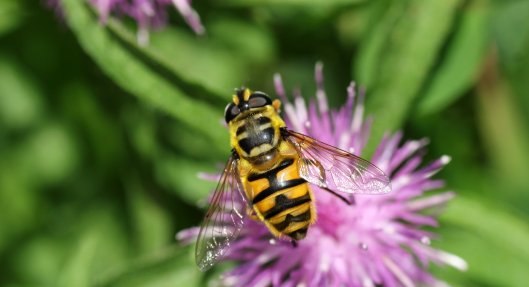
160806 Myathropa florea

Myathropa florea
With its striking and often very vibrant pattern of yellow, orange and black markings, Myathropa florea is easily identifiable and, though it flies from May to October, it seems to be the hoverfly I’m seeing most often right now. Like Mr Scruffy, it enjoys feasting on the umbellifer flowers that grow along woodland edges. Can you see why it’s often called the Batman hoverfly?

160806 Volucella inanis (1)
160806 Volucella inanis (2)

Volucella inanis
Now we come to the big boys (and girls) of the hoverfly world. Volucella inanis and its very similar friend Volucella zonaria (below) are hornet mimics but don’t worry – with their vibrant colouring they may look like hornets, but they’re harmless. V. inanis was once localised around London but is gradually spreading throughout Britain.

160806 Volucella zonaria

Volucella zonaria
Volucella zonaria is a European hoverfly which, apparently, only got established in Britain in the 1940s. Since then it’s slowly been expanding its range, though I haven’t yet seen one in Wales. My photo was taken in Exeter in 2014, when I didn’t even know such things as hoverflies existed.

160806 Volucella pellucens

Volucella pellucens
Also known as the Pellucid Fly, Volucella pellucens is quite easy to recognise, as it has a distinctive broad white band across its body. It also favours umbellifer flowers and, though it can be seen right through till October, it’s almost past its peak season so get out and see if you can find one.

Like Loading...
Newer posts →

About me

sconzani

sconzani

I'm a writer and photographer; researcher and blogger; birder and nature lover; countryside rambler and city strider; volunteer and biodiversity recorder.

View Full Profile →

Follow earthstar on WordPress.com

Enter your email address to follow this blog and receive notifications of new posts by email.

Recent blog posts

  • N is for nest December 19, 2025
  • M is for mite December 18, 2025
  • L is for lepidopteran lifers December 17, 2025
  • K is for Keeled skimmers December 16, 2025
  • J is for Jersey tiger December 15, 2025

From the archives

COPYRIGHT

Unless otherwise acknowledged, the text and photographs on this blog are my own and are subject to international copyright. Nothing may be downloaded or copied without my permission.

Fellow Earth Stars!

  • Unknown's avatar
  • Unknown's avatar
  • Unknown's avatar
  • Unknown's avatar
  • Unknown's avatar
  • Unknown's avatar
  • Unknown's avatar
  • Unknown's avatar
  • Unknown's avatar
  • Unknown's avatar
  • Unknown's avatar
  • Unknown's avatar
  • Unknown's avatar
  • Unknown's avatar
  • Unknown's avatar
  • Unknown's avatar
  • Unknown's avatar
  • Unknown's avatar
  • Unknown's avatar
  • Unknown's avatar
  • Unknown's avatar
  • Unknown's avatar
  • Unknown's avatar
  • Unknown's avatar
  • Unknown's avatar
  • Unknown's avatar
  • Unknown's avatar
  • Unknown's avatar
  • Unknown's avatar
  • Unknown's avatar
  • Unknown's avatar
  • Unknown's avatar
  • Unknown's avatar
  • Unknown's avatar
  • Unknown's avatar
  • Unknown's avatar
  • Unknown's avatar
  • Unknown's avatar
  • Unknown's avatar
  • Unknown's avatar
  • Unknown's avatar
  • Unknown's avatar
  • Unknown's avatar
  • Unknown's avatar
  • Unknown's avatar
  • Unknown's avatar
  • Unknown's avatar
  • Unknown's avatar
  • Unknown's avatar
  • Unknown's avatar

Blog at WordPress.com.

Privacy & Cookies: This site uses cookies. By continuing to use this website, you agree to their use.
To find out more, including how to control cookies, see here: Cookie Policy
  • Subscribe Subscribed
    • earthstar
    • Join 667 other subscribers
    • Already have a WordPress.com account? Log in now.
    • earthstar
    • Subscribe Subscribed
    • Sign up
    • Log in
    • Report this content
    • View site in Reader
    • Manage subscriptions
    • Collapse this bar
 

Loading Comments...
 

You must be logged in to post a comment.

    %d