• ABOUT
  • BIRDING 2018
  • Birding 2019
  • BLOG POSTS
  • Butterflies 2018
  • Resources

earthstar

~ a celebration of nature

earthstar

Tag Archives: Lavernock Nature Reserve

The flower of the moment is …

03 Friday Aug 2018

Posted by sconzani in flowers, insects, nature, wildflowers

≈ 2 Comments

Tags

British butterflies, British wildflowers, butterflies, Common fleabane, fleabane, insects on fleabane, Lavernock Nature Reserve, Pulicaria dysenterica

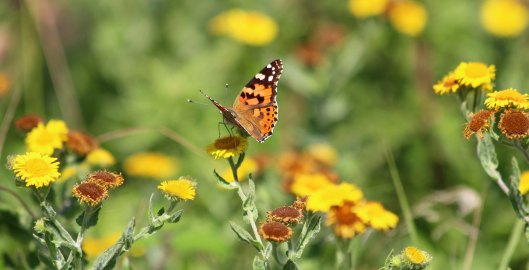
The flower of the moment is Fleabane (Pulicaria dysenterica) or, at least it is at Lavernock Nature Reserve.
180803 fleabane

I’ve read that Fleabane usually grows in ditches and damp meadows so, despite the recent drought conditions, I guess there must be water somewhere below the wildflower meadows at Lavernock, as they are currently awash with these bright golden flowers. And, at a time when most other wildflowers have dried up and died off, the Fleabane is providing a much-needed source of pollen and nectar for butterflies and other assorted mini-beasties.

180803 bee on fleabane
180803 brimstone on fleabane
180803 comma on fleabane (1)
180803 common blue on fleabane (4)
180803 cricket on fleabane
180803 small white on fleabane
180803 small copper on fleabane
180803 gatekeeper on fleabane
180803 meadow brown on fleabane
180803 green-veined white on fleabane
180803 painted lady on fleabane
180803 red admiral on fleabane
180803 speckled wood on fleabane
180803 six-spot burnet on fleabane
Like Loading...

Ringlet no.1

18 Monday Jun 2018

Posted by sconzani in insects, nature

≈ Leave a comment

Tags

#30DaysWild, 30 Days Wild, British butterfly, Common blue, Large skipper, Lavernock Nature Reserve, Ringlet, Ringlet butterfly, Small white

Today, on day 18 of #30DaysWild, I walked along the coastal path to Lavernock Nature Reserve, intending to do some sea-watching – and I did – I watched the sea for over an hour. I saw a couple of gulls and a lot of waves and a couple of large container ships heading up and down the channel. Of course, that was not what I was hoping to see. Over the past few days, there have been reports of large numbers of Manx shearwaters flying back and forth, as well as the occasional Storm petrel, Arctic skua, Gannets, Guillemots, Fulmars, etc. Today there were none – well, maybe 2 or 3 birds a long long long way out – but none that I could see with my bins.

180618 ringlet (1)

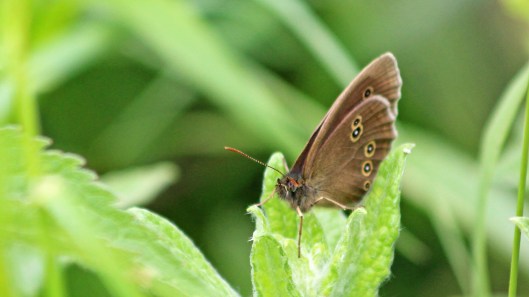
Luckily for me, though, I bumped into Alan, a fellow birder, who’s also a fan of butterflies and dragonflies – many of us birders are – and he very kindly showed me a Ringlet butterfly he’d just spotted. It was the first I’d seen in 2018 and, once I’d finished staring at the sea, I wandered around Lavernock and found another – or, possibly, the same one – plus a few other butterflies. So, I may not have bagged a new bird for my year list but I did bag a new butterfly (metaphorically speaking, of course).

180618 ringlet (2)

The supporting cast consisted of Large skippers, Common blues and a Small white.

180618 3 common blue
180618 4 large skipper
180618 5 common blue
180618 6 large skipper
180618 7 small white
180618 9 large skipper
Like Loading...

Lively Lavernock

12 Tuesday Jun 2018

Posted by sconzani in insects, nature

≈ Leave a comment

Tags

#30DaysWild, 30 Days Wild, Blue-tailed damselfly, Broad-bodied Chaser, Common blue butterfly, Emperor dragonfly, Large Red damselfly, Large skipper, Lavernock Nature Reserve, Six-spot burnet, Small copper, Speckled wood

Day 12 of my #30DaysWild was spent wandering around the nature reserve at Lavernock. Though it’s not yet the riot of colour it will be in another month or so, many wildflowers are already blooming, including the Common spotted and Pyramidal orchids, and plenty of critters were feasting on nectar and pollen.

180612 creature 1
180612 creature 2
180612 Pyramidal & Common spotted orchids

Today’s highlights included my first Six-spot burnet moth of the year, which was dazzling in the bright sunlight, and my second Small copper butterfly, a rather tatty looking specimen but still lovely to see. The Large skippers, Common blues and Speckled woods were abundant, and I also saw whites, a Brimstone and several Meadow brown butterflies.

180612 2 6-spot burnet moth
180612 3 6-spot burnet moth

180612 1 small copper

180612 Speckled wood
180612 Large skipper
180612 Common blue

The pond was alive with dragon- and damselfly action, with both a female Emperor and a female Broad-bodied chaser ovipositing. There were three male Broad-bodied chasers constantly squabbling over territory and a Four-spotted chaser trying to avoid them all. Damselflies included Large reds, Common blues, Azures and Blue-tailed. ’Twas a very lively place today!

180612 Broad-bodied chaser male180612 Broad-bodied chaser emale

180612 Blue-tailed damselfly
180612 Emperor female
180612 Large red damselfly
Like Loading...

Mystery solved!

02 Saturday Jun 2018

Posted by sconzani in birds, nature

≈ Leave a comment

Tags

#30DaysWild, 30 Days Wild, birding, birdwatching, British birds, Lavernock Nature Reserve, Lesser whitethroat

On day two of #30DaysWild I decided to try to solve a mystery. Last Monday, 28 May, I was having a wander around Lavernock Nature Reserve when I heard a bird making an unusual ‘tech tech’ sound in a group of nearby shrubs and trees (you can hear it at the beginning of this short video clip I recorded). I edged closer and got glimpses of a dark head and back with a much lighter front and belly, but I couldn’t get a clear view or any photos.

180602 Lesser whitethroat (4)

Silly me thought it might have been a Pied flycatcher but I knew that was probably wrong, and I was soon put straight about how extremely unlikely that possibility was for the Lavernock site by a much more experienced birding friend. But what was it?

180602 Lesser whitethroat (2)

I wasn’t sure if the bird would still be around but today was a lovely day for a walk and Lavernock is a wonderful nature reserve – I knew I would find things of interest even if I couldn’t find the bird again.

180602 Lesser whitethroat (1)

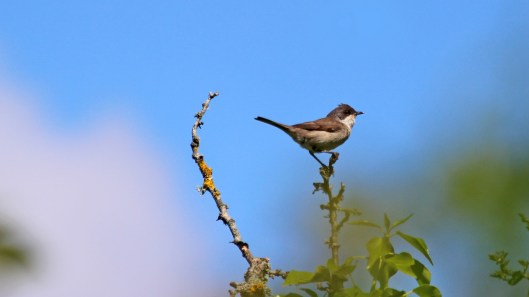
Well, as you’ve guessed from the title of this post and from the photos here, I found my bird and solved the mystery. It’s a Lesser whitethroat – in fact, I’m 99% sure there were two of them and that they’re nesting, as I watched the bird repeatedly foraging for food in the greenery, then flying back and forth to the same location in a clump of bushes.

180602 Lesser whitethroat (3)

These are usually very skulky birds, more often staying within trees and bushes and not easily seen, so I was very lucky to get some decent views of one bird sitting high in the tree tops. A perfect result for the second day of my 30 Days Wild!

Like Loading...

Holly blues

20 Sunday May 2018

Posted by sconzani in insects, nature

≈ 5 Comments

Tags

blue butterfly, British butterflies, butterflies, Holly blue, Holly blue butterfly, Lavernock Nature Reserve

180520 Holly blue (2)

With clear blue skies and temps in the mid 20s, it was hot work chasing the Holly blue butterflies (Celastrina argiolus) around Lavernock last Monday. I think I saw five but they move so quickly along the scrub and up and over the trees that it was hard to be sure. Those fast fliers are mostly the males, I think, constantly sniffing for the female pheromones.

180520 Holly blue (1)

I know there were at least two Holly blues, as I managed to get a male and female together in one photo, and then was lucky enough to catch the female laying an egg on a Dogwood plant. Once she’d departed I carefully examined the plant but couldn’t find the egg. I think she must have tucked it well in amongst the flower buds, which I didn’t pry apart in case I damaged the newly laid egg. But I remember where it was so will try and go back in a week or so to check for a caterpillar.

180520 Holly blue (3)180520 Holly blue (5)

Holly blues are the first of Britain’s blue-coloured butterflies to emerge each year, which is one way to distinguish them from the many other blue butterflies. Another is their flight pattern – the other blues usually fly close to the ground. And the Holly blues are the only ones with small black dots on the undersides of their wings though, unless you see one perched, you’ll need to be quick to spot those dots ’cause these little beauties are speedy.

180520 Holly blue (4)

Like Loading...

Dragons at Lavernock

27 Sunday Aug 2017

Posted by sconzani in insects, nature, parks

≈ 2 Comments

Tags

British dragonflies, Broad-bodied Chaser, Common Darter, dragonflies, dragonfly ovipositing, Emperor dragonfly, Lavernock Nature Reserve

There were some cracking dragonflies scooting around the pond at Lavernock Nature Reserve yesterday.

170827 Common darter male
170827 Common darter female

Both the male and the female Common darters posed very obligingly for me.

170827 Emperor male

The male Emperor kept busy patrolling the pond and indulging in occasional rapid trysts with a female. Judging by his tattered wings, he’s notched up quite a few trysts in recent days / weeks. He only stopped once, and then very briefly, so this photo doesn’t really do him justice.

170827 Emperor female

The female Emperor was then kept busy laying eggs at various spots all around the pond edges. A woman’s work is never done!

170827 Broad-bodied chaser male

The star of the show was this gorgeous male Broad-bodied chaser. Apparently, this is very late in the season for them, and he was looking pristine, so perhaps he had only recently hatched. Whatever his story, he was a stunning sight.

Like Loading...

Clouded yellows

16 Wednesday Aug 2017

Posted by sconzani in insects, nature

≈ 7 Comments

Tags

British butterflies, butterflies, butterfly, Clouded yellow, Colias croceus, Lavernock Nature Reserve

Some days are just good days! On the same day that I finally caught up with the Spotted flycatchers at Cosmeston, I also saw my first Clouded yellow butterflies, and I’d been chasing those for a couple of weeks as well.

170816 Clouded yellow (2)

Colias croceus is primarily an immigrant – it has occasionally been known to overwinter but is usually killed by the cold and damp of British winters – and flies in for the summer months from southern Europe and north Africa. Way back in 1947, there was a huge migration, with numbers estimated at 36,000, but most years the numbers are much less, and this year very few of my butterfly-watching friends have seen any. So, I count myself very privileged indeed to have seen two at Lavernock Nature Reserve last Sunday.

170816 Clouded yellow (3)
170816 Clouded yellow (1)
Like Loading...

Not one but three!

14 Monday Aug 2017

Posted by sconzani in insects, nature

≈ 1 Comment

Tags

British moths, Euplagia quadripunctaria, Jersey tiger, Lavernock Nature Reserve, moth, moths, UK moths

So, my question today is how many moths does it take to make a colony?

170814 Jersey tiger 100817170814 Jersey tiger 130817 (1)170814 Jersey tiger 130817 (2)

I passed through Lavernock Nature Reserve again yesterday and found two more Jersey tigers (Euplagia quadripunctaria). I can tell neither of these is the same as the one I saw three days earlier because the spots on their wings are all different (see inside bottom edge of right wing in these photos of all three, as shown below). I’m hoping this means there is now a colony of Jersey tigers becoming established in the reserve, rather than immigrants all arriving at the same time.

170814 Jersey tiger 100817 crop
170814 Jersey tiger 130817 crop (1)
170814 Jersey tiger 130817 crop (2)
Like Loading...

Fluttering at Lavernock

13 Sunday Aug 2017

Posted by sconzani in insects, nature

≈ 10 Comments

Tags

Brimstone butterfly, British butterflies, British moths, butterflies, Common blue, Large white, Lavernock Nature Reserve, moths, Painted Lady, Peacock, Red Admiral, Silver Y moth, Small copper

Now, I know I’ve been posting quite a few butterfly photos lately but I just adore them and, as summer will soon be over and they’ll disappear for another year, I can’t help but share their beauty while I can. So, as well as that gorgeous Jersey tiger I showed you yesterday, here are just a few of the 16 species of Lepidoptera from Lavernock Nature Reserve on Thursday: there were 4 Brimstone butterflies; large numbers of Common blues; this pair of Large whites mating; 5 Painted ladies; 2 stunning Peacocks; 4 Red admirals; 2 Silver Y moths that just wouldn’t keep still for a sharp photo; and only my second-ever Small copper that got scared off when someone came walking down the path towards me.

170813 Brimstone butterfly
170813 Common blue
170813 Large whites mating
170813 Painted lady
170813 Peacock
170813 Red admiral
170813 Silver Y moth
170813 Small copper
Like Loading...

A Jersey tiger!

12 Saturday Aug 2017

Posted by sconzani in insects, nature

≈ 7 Comments

Tags

British moth, Euplagia quadripunctaria, Jersey tiger, Lavernock Nature Reserve, moth

170812 Jersey tiger (1)

Ooo look, a Red admiral … hang on a minute … what’s that???!!!

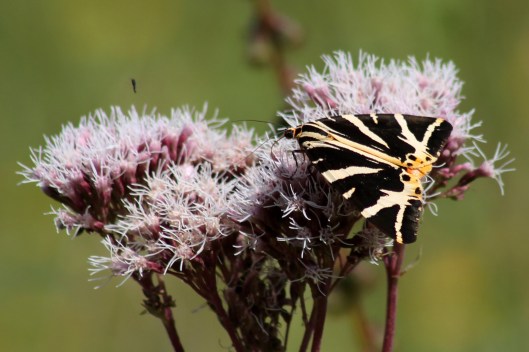
I went looking for migrant birds at high tide at Sully beach – and found nothing more exotic than some Rock pipits and Turnstones – but my walk home, along the coastal path, took me through Lavernock Nature Reserve and there I got lucky. There I found an altogether different migrant, a beautiful Jersey tiger (Euplagia quadripunctaria).

170812 Jersey tiger (3)

Obviously, it’s not a mammal that’s swum across the Channel from Jersey: it’s a moth. It may also not have been an immigrant, as colonies have become established in a couple of places along the southern English coast in recent years. It is still, however, not so common in Wales, with only 24 records in the national database.

170812 Jersey tiger (4)
170812 Jersey tiger (5)

As you can see, it has gorgeous and quite distinctive markings – just look at that bright orange underwing! – so there was no mistaking what it was. Let’s hope a few other Jersey tigers arrive to establish a colony in Lavernock’s wonderful wildflower meadows.

170812 Jersey tiger (2)

Like Loading...
← Older posts
Newer posts →

About me

sconzani

sconzani

I'm a writer and photographer; researcher and blogger; birder and nature lover; countryside rambler and city strider; volunteer and biodiversity recorder.

View Full Profile →

Follow earthstar on WordPress.com

Enter your email address to follow this blog and receive notifications of new posts by email.

Recent blog posts

  • P is for Phalarope December 21, 2025
  • O is for Odonata December 20, 2025
  • N is for nest December 19, 2025
  • M is for mite December 18, 2025
  • L is for lepidopteran lifers December 17, 2025

From the archives

COPYRIGHT

Unless otherwise acknowledged, the text and photographs on this blog are my own and are subject to international copyright. Nothing may be downloaded or copied without my permission.

Fellow Earth Stars!

  • Unknown's avatar
  • Unknown's avatar
  • Unknown's avatar
  • Unknown's avatar
  • Unknown's avatar
  • Unknown's avatar
  • Unknown's avatar
  • Unknown's avatar
  • Unknown's avatar
  • Unknown's avatar
  • Unknown's avatar
  • Unknown's avatar
  • Unknown's avatar
  • Unknown's avatar
  • Unknown's avatar
  • Unknown's avatar
  • Unknown's avatar
  • Unknown's avatar
  • Unknown's avatar
  • Unknown's avatar
  • Unknown's avatar
  • Unknown's avatar
  • Unknown's avatar
  • Unknown's avatar
  • Unknown's avatar
  • Unknown's avatar
  • Unknown's avatar
  • Unknown's avatar
  • Unknown's avatar
  • Unknown's avatar
  • Unknown's avatar
  • Unknown's avatar
  • Unknown's avatar
  • Unknown's avatar
  • Unknown's avatar
  • Unknown's avatar
  • Unknown's avatar
  • Unknown's avatar
  • Unknown's avatar
  • Unknown's avatar
  • Unknown's avatar
  • Unknown's avatar
  • Unknown's avatar
  • Unknown's avatar
  • Unknown's avatar
  • Unknown's avatar
  • Unknown's avatar
  • Unknown's avatar
  • Unknown's avatar
  • Unknown's avatar

Blog at WordPress.com.

Privacy & Cookies: This site uses cookies. By continuing to use this website, you agree to their use.
To find out more, including how to control cookies, see here: Cookie Policy
  • Subscribe Subscribed
    • earthstar
    • Join 667 other subscribers
    • Already have a WordPress.com account? Log in now.
    • earthstar
    • Subscribe Subscribed
    • Sign up
    • Log in
    • Report this content
    • View site in Reader
    • Manage subscriptions
    • Collapse this bar
 

Loading Comments...
 

You must be logged in to post a comment.

    %d