• ABOUT
  • BIRDING 2018
  • Birding 2019
  • BLOG POSTS
  • Butterflies 2018
  • Resources

earthstar

~ a celebration of nature

earthstar

Author Archives: sconzani

Lifer: Lulworth skipper

16 Monday Jun 2025

Posted by sconzani in insects

≈ 2 Comments

Tags

British butterflies, British skippers, butterfly, Isle of Portland butterflies, Lulworth skipper, summer butterflies, Thymelicus acteon, Tout Quarry

This was another new-to-me butterfly, the Lulworth skipper (Thymelicus acteon), and this was the butterfly that I really hoped to see during my visit to Weymouth. Clearly, I was not disappointed.
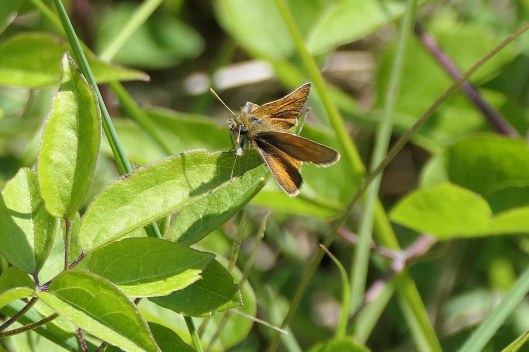
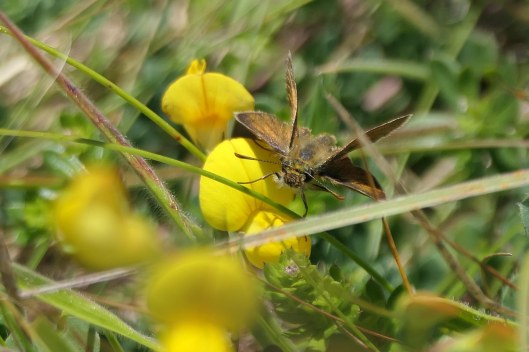
This was another find in the sculpture park that is Tout Quarry on the Isle of Portland, and I saw my first Lulworth skipper almost as soon as I arrived. At first glance, they could easily be mistaken for Small skippers, but Lulworths are slightly smaller and generally darker, often turning an olive-brown colour as they age. The females also have a series of golden marks that form a notable circle on their wings, though that didn’t help me. As is common amongst butterfly species, the males emerge first, and I saw no females.
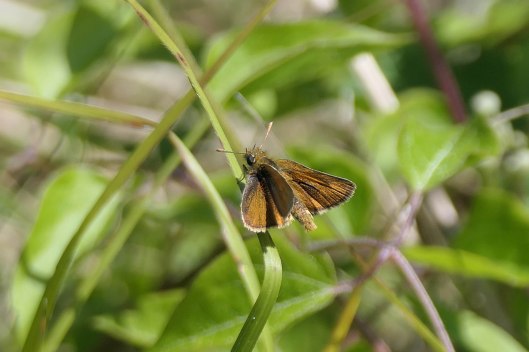
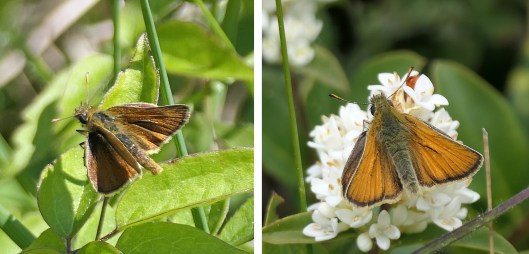
However, by sheer good luck, I also spotted my first Small skipper of the year as I explored Tout Quarry, which proved a very good comparison for the Lulworths I was seeing. I’ve included a photo of the two species below; this is not precise as to their size relationship but does, hopefully, give some idea of their colour differences (Lulworth on the left, Small skipper on the right).
The Lulworth skipper is named after the Dorset town of Lulworth, where it was first found in 1832. Though these butterflies have expended their range a little in the intervening 190 years, they are still only found in locations along the south Dorset coast. I had expected to have to catch a bus to Lulworth until I read the butterflies could be found on Portland, and I booked my little break away as soon as I heard they were on the wing. So, it was a real treat to find them so quickly and easily, and then to spend perhaps 90 minutes in the quarry, enjoying all the butterfly species, the local plants, and, yes, I did also look at the stone sculptures.
Like Loading...

Portland spurge

15 Sunday Jun 2025

Posted by sconzani in wildflowers

≈ Leave a comment

Tags

British wildflowers, Euphorbia, Euphorbia portlandica, Portland spurge, spurge, summer colour, summer wildflowers, yellow wildflowers

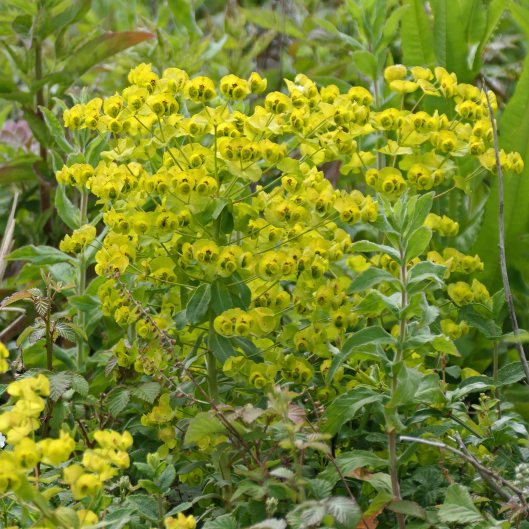
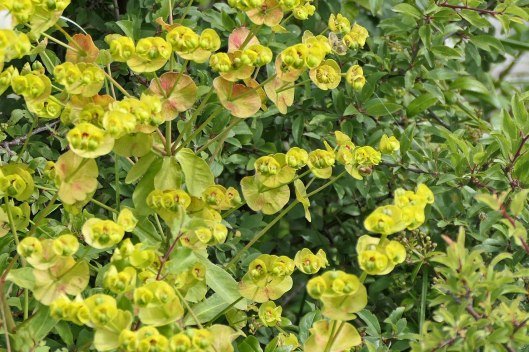
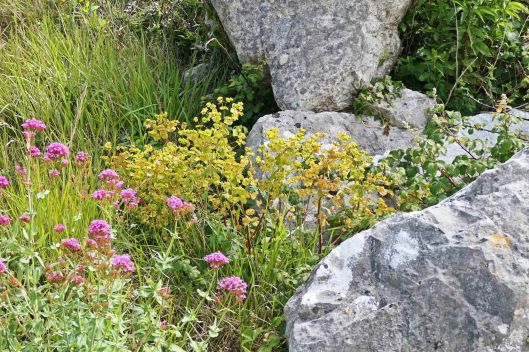
From its structure I knew this wonderfully sunny plant was a Euphorbia, a member of the Spurge family, as soon as I saw it, but I had no idea until I researched it later that the Isle of Portland had its very own species.

This is Portland spurge (Euphorbia portlandica), a close relative of Sea spurge (Euphorbia paralias) but with some subtle differences in the shape of its leaves: Sea spurge has thick fleshy leaves, whereas those of Portland spurge are thinner, with more pointy tips. Unfortunately, I wasn’t aware of that until later so the leaves are rather obscured in my photographs. I was just delighted by the joyous colour of Portland’s flowers, so appropriate for this seaside location.

Portland spurge is not confined to the Isle of Portland; it can also be found growing on dune sands and coastal sea cliffs around the south and west of Britain and Ireland.

Like Loading...

Lifer: Silver-studded blue

14 Saturday Jun 2025

Posted by sconzani in insects

≈ Leave a comment

Tags

British butterflies, butterfly, Dorset butterflies, Isle of Portland butterflies, Plebejus argus, Silver-studded blue, Tout Quarry

I’ve just returned from four wonderful nights in Weymouth, on England’s south coast, my days full of walking and wildlife. I may see a lot of wildlife where I live but part of the reason for my recent house move was so that I could afford to have a few short breaks away to explore new areas and see different wildlife while I still have the energy and mobility to do that, and also while being as low-carbon as possible in the process, of course, so travelling by train and/or bus and with a lot of walking as well. So, there will be a few blogs in the next week or so, covering some of the things I saw while away.

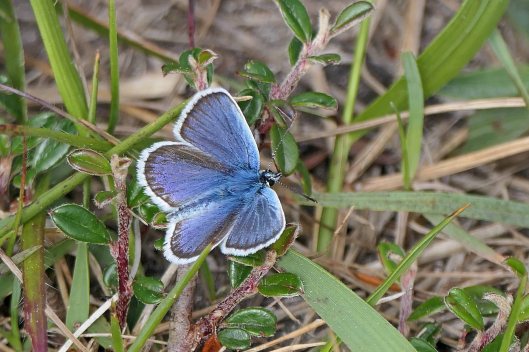
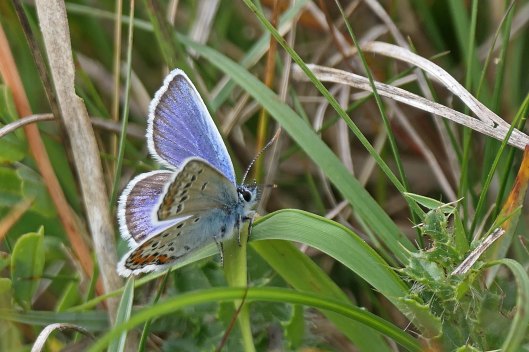
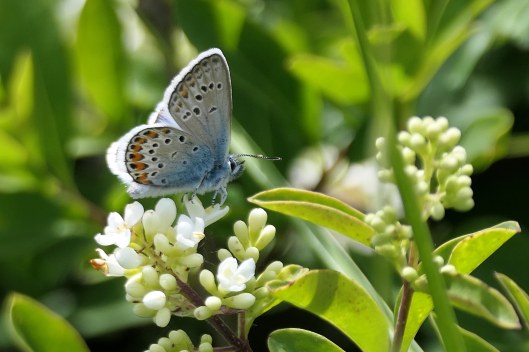
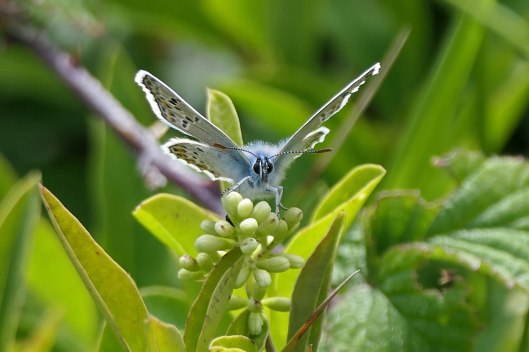
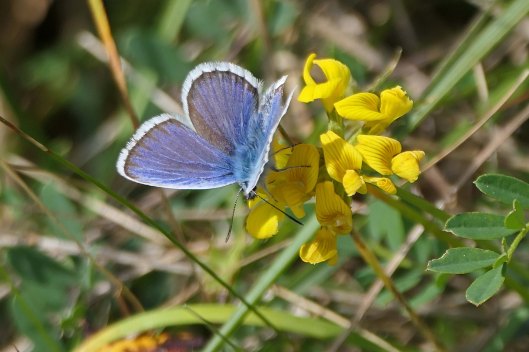
First up, in an old disused quarry on the Isle of Portland, were my first ever Silver-studded blue butterflies (Plebejus argus). The ‘silver-studded’ part of the name comes from the way the light is reflected off the light blue scales on the underside of the adults’ hindwings, making them shimmer like silver. And the ‘argus‘ epithet in its scientific name is a nod to the multi-eyed shepherd of Greek mythology, a reference to the spots on the undersides of the wings.

Silver-studded blues are rare and only seen in a few isolated areas around the southern coast of England, in Pembrokeshire and around the Great Orme in Wales, and in a couple of coastal locations in Norfolk and Suffolk. From those locations, you can perhaps guess that they prefer heathland, sand-dune systems and limestone grassland, in particular sheltered sunny spots where their companions, the black Lasius ant species, thrive. As is seen in several butterfly species, ants provide the butterflies with protection from insect predators throughout their life cycle.

Tout quarry provides the perfect environment for the Silver-studded blues. Quarrying has hollowed out large areas of ground, making it a sun trap and leaving stony areas where specialist wildflower species have managed to seed and flourish, though the vegetation does have to be managed to ensure the more aggressive plant species don’t overwhelm large areas of ground.

I was extremely lucky with the timing of my trip as these butterflies had only just emerged in the few days prior to my arrival, and that’s why I only saw the vibrant blue male butterflies; the females are brown on both the upper- and undersides of their wings. To see them is the perfect incentive for a return trip!

Like Loading...

Destructive Woodpigeons

13 Friday Jun 2025

Posted by sconzani in birds, trees

≈ Leave a comment

Tags

Ash trees, bird behaviour, birding, birdwatching, British birds, damage to Ash leaves, Woodpigeon, Woodpigeon eating Ash leaves

Although I am officially on the ground floor in my new home, the site slopes quite steeply so my flat is actually on the middle of three levels and, from my windows, I look out over the small slice of ancient woodland that’s adjacent to this property at the level of the tree tops. This is perfect for watching the antics of the local bird life, from the several species of tits to the larger Carrion crows and Woodpigeons, and I’m noticing behaviour that I couldn’t previously see from ground level.

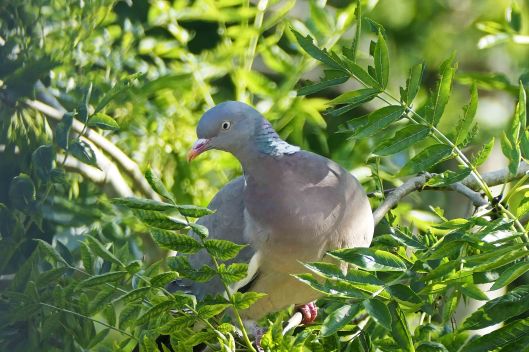
The Woodpigeons, of which there are many, spend quite a lot of time in the Ash trees. Looking through my binoculars, I’ve noticed that they appear to be carefully inspecting the leaves before pecking at them. Though they are predominantly vegetarian, they are known to eat some small invertebrates so, initially, I thought they were picking off aphids from the leaves. In the process they peck off chunks of leaf matter, which actually causes quite a lot of damage to the foliage. I have now read that they are actually eating the Ash leaves, targeting, in particular the shoots and younger leaves, presumably because those have the most nutrients. This feeding behaviour is really quite destructive – you can see the leaf damage to the right of this pigeon’s head in my photos, and something I was completely unaware of until I moved.

Like Loading...

Five big hovers

12 Thursday Jun 2025

Posted by sconzani in insects

≈ Leave a comment

Tags

British hoverflies, Chrysotoxum cautum, hoverfly, large hoverflies, Merodon equestris, Volucella bombylans, Volucella inflata, Volucella pellucens

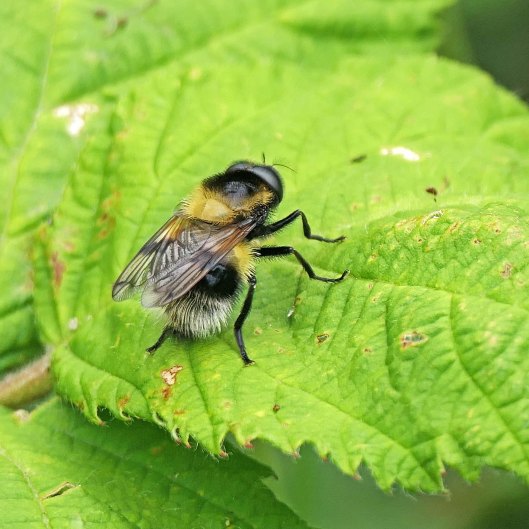
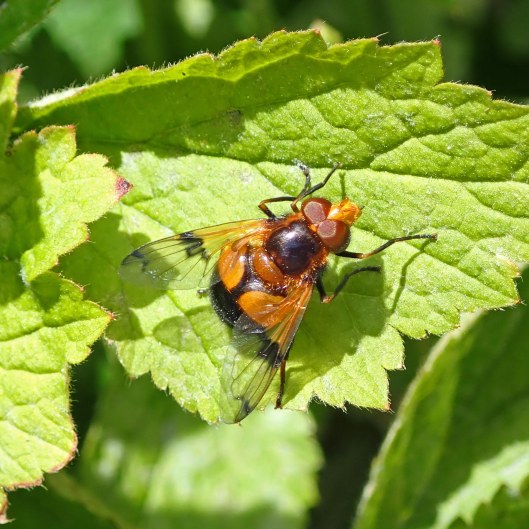
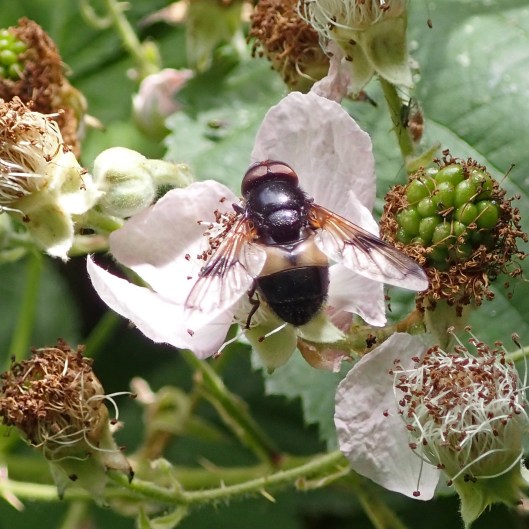
I’ve come to the conclusion, rightly or wrongly, that large hoverflies are like buses: you don’t see any at all and then they all come along at once. At least that has been my recent experience (it’s probably more to do with the weather and the time of year, but I like my buses theory). The five big beasties shown here were all seen over just four days, between 29 May and 1 June.

With its black-and-yellow striping, it’s easy to see that Chrysotoxum cautum is one of the wasp-mimicking hoverflies. The eight British species of Chrysotoxum all have quite long antennae, and it is the relative lengths of the segments of those antennae that are used to differentiate between the five most similar species.

Merodon equestris comes in a variety of colour forms, each of which mimics bumblebees. The one pictured above is a rather worn specimen of form validus, which has a totally dark thorax and a grey-buff coloured bottom.

These final three are all members of the Volucellini, of which there are five British species. Like Merodon equestris, Volucella bombylans is a bumblebee mimic; which bumblebee it is attempting to mimic depends on which of the colour variations you see. This yellow-and-black form mimics Bombus lucorum, the White-tailed bumblebee, but there is also a mostly black, orange-bottomed variation of Volucella bombylans that mimics Bombus lapidarius, the Red-tailed bumblebee.

I was particularly pleased to see Volucella inflata as I’ve only found it once before. With its vivid and very distinctive markings, its round body, and protruding yellow snout, it’s a stunning hoverfly to encounter. Sadly for those of you in northern Britain, it’s mostly found in the southern counties and south Wales.

Volucella pellucens, on the other hand, is common and abundant throughout Britain, often seen hovering around head height along woodland rides and forest tracks. Due to its black-and-white colouring, it’s also known as the Great pied hoverfly.

Like Loading...

Spider: Pardosa species

11 Wednesday Jun 2025

Posted by sconzani in spiders

≈ Leave a comment

Tags

British spiders, Lycosidae, Pardosa female with egg sac, Pardosa species, wolf spiders

Does it look like a wolf? Then why is this one of the so-called wolf spiders? I presume it’s because the Lycosidae or wolf spiders don’t use webs to catch their prey, relying instead on their running speed and superb eyesight (they have 8 eyes lined up in 2 rows) to catch their food.

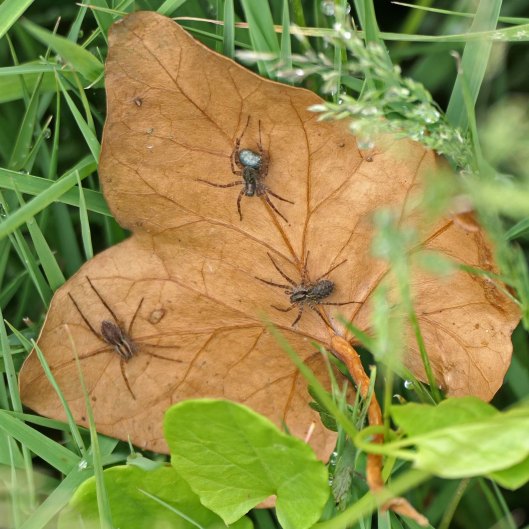
There are nine genera of wolf spiders, and the spiders shown here belong to one of 15 British species in the Pardosa genus. I cannot be more precise about the name because this is yet another family where identification is difficult; my guide book states that ‘even with the use of a microscope, identification can be extremely difficult’, so I’m just glad I managed to get the fact that these are Pardosa species verified.

All the Pardosa are brownish in colour, with similar markings on their abdomens in lighter and darker hues. As you can perhaps make out in my photos, even though these are all the same species, the markings are different in each spider. As you may also have gathered from looking at my photos, the females in this family carry their egg sacs around with them, presumably to protect them. Those sacs are usually a blue-green colour, with a paler seam down the centre.

If you want to see more of the spiders in this family, check out Steven Falk’s amazing album of photos on Flikr.

Like Loading...

Rhabdomiris striatellus

10 Tuesday Jun 2025

Posted by sconzani in insects, trees

≈ Leave a comment

Tags

British miridae, British plant bugs, bugs on Oak, insects on Oak trees, Miridae, oak tree, plant bug on Oak, Rhabdomiris striatellus

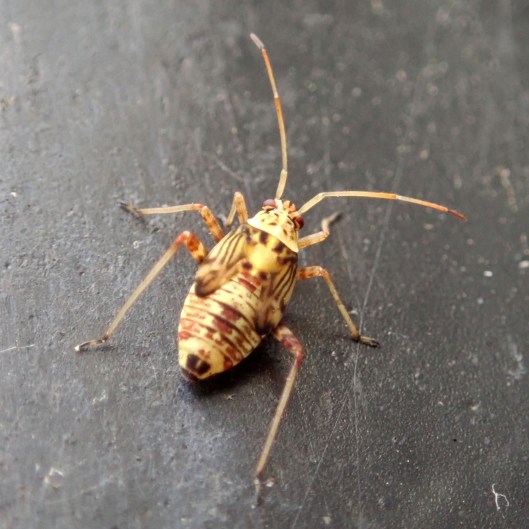
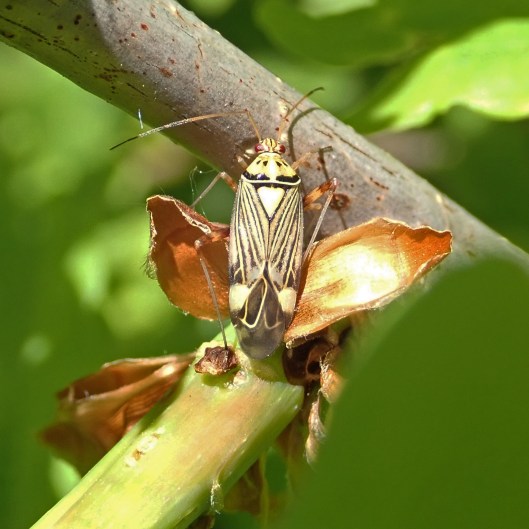
Here’s another bug that I’d never seen before this year and I’ve been lucky enough to find both a nymph and an adult. This is Rhabdomiris striatellus, one of the UK’s 200-plus species of plant bugs in the Miridae family. (I’ve probably only seen about a tenth of them so I’ve got plenty more discoveries yet to make.)

As this bug’s larvae feed on unripe catkins, it is usually found on or around Oak trees, and that’s certainly where I found the adult bug, shown below. The nymph above had probably fallen out of an Oak tree, or had decided to go walkabout to find a neighbouring Oak; I found it on the railings of my local park, where I’ve found so many invertebrates.

Rhabdomiris striatellus overwinters as an egg, hatches out in mid Spring, then passes through a series of instars until it reaches adulthood. The adults can then be seen from May through to July. Those timings certainly fit with my discoveries; I found the nymph on 25 April and the adult, in a different location, on 3 May.

Like Loading...

Leafmines: Coleophora paripennella

09 Monday Jun 2025

Posted by sconzani in insects, plants

≈ Leave a comment

Tags

British coleophora, British moths, case-bearing moth larva, case-bearing moth larva on Knapweed, Coleophora, Coleophora paripennella, leaf-mining moth larvae, moth larva on Knapweed

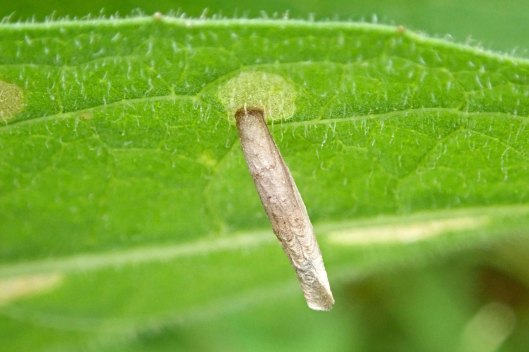
When I got home and checked my photos of this Coleophora, much head scratching ensued. From the British Leafminers website, I could see that there are only three species of case-bearing moth larvae known to feed on Knapweed (Centaurea nigra) and this case didn’t look like any of them. The case of Coleophora conspicuella is described as black and glossy, and has a peculiar almost keel-like shape. Coleophora peribenanderi mostly mines thistle species, is only occasionally seen on Knapweed, and the larvae is active from August to October. Coleophora paripennella‘s case looked the most likely, but is also usually much darker, almost black. So, I ‘phoned a friend’.

And my friendly expert from British Leafminers also ‘phoned a friend’, checking with another moth larvae expert. Their opinions concurred: this was Coleophora paripennella, just with a much lighter-coloured case than usual. Like C. peribenanderi, C. paripennella uses both thistles and Knapweed as larval plants, but in this case, those larvae that use thistle are fully grown by the autumn, whereas those that munch on Knapweed, top up their larval development by feeding again from April to May/June. You can see the sleek and glossy adult moth that eventually results from all this leaf munching on the UK Moths website here.

Like Loading...

Coteries of orchids

08 Sunday Jun 2025

Posted by sconzani in flowers, wildflowers

≈ Leave a comment

Tags

Anacamptis pyramidalis, Bee orchid, British orchids, Dactylorhiza maculata, Dactylorhiza praetermissa, Heath spotted-orchid, native orchids, Ophrys apifera, orchids, Pyramidal orchid, Southern marsh orchid, Spring colour, spring orchids

I was searching for adjectives to describe the many native orchids I’ve been seeing during my recent meanders, then decided that you didn’t really need my blathering to see how sublime they are.

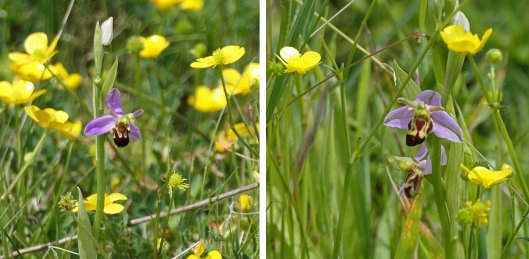
Bee orchids (Ophrys apifera), at Cardiff’s Grangemoor Park. Note the unusual markings on the ‘face’ of the orchid on the right – it looks to me to be crying.

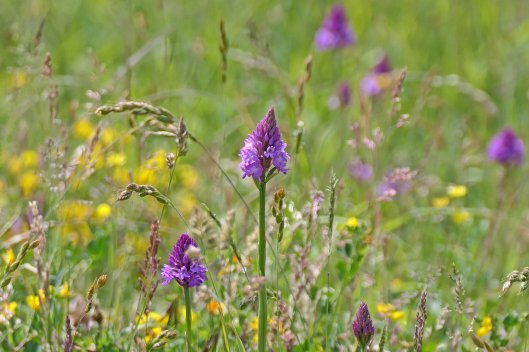
Also from Grangemoor Park, a feast of Pyramidal orchids (Anacamptis pyramidalis)

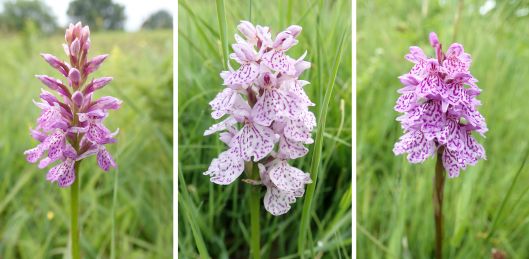
Heath spotted-orchids (Dactylorhiza maculata) from last Wednesday’s visit to Aberbargoed Grasslands NNR

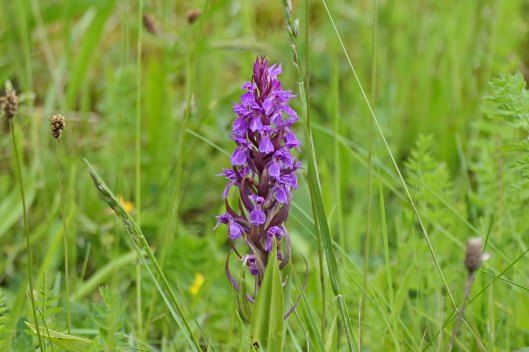
One of just a few Southern marsh orchids (Dactylorhiza praetermissa) growing on the coal spoil tip at Aberbargoed

Like Loading...

Grassland pearls

07 Saturday Jun 2025

Posted by sconzani in insects

≈ Leave a comment

Tags

Aberbargoed Grasslands, Boloria selene, British butterflies, British fritillaries, butterfly, fritillaries, fritillary butterflies, Small Pearl-bordered Fritillary

Wednesday’s weather wasn’t the best for trying to find butterflies – a constant westerly wind was keeping the temperatures low even when the sun did manage to peak out from behind the constant parade of big clouds rolling through, but my friend Shar’s optimism proved well founded.

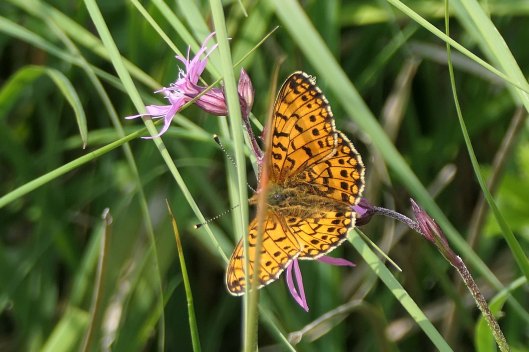
Though even her sharp eyes didn’t manage to spot any Marsh fritillaries (as they seem to have emerged early everywhere this year, we were probably too late for them at this site), we did find a few gorgeous Small pearl-bordered fritillaries (Boloria selene), the species I was really hoping to see that day. Initially, we thought we had two but on checking my photos at home later, I realised from the wing markings that we’d actually seen three.

As usual, we were conducting our butterfly hunt in the habitat most favoured by these fritillaries, the damp grasslands of the Aberbargoed Grasslands National Nature Reserve, where the butterflies particularly enjoy flowers like common violets and bluebells, Marsh thistles and Ragged robin. The reserve is also home to a large population of orchids, both Common and Heath spotted-orchids, as well as Cross-leaved heath, Tormentil, Devil’s-bit scabious and Knapweed, amongst other wildflower species, making a wander around its fields a pleasure even when you don’t see very many butterflies.

Like Loading...
← Older posts
Newer posts →

About me

sconzani

sconzani

I'm a writer and photographer; researcher and blogger; birder and nature lover; countryside rambler and city strider; volunteer and biodiversity recorder.

View Full Profile →

Follow earthstar on WordPress.com

Enter your email address to follow this blog and receive notifications of new posts by email.

Recent blog posts

  • Turtle bug March 23, 2026
  • Springtime invasives March 22, 2026
  • Singing Dunnocks March 21, 2026
  • New cat: Large yellow underwing March 20, 2026
  • Curious Coal tit March 19, 2026

From the archives

COPYRIGHT

Unless otherwise acknowledged, the text and photographs on this blog are my own and are subject to international copyright. Nothing may be downloaded or copied without my permission.

Fellow Earth Stars!

  • Unknown's avatar
  • Unknown's avatar
  • Unknown's avatar
  • Unknown's avatar
  • Unknown's avatar
  • Unknown's avatar
  • Unknown's avatar
  • Unknown's avatar
  • Unknown's avatar
  • Unknown's avatar
  • Unknown's avatar
  • Unknown's avatar
  • Unknown's avatar
  • Unknown's avatar
  • Unknown's avatar
  • Unknown's avatar
  • Unknown's avatar
  • Unknown's avatar
  • Unknown's avatar
  • Unknown's avatar
  • Unknown's avatar
  • Unknown's avatar
  • Unknown's avatar
  • Unknown's avatar
  • Unknown's avatar
  • Unknown's avatar
  • Unknown's avatar
  • Unknown's avatar
  • Unknown's avatar
  • Unknown's avatar
  • Unknown's avatar
  • Unknown's avatar
  • Unknown's avatar
  • Unknown's avatar
  • Unknown's avatar
  • Unknown's avatar
  • Unknown's avatar
  • Unknown's avatar
  • Unknown's avatar
  • Unknown's avatar
  • Unknown's avatar
  • Unknown's avatar
  • Unknown's avatar
  • Unknown's avatar
  • Unknown's avatar
  • Unknown's avatar
  • Unknown's avatar
  • Unknown's avatar
  • Unknown's avatar
  • Unknown's avatar

Blog at WordPress.com.

Privacy & Cookies: This site uses cookies. By continuing to use this website, you agree to their use.
To find out more, including how to control cookies, see here: Cookie Policy
  • Subscribe Subscribed
    • earthstar
    • Join 668 other subscribers
    • Already have a WordPress.com account? Log in now.
    • earthstar
    • Subscribe Subscribed
    • Sign up
    • Log in
    • Report this content
    • View site in Reader
    • Manage subscriptions
    • Collapse this bar
 

Loading Comments...
 

You must be logged in to post a comment.

    %d