• ABOUT
  • BIRDING 2018
  • Birding 2019
  • BLOG POSTS
  • Butterflies 2018
  • Resources

earthstar

~ a celebration of nature

earthstar

Author Archives: sconzani

Leafhopper: Oncopsis alni

27 Tuesday May 2025

Posted by sconzani in insects

≈ Leave a comment

Tags

British cicadellidae, British leafhoppers, Cicadellidae, cicadellidae on Alder, leafhoppers on Alder, Oncopsis alni

Oncopsis alni is one of the more chunky leafhoppers and it lives almost exclusively on Alder, hence the alni in its name. As I’ve been strolling along my various local walking routes this Spring, I’ve been checking the Alder trees for signs of leafhoppers, and have seen quite a lot of nymphs of various sizes but, as they’ve been juveniles, I haven’t been certain of their identification.

Now that some of the nymphs are reaching adulthood, it’s possible to be somewhat more certain. Although the Naturespot website warns that this species ‘can only be identified by examination of internal genital structure’, the information on the British Bugs website is a bit more optimistic. For one thing, and with the proviso that bugs don’t always stick to the rules, this is the only member of the Oncopsis genus that is found on Alder. Also, ‘although males can show extensive dark markings on the upper part of the face, the discoidal spots below these are small in both sexes’, and I think I can see this distinguishing feature in my various photos. I should add a disclaimer though: my finds have not yet been verified by the national recorder.

Like Loading...

Fly: Poecilobothrus nobilitatus

26 Monday May 2025

Posted by sconzani in insects

≈ Leave a comment

Tags

British flies, fly, long-legged fly, Poecilobothrus nobilitatus

Its name sounds like an incantation a Harry Potter acolyte might chant to turn an annoying peer into a toad, though Google AI suggests: ‘The genus name Poecilobothrus comes from the Greek words “poikilos” (various, or variegated) and “botryx” (a cluster of grapes), likely referring to the diverse and ornate nature of some dance fly species’ and ‘The species name nobilitatus is derived from the Latin word “nobilitatus,” meaning “made noble” or “ennobled,” which could relate to the elegant or showy appearance of the fly, particularly during courtship.’ I can certainly agree that this little long-legged fly is an ornate and elegantly formed creature.

I don’t usually have much luck identifying fly species but, fortunately for me, this one was a male and so it has distinctive white markings on the end of its wings, which it flashes at potential mates during its courtship display. I spotted this specimen sitting on vegetation next to a local footpath but they are usually to be found in wet locations, often sitting on weed floating on the surface of a pond or slow-moving stream.

Like Loading...

Orchids already?

25 Sunday May 2025

Posted by sconzani in flowers, wildflowers

≈ Leave a comment

Tags

British orchids, Common spotted-orchid, Dactylorhiza fuchsii, native orchids, orchids

This year seems to be flying by. I mean, how can the Common spotted-orchids be flowering already?

Maybe it’s just me, and the house move, and everything associated with that that’s made this year seem to be passing so quickly. Or maybe it’s just old age – when I was young, time often seemed to drag; now it zips by too quickly.

Anyhoo, whether or not I was ready for them, the orchids are out and looking as gorgeous as they always do. I hope you get to enjoy them too.

Like Loading...

Demoiselles

24 Saturday May 2025

Posted by sconzani in insects

≈ Leave a comment

Tags

Banded Demoiselle, Beautiful Demoiselle, British dragonflies, Calopteryx splendens, Calopteryx Virgo, demoiselles, Odonata

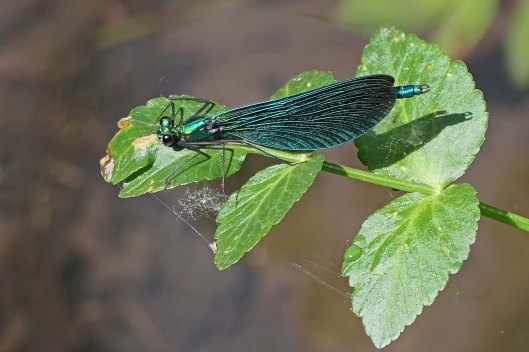
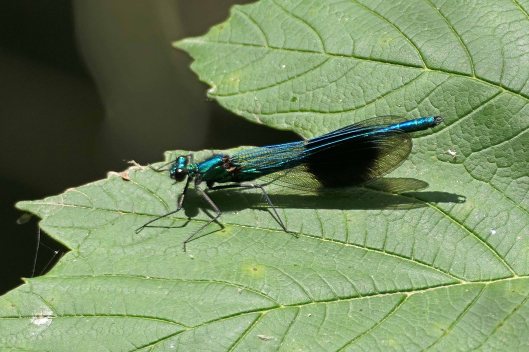
Thursday was a good day for demoiselles. As I strolled along the old Glamorgan canal at Forest Farm Nature Reserve, I was almost constantly entertained by both the Beautiful (Calopteryx virgo) and the Banded demoiselles (Calopteryx splendens), though there were definitely many more of the former than the latter.

 ~ male Beautiful demoiselle

While the females mostly perched quietly on leaves somewhat removed from the males – the only way to escape their attention, the males seldom kept still. They flashed their wings, displaying their metallic blue hues to impress any female that did venture past, and competed with other males for the best territories, those with sun, and shelter, and perches, and suitable places for egg-laying. What was serious breeding business for these stunning creatures was enchanting and magical for me.

~ male Banded demoiselle

Like Loading...

A skipper surprise

23 Friday May 2025

Posted by sconzani in insects

≈ Leave a comment

Tags

British butterflies, butterfly, early emergence, Large skipper, skipper butterflies

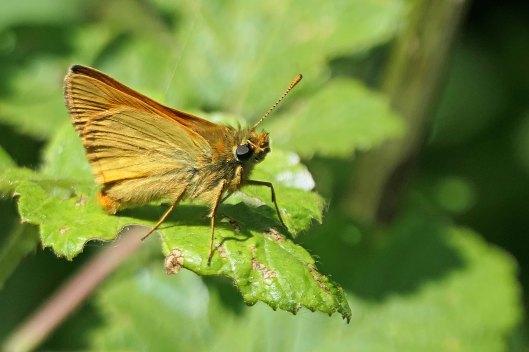
You could’ve knocked me over with the draft from a butterfly’s wing when this gorgeous creature flitted up from the foliage to greet me as I walked the coastal path on Tuesday. Large skippers don’t usually appear locally until early June but our lengthy spell of warm dry weather is having a very obvious effect on insect emergence times this year.

Like Loading...

Meligramma trianguliferum larvae

22 Thursday May 2025

Posted by sconzani in insects

≈ Leave a comment

Tags

British hoverflies, hoverfly, hoverfly larvae, Meligramma trianguliferum, Meligramma trianguliferum larvae

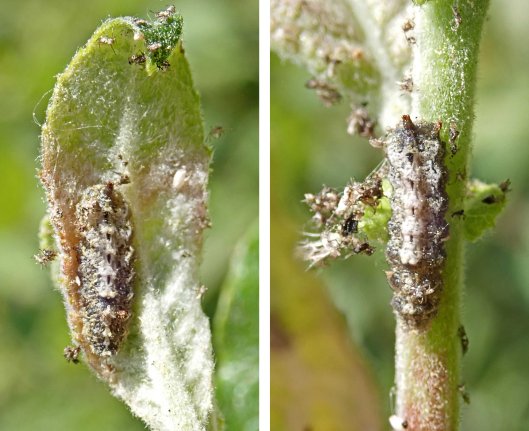
I’ve never seen an adult Meligramma trianguliferum hoverfly due, no doubt, to the fact that this species is rare in Wales, with only four previous sightings logged. However, I am now very hopeful I will see one this summer, as I found six larvae on one particularly heavily aphid-infested shrub in a local park, and there were probably more larvae that I didn’t spot lurking under the leaves.

I didn’t recognise the species when I saw it, of course, but, fortunately for me, the national hoverfly larvae recorder Geoff is on social media and is very willing to identify sighting from photographs where possible. There were so many aphids on this shrub that it was sticky with honeydew and even the larvae were covered in it and looking quite manky so I’m glad Geoff was still able to recognise them. To see the adults, check out the photos on the Naturespot website and, fingers crossed, I’ll find some and share photos of those sometime in the summer. 

Like Loading...

Spider: Segestria florentina

21 Wednesday May 2025

Posted by sconzani in spiders

≈ 2 Comments

Tags

British spiders, Segestria florentina, tube web spider, tube-dwelling spider

With this year’s focus on identifying spiders, I’m getting better at being close to them but this large beast did give me pause. Fortunately, it wasn’t in my house or any other enclosed space; I spotted it sitting on an external house wall as I walked along a street. After consulting a local with good spider knowledge, I can confirm this is the tube web spider Segestria florentina, though its chelicerae (fanged mouthparts) are not the shiny green colour described in my guide book. Perhaps that was just due to the light conditions when I photographed it.

Segestria florentina usually lives in a tube-shaped web, tucked in a hole in a wall or amongst rocks, speeding out to grab its prey when it passes the hole. You definitely wouldn’t want to poke your finger in its hole, as it does have a venomous bite, though apparently it’s not dangerous, and the spider’s only found in the south of the UK. If you want to know more, the iNaturalist website has a good article and excellent photos.

Like Loading...

Thistle tortoise beetle

20 Tuesday May 2025

Posted by sconzani in insects

≈ Leave a comment

Tags

beetle egg-laying, bettle, British beetles, Cassida rubiginosa, Thistle tortoise beetle, tortoise beetles

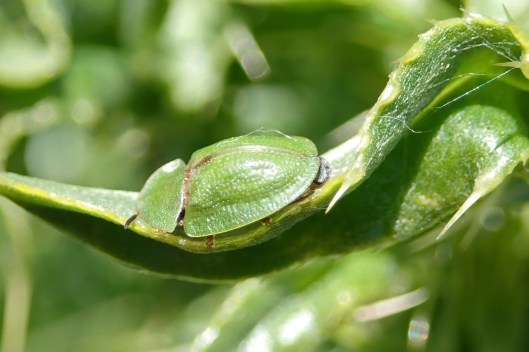
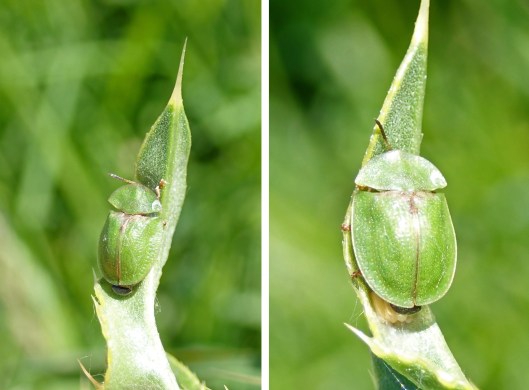
Back in 2022, I blogged about this beetle’s bizarre larvae, the ones that carry their own poo above their backs as camouflage (see Thistle tortoise beetle larvae, July 2022). It’s taken me almost three years to spot an adult Thistle tortoise beetle (Cassida rubiginosa) but, now that I see how well they blend in to their thistle surroundings (no poo required), I understand why.

I also understand now why they’re called tortoise beetles, as their ‘shell’ really is tortoise-like. And, even better, if you look closely at the rear end of the beetle in the photo below right, you may be able to spot some tiny cream-coloured tubes – this beautiful beetle was a female and she was egg-laying.

Like Loading...

Scribbled wingwaver

19 Monday May 2025

Posted by sconzani in insects

≈ 2 Comments

Tags

British flies, Herina frondescentiae, picture-winged flies, Scribbled wingwaver, tiny fly with patterned wings

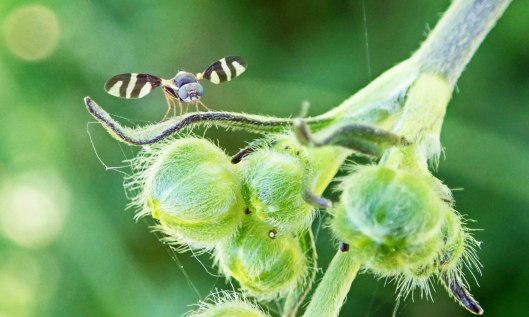
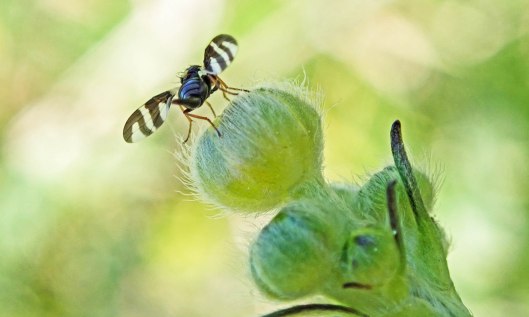
Is this the most charming insect name you’ve ever heard? The Scribbled wingwaver (Herina frondescentiae), one of the aptly named picture-winged flies, does indeed wave its pretty little wings around. Whether this is to attract the attention of other passing wingwavers or to warn off potential predators, I’m not sure, but it certainly attracted my eye.

At just 3mm long, this is one of Britain’s smallest picture-winged flies. The one shown here is a female, which is why she has that large pointy bit on her rear end; it’s for depositing her eggs, possibly in rotting vegetation, but the species’ life cycle seems not to have been investigated fully yet.

According to the Naturespot website, it usually inhabits ‘wet, rush-dominated habitats and brownfield sites’. I found mine during a wander around some local farm fields that have been earmarked for a housing development, though the site is adjacent to an old abandoned railway line so I guess that counts as brownfield. Apparently, the Scribbled wingwaver is quite common throughout Britain, so do keep your eyes peeled for a tiny fly waving its patterned wings at you as you walk by.

Like Loading...

Kidney vetch

18 Sunday May 2025

Posted by sconzani in wildflowers

≈ 2 Comments

Tags

Anthyllis vulneraria, British wildflowers, Kidney vetch, Spring colour, yellow wildflowers

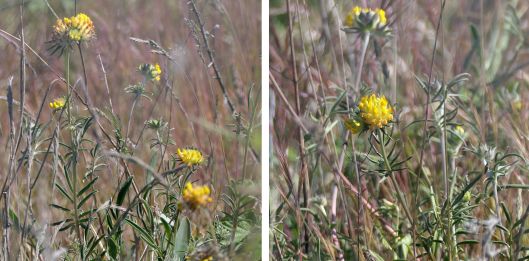
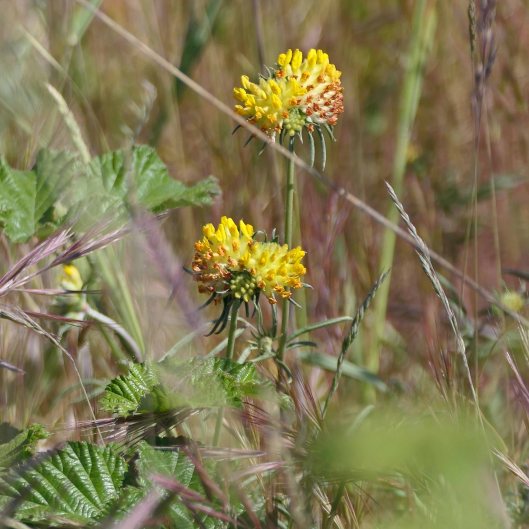
If only Cardiff Bay had a large thriving area of Kidney vetch (Anthyllis vulneraria), then we might also have a small thriving colony of Small blue butterflies, as this is their larval food plant.

Sadly, the few plants that manage to survive in the Bay are locked away behind a tall barrier of diagonal wire mesh in a tiny patch of waste ground; the fact they’re inaccessible is probably the only reason they’ve survived Cardiff Council’s ‘spray herbicide on everything’ policy of environmental (mis)management. The mesh also means the plants are very much overlooked and under-appreciated, as well as being difficult to photograph, which is a great shame, as Kidney vetch is a very attractive wildflower.

Like Loading...
← Older posts
Newer posts →

About me

sconzani

sconzani

I'm a writer and photographer; researcher and blogger; birder and nature lover; countryside rambler and city strider; volunteer and biodiversity recorder.

View Full Profile →

Follow earthstar on WordPress.com

Enter your email address to follow this blog and receive notifications of new posts by email.

Recent blog posts

  • Turtle bug March 23, 2026
  • Springtime invasives March 22, 2026
  • Singing Dunnocks March 21, 2026
  • New cat: Large yellow underwing March 20, 2026
  • Curious Coal tit March 19, 2026

From the archives

COPYRIGHT

Unless otherwise acknowledged, the text and photographs on this blog are my own and are subject to international copyright. Nothing may be downloaded or copied without my permission.

Fellow Earth Stars!

  • Unknown's avatar
  • Unknown's avatar
  • Unknown's avatar
  • Unknown's avatar
  • Unknown's avatar
  • Unknown's avatar
  • Unknown's avatar
  • Unknown's avatar
  • Unknown's avatar
  • Unknown's avatar
  • Unknown's avatar
  • Unknown's avatar
  • Unknown's avatar
  • Unknown's avatar
  • Unknown's avatar
  • Unknown's avatar
  • Unknown's avatar
  • Unknown's avatar
  • Unknown's avatar
  • Unknown's avatar
  • Unknown's avatar
  • Unknown's avatar
  • Unknown's avatar
  • Unknown's avatar
  • Unknown's avatar
  • Unknown's avatar
  • Unknown's avatar
  • Unknown's avatar
  • Unknown's avatar
  • Unknown's avatar
  • Unknown's avatar
  • Unknown's avatar
  • Unknown's avatar
  • Unknown's avatar
  • Unknown's avatar
  • Unknown's avatar
  • Unknown's avatar
  • Unknown's avatar
  • Unknown's avatar
  • Unknown's avatar
  • Unknown's avatar
  • Unknown's avatar
  • Unknown's avatar
  • Unknown's avatar
  • Unknown's avatar
  • Unknown's avatar
  • Unknown's avatar
  • Unknown's avatar
  • Unknown's avatar
  • Unknown's avatar

Blog at WordPress.com.

Privacy & Cookies: This site uses cookies. By continuing to use this website, you agree to their use.
To find out more, including how to control cookies, see here: Cookie Policy
  • Subscribe Subscribed
    • earthstar
    • Join 668 other subscribers
    • Already have a WordPress.com account? Log in now.
    • earthstar
    • Subscribe Subscribed
    • Sign up
    • Log in
    • Report this content
    • View site in Reader
    • Manage subscriptions
    • Collapse this bar
 

Loading Comments...
 

You must be logged in to post a comment.

    %d