• ABOUT
  • BIRDING 2018
  • Birding 2019
  • BLOG POSTS
  • Butterflies 2018
  • Resources

earthstar

~ a celebration of nature

earthstar

Author Archives: sconzani

Number 20

20 Thursday Jun 2024

Posted by sconzani in insects

≈ Leave a comment

Tags

Aberbargoed coal tip, British butterflies, butterfly, Small heath

Butterfly species 20 for 2024 took some finding. I usually see a few of these little beauties when I visit Aberbargoed Grasslands National Nature Reserve looking for fritillaries but, perhaps due to our exceedingly wet spring, butterflies everywhere have been thin on the ground this year. So, when my second visit to the grasslands failed to turn up any butterflies at all, I decided to try the adjacent coal spoil tip, thinking that the shingle and scree surface might be both drier and warmer. And so it proved. And there, in a small sheltered area, I found my first three Small heath butterflies of the year.

Like Loading...

A day of golden dragons

19 Wednesday Jun 2024

Posted by sconzani in insects

≈ Leave a comment

Tags

Black-tailed skimmer, British dragonflies, Broad-bodied Chaser, dragonfly, Four-spotted Chaser, Libellula depressa, Libellula quadrimaculata, Odonata, Orthetrum cancellatum

Last Saturday was a day of golden dragons …

240619 black-tailed skimmer

my first Black-tailed skimmers (Orthetrum cancellatum) of the year (unfortunately, the male didn’t stop for a photo),

240619 broad-bodied chaser

a female Broad-bodied chaser (Libellula depressa), and …

240619 four-spotted chaser

a Four-spotted chaser (Libellula quadrimaculata).

Like Loading...

Cricket bat spider

18 Tuesday Jun 2024

Posted by sconzani in spiders

≈ Leave a comment

Tags

British spiders, Cricket bat spider, Mangora acalypha

I think you can easily see how this little arachnid got its common name of Cricket bat spider – the black shape on its abdomen does look very similar to a cricket bat and, to my eye, the three lines on the base of its abdomen also resemble the stumps, though that may just be my fanciful imagination.

240618 Cricket Bat spider

This is Mangora acalypha, which the Spider and Harvestman Recording Scheme website reports is mostly found in southern Wales and England, mostly on gorse bushes but also on other shrubs. These were the first two I’d ever seen and were on Creeping thistle and Common fleabane, in a field that once was farmed but is now re-wilding (though, sadly, the Welsh government has plans to build 500 houses in this location). You can read more details about this species and see a map of its distribution on the SHRS website.

Like Loading...

Leafmines: Agromyza albitarsis

17 Monday Jun 2024

Posted by sconzani in insects, trees

≈ Leave a comment

Tags

Agromyza albitarsis, British leafmines, leaf-mining fly larvae, leafmine, leafmine on White poplar, White poplar

I hadn’t found any new leafminers for a while so was delighted recently to find two within five minutes of each other. These two mines were the first I spotted, here on the leaves of White poplar (Populus alba), though they can also be found on other Poplar (Populus) and Willow (Salix) species.

240617 agromyza albitarsis

These are the larval mines of the little fly Agromyza albitarsis – you can see what the adult fly looks like by clicking on the ‘images’ tab on the National Agromyzidae Recording Scheme website. I couldn’t actually count how many larvae were present in these mines but have read that they often feed communally, forming large green blotches that eventually turns a dark brown-black colour.

Like Loading...

Milkwort

16 Sunday Jun 2024

Posted by sconzani in wildflowers

≈ Leave a comment

Tags

British wildflowers, Common milkwort, milkwort, Polygala vulgaris

It’s always a delightful surprise to spot the tiny blue flowers of Milkwort in amongst the grasses and other wildflowers. Apparently, the flowers, which bloom from May right through to September in some locations, can also be deep purple and white but I’ve only ever seen this wonderful bright blue hue.

240616 milkwort (1)

Wikipedia reports that Classical and Renaissance writers stated ‘common milkwort was used medicinally as an infusion to increase the flow of a nursing mother’s milk’.

240616 milkwort (2)

I have assumed until now that the Milkwort plants I’ve seen, in various locations from grasslands to a coal spoil tip, have all been Common milkwort (Polygala vulgaris) but I admit that I have been so taken with the flowers that I haven’t paid much attention to the leaves. It seems that Heath Milkwort (Polygala serpyllifolia) is another possibility and, in future, I need to check whether the lower leaves are opposite each other on the stems (Heath milkwort) or alternate (Common milkwort).

240616 milkwort (3)

Like Loading...

Brown and orange

15 Saturday Jun 2024

Posted by sconzani in insects

≈ 2 Comments

Tags

British butterflies, butterfly, Large skipper, Meadow Brown

Time for an update on the butterfly front …
Usually I see Large skippers before I see Meadow browns but this year it was the other way around, with the local Meadow browns emerging slightly earlier than usual. Who knows why – maybe something to do with the crazy weather we’ve been experiencing – warm one minute, cool the next. My first Meadow browns were seen fluttering over the wildflowers in the meadows at Cosmeston Lakes Country Park on 3 June.

240615 meadow brown

And, despite a keen breeze and large fluffy clouds frequently obscuring the sun, I spotted my first six Large skippers basking on Bramble and other shrubs along the leeward side of a coastal hedgerow two days later, on 5 June.

240615 large skipper

Like Loading...

A horsefly’s eyes

14 Friday Jun 2024

Posted by sconzani in insects

≈ 2 Comments

Tags

British horseflies, cleg, Haematopota pluvialis, horseflies' eyes, horsefly, Tabanidae

This was my first horsefly of the year, never a welcome sight as I react quite badly to their bites.

240614 Haematopota pluvialis (1)

She had just settled on my forearm (they have such a light touch that you often don’t notice they’re there until it’s too late), and was focused on her next task of slicing open my skin so that she could feed on my blood. But, before I fell victim to her bloodsucking, I made a quick grab for her and, amazingly, managed to get hold of one wing. That allowed me to get some reasonable close-up photos of her vicious mouth parts and those incredible eyes!

240614 Haematopota pluvialis (2)

The BBC Wildlife website reports that horseflies’ eyes ‘are packed with hundreds (or thousands) of individual light-sensitive columns known as ommatidia (only the near-circular lens facets on the outside are visible)’ and also that the ‘hues are created not by pigments but by the light-refracting qualities of neighbouring groups of facets, determined by the densities of the lens cuticles.’ These particularly stunning eyes may belong to a female Haematopota pluvialis (only the females bite) but I haven’t yet had that identity confirmed.

Like Loading...

Sad news, good news

13 Thursday Jun 2024

Posted by sconzani in birds

≈ Leave a comment

Tags

birding, birdwatching, breeding Lesser black-backed gulls, British birds, Lesser black-backed gull chicks, Lesser blacked gull, urban gulls

A pair of Lesser black-backed gulls is once again attempting to raise a family amongst the chimney pots of a house visible from the back of my flat.

Sadly, this process involves many hazards, one of which being the fact that, once they become more active, the chicks can easily fall from their precarious home. And that’s exactly what has happened to one of the local chicks. As I watched, and in spite of the slippery nature of the slate roofing tiles, it managed to climb up to the roof ridge but, of course, there was no way it could return to the nest. The parent gulls were very concerned and made a lot of noise when they discovered what had happened but, to be honest, that only made things worse as the little chick tried to reach them along the ridge but kept constantly slipping down the roof. I don’t know what eventually happened to the wee thing but I presume it fell off the roof and died.

The good news is that there is still one chick in the nest, and the parents are, so far, taking good care of it. Whether or not it survives to adulthood remains to be seen. Fingers crossed!

Like Loading...

The hatchling, and family

12 Wednesday Jun 2024

Posted by sconzani in insects, wildflowers

≈ Leave a comment

Tags

British weevils, British wildflowers, Cionus scrophulariae, Common figwort, Figwort weevil, Scrophularia nodosa

My little alien has hatched. As I had begun to suspect, it’s the most gorgeous Figwort weevil (Cionus scrophulariae).

240612 figwort weevil (1)

I’ve just returned from delivering my tiny miracle to the small group of Figwort (Scrophularia nodosa) plants near where I first found its cocoon.

240612 figwort weevil (2)

These are two other Figwort weevils I found on those plants; they are probably some of its siblings. Aren’t they just delightful creatures?

240612 figwort weevil (3)240612 figwort weevil (4)

Like Loading...

A colony of Woundwort shieldbugs

11 Tuesday Jun 2024

Posted by sconzani in insects, plants

≈ Leave a comment

Tags

British shieldbugs, Eysarcoris venustissimus, Hedge woundwort, Stachys sylvatica, Woundwort shieldbug

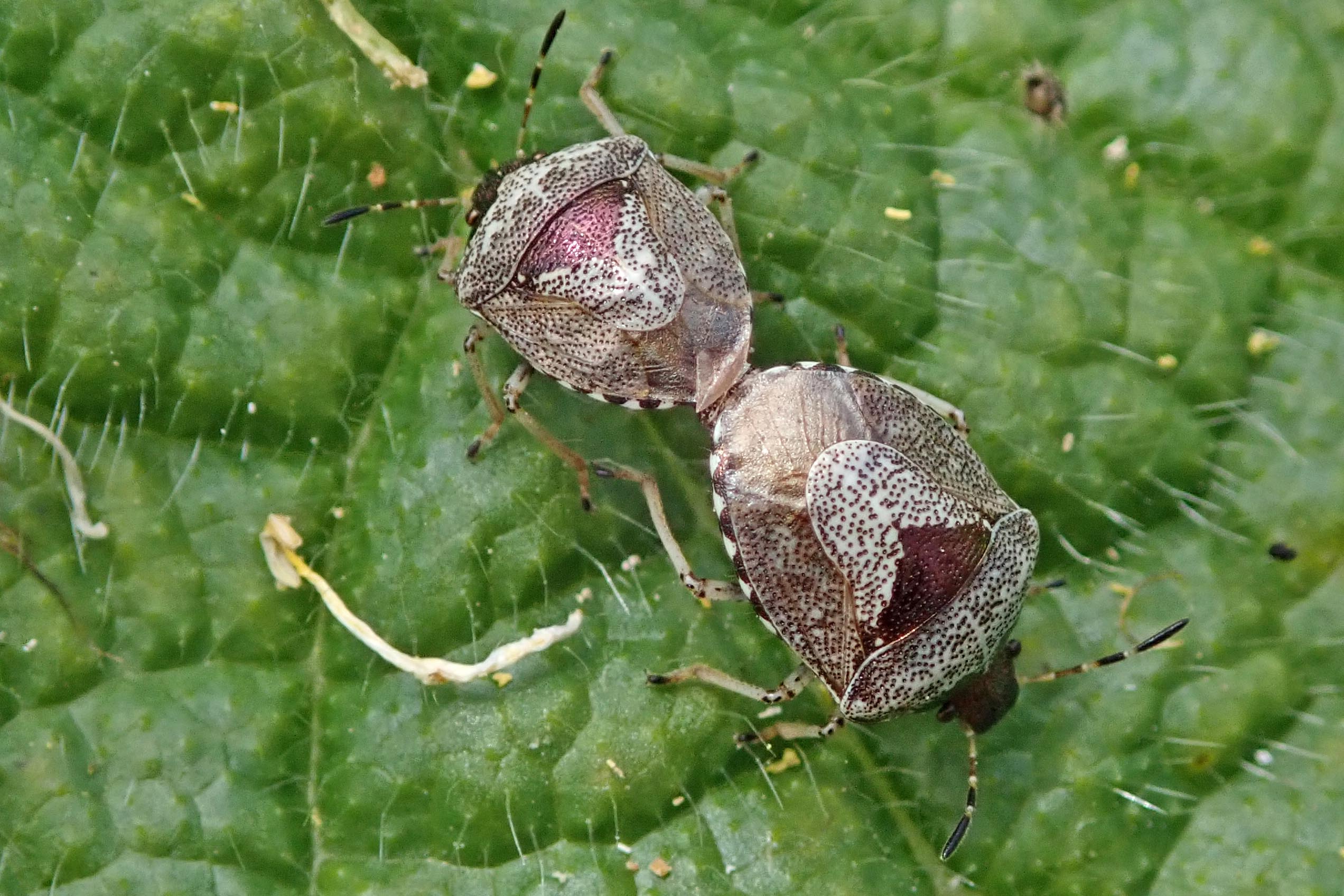
I was actually checking the Hedge woundwort plants growing alongside our local coastal path for leaf-mining moths (of which there were none) when I spotted first one Woundwort shieldbug, then another, and another, and then two mating.

240611 woundwort shieldbugs (3)

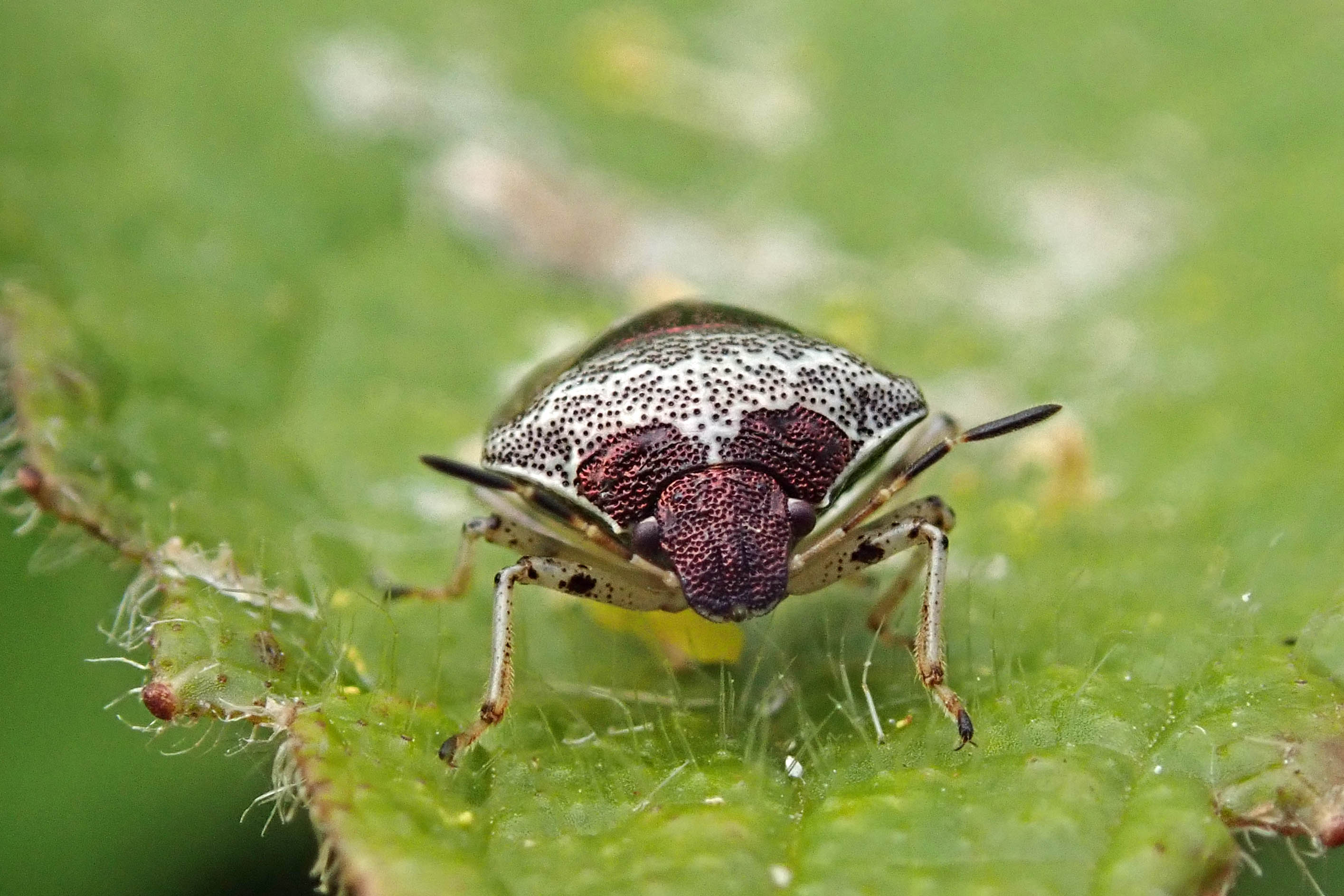
In fact, I eventually counted eight, which is more than I’ve ever seen in one spot before. Hopefully, this means their numbers are increasing generally as they are very handsome little bugs.

240611 woundwort shieldbugs (2)

As well as feeding on Hedge woundwort (Stachys sylvatica), the Woundwort shieldbug (Eysarcoris venustissimus) is also partial to the Lamiaceae species of plants, especially White dead-nettle (Lamium album).

240611 woundwort shieldbugs (1)

Like Loading...
← Older posts
Newer posts →

About me

sconzani

sconzani

I'm a writer and photographer; researcher and blogger; birder and nature lover; countryside rambler and city strider; volunteer and biodiversity recorder.

View Full Profile →

Follow earthstar on WordPress.com

Enter your email address to follow this blog and receive notifications of new posts by email.

Recent blog posts

  • Cute cootlet April 30, 2026
  • Blood bees April 29, 2026
  • Nesting material April 28, 2026
  • Lifer: Box bug April 27, 2026
  • Peak Wild garlic April 26, 2026

From the archives

COPYRIGHT

Unless otherwise acknowledged, the text and photographs on this blog are my own and are subject to international copyright. Nothing may be downloaded or copied without my permission.

Fellow Earth Stars!

  • Unknown's avatar
  • Unknown's avatar
  • Unknown's avatar
  • Unknown's avatar
  • Unknown's avatar
  • Unknown's avatar
  • Unknown's avatar
  • Unknown's avatar
  • Unknown's avatar
  • Unknown's avatar
  • Unknown's avatar
  • Unknown's avatar
  • Unknown's avatar
  • Unknown's avatar
  • Unknown's avatar
  • Unknown's avatar
  • Unknown's avatar
  • Unknown's avatar
  • Unknown's avatar
  • Unknown's avatar
  • Unknown's avatar
  • Unknown's avatar
  • Unknown's avatar
  • Unknown's avatar
  • Unknown's avatar
  • Unknown's avatar
  • Unknown's avatar
  • Unknown's avatar
  • Unknown's avatar
  • Unknown's avatar
  • Unknown's avatar
  • Unknown's avatar
  • Unknown's avatar
  • Unknown's avatar
  • Unknown's avatar
  • Unknown's avatar
  • Unknown's avatar
  • Unknown's avatar
  • Unknown's avatar
  • Unknown's avatar
  • Unknown's avatar
  • Unknown's avatar
  • Unknown's avatar
  • Unknown's avatar
  • Unknown's avatar
  • Unknown's avatar
  • Unknown's avatar
  • Unknown's avatar
  • Unknown's avatar
  • Unknown's avatar

Blog at WordPress.com.

Privacy & Cookies: This site uses cookies. By continuing to use this website, you agree to their use.
To find out more, including how to control cookies, see here: Cookie Policy
  • Subscribe Subscribed
    • earthstar
    • Join 642 other subscribers
    • Already have a WordPress.com account? Log in now.
    • earthstar
    • Subscribe Subscribed
    • Sign up
    • Log in
    • Report this content
    • View site in Reader
    • Manage subscriptions
    • Collapse this bar

Loading Comments...

You must be logged in to post a comment.

    %d