• ABOUT
  • BIRDING 2018
  • Birding 2019
  • BLOG POSTS
  • Butterflies 2018
  • Resources

earthstar

~ a celebration of nature

earthstar

Category Archives: insects

On the scabious

31 Friday Aug 2018

Posted by sconzani in flowers, insects, nature, wildflowers

≈ Leave a comment

Tags

#FloralFriday, bees, British insects, British wildflowers, bumblebees, Devil's-bit scabious, flies, hoverflies, insects on scabious, Lavernock Nature Reserve, Succisa pratensis

180831 devil's-bit scabious (1)

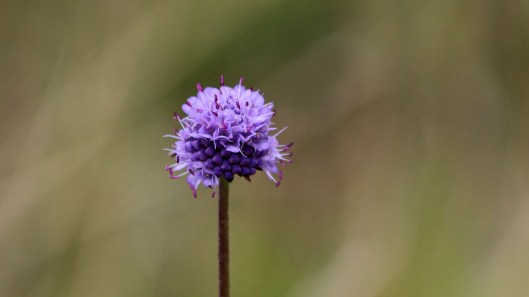
Devil’s-bit scabious (Succisa pratensis) has a beautiful flower that paints the wildflower meadows at Lavernock Nature Reserve in shades of purple lusciousness and provides some very welcome late summer nectar and pollen to a host of insects, particularly bees, flies and butterflies.

180831 devil's-bit scabious (3)
180831 devil's-bit scabious (5)
180831 devil's-bit scabious (2)
180831 devil's-bit scabious (4)
180831 devil's-bit scabious (6)

And that name? Well, the story goes that the devil was not pleased that the plant’s medicinal properties were healing the skin conditions of people suffering from bubonic plague and scabies so, in a fit of rage, he tried to kill off the plant by biting off the ends of the plant’s roots. Ever the party pooper!

180831 devil's-bit scabious (11)
180831 devil's-bit scabious (8)
180831 devil's-bit scabious (9)
180831 devil's-bit scabious (10)
180831 devil's-bit scabious (7)
Like Loading...

Wild word: cocoon

29 Wednesday Aug 2018

Posted by sconzani in insects, nature

≈ 5 Comments

Tags

#WildWords, 5-spot Burnet, 6-spot Burnet, British moths, Burnet moth cocoon, cocoon, Five-spot Burnet moth, moth cocoon, Six-spot Burnet moth, wild words

Cocoon: Noun; A silky case spun by the larvae of many insects for protection as pupae (Oxford Dictionary).
The cocoons in my photos are those of Burnet moths, both 5-spot (below left) and 6-spot (below right): you can’t tell the difference in the cocoons from the outside – I just know which moths were present in the locations where I took my photos.

180828 5-spot burnet moth
180828 6-spot burnet moth

After hatching from their eggs, the caterpillars/larvae of both moths feed on plants from the pea family; the 6-spot burnet is particularly partial to Common bird’s-foot trefoil, which is why I see a lot of these moths at Cosmeston.

180828 occupied 5-spot pupa
180828 occupied 6-spot pupa

When they’re ready to pupate, the caterpillars find themselves a suitable location, often high up on a sturdy grass stem (though I have seen them on other plants), and spin an oval-shaped cocoon. The cocoons pictured above are still occupied by caterpillars in the throes of metamorphosing into moths, a process which takes about two weeks.

180828 empty cocoon (2)
180828 empty cocoon (1)

These are the empty cocoons that remain once the adult moths have emerged (with the remains of the larvae’s pupae cases poking out the tops). The cocoons are quite sturdy: their yellowish-white papery structures often seem to last for a month or more after the adults have departed or even until the grasses themselves collapse with the coming of the wild winds and chilly days of autumn.

Like Loading...

Butterflies 2018

28 Tuesday Aug 2018

Posted by sconzani in insects, nature

≈ 4 Comments

Tags

British butterflies, butterflies, butterflies in Britain, UK butterflies

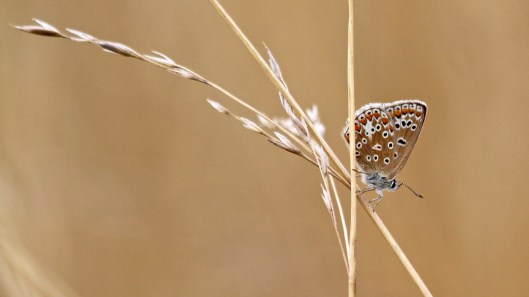
The sharp-eyed amongst you may have noticed that I recently added a new page to this blog (see the link in the top menu). As it says on the page, Butterflies 2018 is a chronological list of the first time I’ve spotted each British butterfly species during 2018. This isn’t like my Birding 2018 challenge, where I’m deliberately trying to see 200 species in a single year – 2018 just happens to have been a very good year for me for seeing more butterfly species than ever before (bear in mind that I’ve only been living in Britain three years, so I haven’t had a lifetime of butterfly watching, and there are plenty more species I’ve not yet seen). And I figured it would be a good idea to have a chronological list as a personal aide-memoire, so I know which butterflies to look out for in which months in future years.

180828 Common blue

Common it may be, but I still think the Common blue is one of Britain’s loveliest butterflies.

Like Loading...

The Chinooks of the hoverfly world

26 Sunday Aug 2018

Posted by sconzani in insects, nature

≈ 6 Comments

Tags

British hoverflies, Great pied hoverfly, Hornet mimic, hoverflies, hoverfly, Penarth Rail Trail, Volucella pellucens, Volucella species, Volucella zonaria

These are a couple of the Volucella species, the Chinooks of the hoverfly world and, if you live in the southern parts of Britain, they’ll be out there hovering along woodland paths and in local parks near you right now. Before you panic and get out your fly swat, these hoverflies may look a little menacing – and some of them even look a bit like Hornets – but, please rest assured, they are all completely harmless. And, if you take a little time for a closer look, you will soon see what incredibly handsome mini-beasties they are.

180826 Volucella zonaria (4) 

180826 Volucella zonaria (3)
180826 Volucella zonaria (2)
180826 Volucella zonaria (1)

With a wing length between 15 and 20mm, Volucella zonaria is the largest British hoverfly and is sometimes known as the Hornet mimic. (There is a very similar species called Volucella inanis but we don’t see them very often in south Wales.) Since arriving in Britain, on England’s south coast, in the 1930s, V. zonaria has made itself at home and has spread west and northwards. During July and August, I’ve seen several of these beauties at Lavernock Nature Reserve and along our local rail trail, a former railway line now a tree-lined foot- and cycling path.

180826 Volucella pellucens (1)

With its large size and black-and-white colouring, Volucella pellucens is a very distinctive hoverfly and easy to identify. You can see why it’s also known as the Great Pied hoverfly. When it’s not feasting on pollen and nectar, it can often be found defending its airspace by hovering around head height along paths and trails. If you stand still, it will sometimes approach to check you out but, once again, it will do you absolutely no harm and move out of your way when you carry on walking. 

180826 Volucella pellucens (2)
180826 Volucella pellucens (3)
180826 Volucella pellucens (4)
Like Loading...

Bumble- or humble-bee?

24 Friday Aug 2018

Posted by sconzani in flowers, insects, nature, wildflowers

≈ Leave a comment

Tags

bumblebee, bumblebee on flowers, Hemp agrimony, humblebee, knapweed, scabious

180824 bumblebee (1)

Bumble: verb; move or act in an awkward or confused manner (Oxford Dictionary).
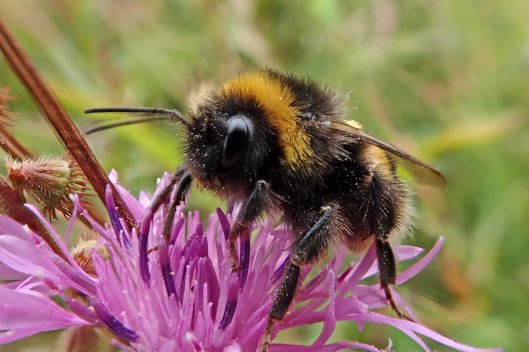
Personally, I think it’s a bit sad that the beautiful bumblebee is associated with confusion and awkwardness of movement, though I admit they can seem rather stupid when they fly in the open windows of my apartment and then bump repeatedly against the glass trying to get out again. Most other insects seem able to work out where the open window is.

OLYMPUS DIGITAL CAMERA

When it comes to finding nourishment though, they seem perfectly able to home directly in on the next delicious flower. And I’ve recently discovered that the bumblebee wasn’t always so named – it was originally the humblebee, not because it was considered modest or lowly but rather because of the humming sound it makes as it flies along.

180824 bumblebee (3)
180824 bumblebee (4)
180824 bumblebee (5)
180824 bumblebee (6)
180824 bumblebee (7)
180824 bumblebee (8)
Like Loading...

Holly blues, the second generation

22 Wednesday Aug 2018

Posted by sconzani in insects, nature

≈ 1 Comment

Tags

British butterflies, butterflies, butterfly, Celastrina argiolus, Holly blue, Holly blue butterfly

I blogged about the Holly blue butterfly (Celastrina argiolus) back in May but I’ve since read some really interesting info about this lovely little butterfly and have some new photos to share as well.

180822 Holly blue (2)

My information comes from the book I’m currently reading, which I highly recommend – it’s Wonderland: A year of Britain’s wildlife day by day by Brett Westwood and Stephen Moss. The entry from 13 August is about the Holly blue and answered a query I had about why I’ve recently been seeing so many Holly blues on Ivy plants rather than on Holly.

180822 Holly blue female

It turns out the Holly blue has two generations per year: as their name suggests, the females from the first generation lay their eggs on Holly plants and that’s what the first generation of caterpillars munch on. Then, once those caterpillars have pupated, they emerge as butterflies from around mid July, and the females from that second generation lay their eggs on Ivy, as that’s what the second generation caterpillars eat.

180822 Holly blue (1)

I’ve also been wondering why I seem to be seeing so many more Holly blues this year and Wonderland has the answer to that too:

These fluctuations [in population], over a cycle of five or six years or so, are caused by a small parasitic wasp called Listrodomus, which injects the caterpillars with a long sting-like ovipositor. The Listrodomus grub lives inside the caterpillar, but keeps it alive long enough to allow it to pupate, emerging later from the chrysalis. As wasp populations increase, they reduce the Holly blues. Fewer butterflies mean fewer opportunities for the wasps and so, in turn, wasp numbers fall too. This allows the butterflies to build up again, and that’s why over a span of several years our sightings of Holly blues go up and down.


180822 Holly blue (3)

Like Loading...

Descrying dragons

21 Tuesday Aug 2018

Posted by sconzani in insects, nature

≈ 3 Comments

Tags

Black-tailed skimmer, British dragonflies, Common Darter, Cosmeston Lakes Country Park, dragonflies, Emperor dragonfly, Lavernock Nature Reserve, Migrant hawker

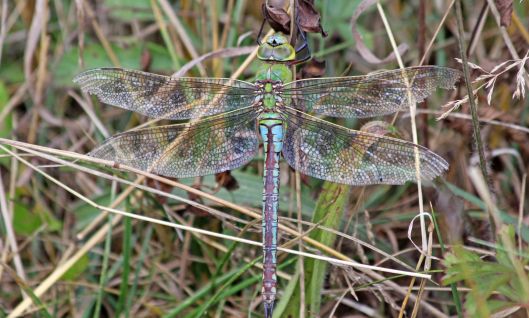
I’ve not seen a huge number of dragonflies this summer, possibly because of the heatwave, which has seen water levels shrink to record lows and the pond at Lavernock Nature Reserve dry up altogether. Luckily, not all dragonflies spend their adult lives in close proximity to water so I have enjoyed some close encounters along field edges and pathways. Here are a few of those recent dragons.

180821 migrant hawker (1)
180821 migrant hawker (2)

These two are both Migrant hawkers; one was near the pond at Lavernock before it dried up completely, the other was just hanging around on vegetation beside the south Wales coastal path, a good choice as there are always an abundance of flying insects along the path’s hedgerows.

180821 emperor

This Emperor was hawking low over the tall wildflowers and grasses in one of the paddocks at Cosmeston. I had to wait quite a while for it to settle, then creep up very slowly and silently to get this photo, but it was worth the wait.
180821 Common darter male
180821 Common darter female

180821 Common darters mating

Last year at this time Cosmeston Lakes Country Park seemed to be swarming with Common darters – they sat like mini sculptures on every gate and fencepost, and there were so many sitting warming themselves on every piece of stone along the pathways that you had to be careful not to step on them. This year I’ve seen very few so it was a delight first to see this male (the red) and female in one paddock and then to spot the mating pair in another field. Let’s hope they return in numbers next year.

180821 black-tailed skimmers

Those Common darters weren’t the only mating dragonflies I almost disturbed at Cosmeston this week, as my stomping carelessly along the path homeward caused these two Black-tailed skimmers to fly up and away. Luckily, they didn’t fly far and I was able to get my camera out and take a few photos before leaving them to carry on their sterling efforts.

Like Loading...

Common purple & gold

20 Monday Aug 2018

Posted by sconzani in insects, nature

≈ Leave a comment

Tags

British moths, Common purple & gold, Cosmeston, Cosmeston Lakes Country Park, moth, moths, Pyrausta purpuralis, UK moths

Every step I take across the west paddock at Cosmeston seems to send at least two tiny beige-looking insects flicking off in different directions in front of me. At first, I think they might be grasshoppers or crickets, springing quickly out of the way of my trampling feet but no – these creatures are not making straight leaps, they are fluttering and flying. They’re not easy to follow – as soon as they touch the ground they seem to disappear so I have to focus intently to follow each flight and then approach very slowly to discover what they are.

180820 Pyrausta purpuralis (1)

It turns out they’re not beige at all – they’re a quite striking combination of maroon and yellow, hence their common name, Common purple & gold. This is Pyrausta purpuralis, not to be confused with Pyrausta aurata, a very similar moth of the same family (see more here).

180820 Pyrausta purpuralis (4)
180820 Pyrausta purpuralis (5)

180820 Pyrausta purpuralis (2)

With a wingspan of just 20mm, this moth really is tiny but it’s relatively common throughout Britain, particularly on chalky downs and dry grasslands. The moths I’m seeing now in such abundance are the second brood of the year and fly, both during the day and at night, from July to August. I saw their parents during May and June, though they didn’t seem as plentiful. Perhaps this is a moth species that has enjoyed our hot dry weather this summer.

180820 Pyrausta purpuralis (3)

Like Loading...

On the umbel

17 Friday Aug 2018

Posted by sconzani in insects, nature, plants, wildflowers

≈ Leave a comment

Tags

#FloralFriday, British insects, British wildflowers, insects on umbellifers, umbellifer

180817 umbellifers

Be it ever so umbel, there’s no place …
better to enjoy a snack of nectar and pollen.

180817 on the umbel (1)
180817 on the umbel (2)
180817 on the umbel (3)
180817 on the umbel (4)
180817 on the umbel (5)
180817 on the umbel (6)
180817 on the umbel (7)
180817 on the umbel (8)
180817 on the umbel (9)
180817 on the umbel (10)
180817 on the umbel (11)
180817 on the umbel (12)
Like Loading...

Bugs are like buses

16 Thursday Aug 2018

Posted by sconzani in insects, nature

≈ Leave a comment

Tags

British bugs, Coreus marginatus, Cosmeston Lakes Country Park, Dock bug

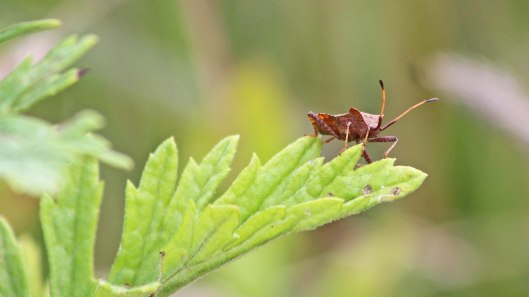
I hadn’t seen any Dock bugs (Coreus marginatus) for a couple of months and then suddenly, at Cosmeston the other day, I saw 11 on one plant!

180816 dock bugs (3)

Now that I’ve read up on them, I understand the sightings gap: it seems adults mate and lay their eggs in the springtime, the nymphs munch away on dock and their other favourite plants for a couple of months and, by August, they have developed into new adults. And here they are …

180816 dock bugs (5)
180816 dock bugs (4)
180816 dock bugs (2)
180816 dock bugs (1)
Like Loading...
← Older posts
Newer posts →

About me

sconzani

sconzani

I'm a writer and photographer; researcher and blogger; birder and nature lover; countryside rambler and city strider; volunteer and biodiversity recorder.

View Full Profile →

Follow earthstar on WordPress.com

Enter your email address to follow this blog and receive notifications of new posts by email.

Recent blog posts

  • Recent Reed buntings April 17, 2026
  • Tiny but feisty April 16, 2026
  • NFY: Large and Small whites April 15, 2026
  • A loveliness of ladybirds April 14, 2026
  • Hairy-footed flower bees April 13, 2026

From the archives

COPYRIGHT

Unless otherwise acknowledged, the text and photographs on this blog are my own and are subject to international copyright. Nothing may be downloaded or copied without my permission.

Fellow Earth Stars!

  • Unknown's avatar
  • Unknown's avatar
  • Unknown's avatar
  • Unknown's avatar
  • Unknown's avatar
  • Unknown's avatar
  • Unknown's avatar
  • Unknown's avatar
  • Unknown's avatar
  • Unknown's avatar
  • Unknown's avatar
  • Unknown's avatar
  • Unknown's avatar
  • Unknown's avatar
  • Unknown's avatar
  • Unknown's avatar
  • Unknown's avatar
  • Unknown's avatar
  • Unknown's avatar
  • Unknown's avatar
  • Unknown's avatar
  • Unknown's avatar
  • Unknown's avatar
  • Unknown's avatar
  • Unknown's avatar
  • Unknown's avatar
  • Unknown's avatar
  • Unknown's avatar
  • Unknown's avatar
  • Unknown's avatar
  • Unknown's avatar
  • Unknown's avatar
  • Unknown's avatar
  • Unknown's avatar
  • Unknown's avatar
  • Unknown's avatar
  • Unknown's avatar
  • Unknown's avatar
  • Unknown's avatar
  • Unknown's avatar
  • Unknown's avatar
  • Unknown's avatar
  • Unknown's avatar
  • Unknown's avatar
  • Unknown's avatar
  • Unknown's avatar
  • Unknown's avatar
  • Unknown's avatar
  • Unknown's avatar
  • Unknown's avatar

Blog at WordPress.com.

Privacy & Cookies: This site uses cookies. By continuing to use this website, you agree to their use.
To find out more, including how to control cookies, see here: Cookie Policy
  • Subscribe Subscribed
    • earthstar
    • Join 642 other subscribers
    • Already have a WordPress.com account? Log in now.
    • earthstar
    • Subscribe Subscribed
    • Sign up
    • Log in
    • Report this content
    • View site in Reader
    • Manage subscriptions
    • Collapse this bar
 

Loading Comments...
 

You must be logged in to post a comment.

    %d