• ABOUT
  • BIRDING 2018
  • Birding 2019
  • BLOG POSTS
  • Butterflies 2018
  • Resources

earthstar

~ a celebration of nature

earthstar

Category Archives: insects

Nettle groundbugs

07 Monday Aug 2023

Posted by sconzani in insects, plants

≈ 2 Comments

Tags

British bugs, bugs on nettle, Heterogaster urticae, insects on nettle, Nettle groundbug

Considering how much nettle I see, I’m amazed I’d never seen a Nettle groundbug (Heterogaster urticae) before last Thursday, when I saw heaps, at various stages of growth between egg and adult, all out sunbathing in little groups on nettle leaves. And there are only 114 records in the Welsh database of flora and fauna, which also surprised me.

230807 nettle groundbugs (1)

They’re actually very attractive little bugs, rather hairy, with quite diverse markings in their different instars. The British Bugs website reports that they overwinter as adults so, in theory, we should be able to see them all year round. The website also says that, when they mate, the male and female ‘may remain coupled together for several days’ – nothing like making sure they’ve succeeded, I guess.

230807 nettle groundbugs (2)

Sorry my pics aren’t the sharpest – the bugs were moving around a bit – but I wanted to show as many instars as possible.

Like Loading...

Carrot mining bee

05 Saturday Aug 2023

Posted by sconzani in insects, plants, wildflowers

≈ Leave a comment

Tags

Andrena nitidiuscula, bees on Wild carrot, British mining bees, Carrot mining bee, Cosmeston Lakes Country Park, Daucus carota, Lavernock Nature Reserve, Wild carrot

In August 2020, local entomologist Liam Olds made the amazing discovery of the first Carrot mining bees (Andrena nitidiuscula) for Wales at Lavernock Nature Reserve, and Liam later went on to find a population of the bees at nearby Cosmeston Lakes Country Park. Despite these parks both being relatively near where I live, it’s taken me three years to find my own Carrot mining bee, at Cosmeston on Thursday.

230805 Carrot mining bee (1)

As you might have guessed from the bee’s name, it can usually be found collecting pollen from the flowers of Wild carrot (Daucus carota). And therein lies one of the problem’s for this bee’s future, the preservation of the right habitat to ensure the bee’s conservation. Earlier this year, despite protests against what was happening, the Vale of Glamorgan Council, which operates Cosmeston, went ahead with planting trees across large areas of a wildflower meadow where the bee had previously been found by Liam Olds. Yes, the planet needs more trees, but those trees need to be planted in the right place. When they’re not, they risk destroying important local flora and fauna. Let’s hope the Carrot mining bee can survive the local council’s actions!

230805 Carrot mining bee (2)

Like Loading...

Moths matter

04 Friday Aug 2023

Posted by sconzani in insects

≈ Leave a comment

Tags

#MothsMatter, Autographa gamma, British moths, Burnet companion, Chiasmia clathrata, Euclidia glyphica, Hummingbird hawk-moth, Large Yellow Underwing, Latticed heath, Macroglossum stellatarum, moth, Noctua pronuba, Silver Y, Six-spot burnet, Zygaena filipendulae

Some recent mothy goodness …

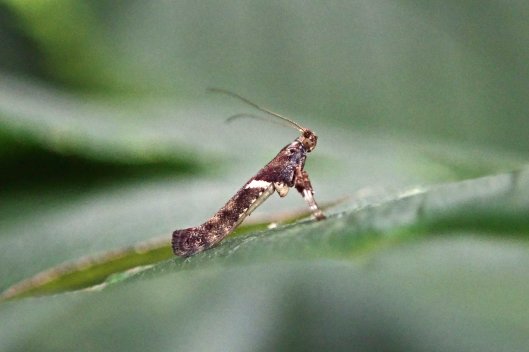
230804 1 Caloptilia semifascia

First, the micro moth Caloptilia semifascia, which I found perched on a leaf during a local meander and which, miraculously, stayed still for some photos.

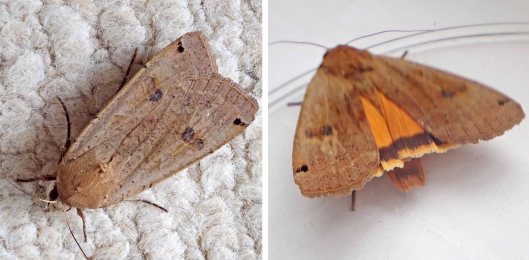
230804 2 large yellow underwing

I grabbed the rain parka I’d left drying on the back of a chair and this beauty flew up. Either I’d brought it home from the previous day’s walk or it had flown in an open window during the night. Whichever it was, this Large yellow underwing (Noctua pronuba) was a welcome visitor.

230804 3 6-spot burnet

I always enjoy watching the Five- and Six-spot burnets during the summer months. This is one of the latter (Zygaena filipendulae).

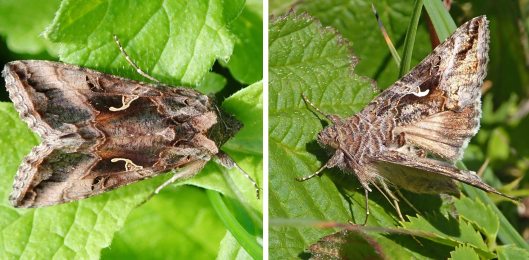
230804 4 silver y

Most of the Silver Ys (Autographa gamma) I see are constantly fluttering about in the long grass but these two were much more cooperative.

230804 5 burnet companion

Burnet companions (Euclidia glyphica) are also frequently camera shy but I got lucky with this beauty that was more intent on feeding than on the lurking photographer.

230804 6 humming-bird hawk-moth

Hummingbird hawk-moths (Macroglossum stellatarum) are most often seem hovering in front of flowers, their long tongues seeking out the tasty nectar within, but this one whizzed past during a recent walk then, luckily for me, settled on the path in front of me.

230804 7 latticed heath

This lovely is another summertime treat. Last but certainly not least, a Latticed heath (Chiasmia clathrata).

Like Loading...

Three little shieldbugs

01 Tuesday Aug 2023

Posted by sconzani in insects

≈ Leave a comment

Tags

British shieldbugs, Bronze shieldbug, Bronze shieldbug mid instar, Eurygaster testudinaria, Pentatoma rufipes, Red-legged shieldbug, shieldbug, Tortoise shieldbug, Tortoise shieldbug final instar, Troilus luridus

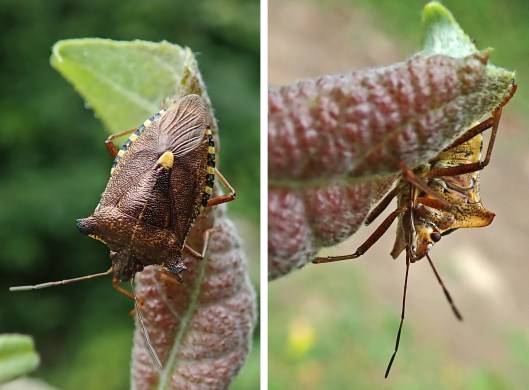
When the sun’s shining (which, admittedly, hasn’t been very often in the last couple of weeks), the patches of bramble and low scrub seem to be full of shieldbugs of various sizes and stages, basking in the welcome warmth. Two I’ve seen recently have been new to me:

230801 bronze mid instar

Although I’ve seen Bronze shieldbugs (Troilus luridus) before, I’ve not seen this particular variation, which is a mid instar, halfway between egg and adult.

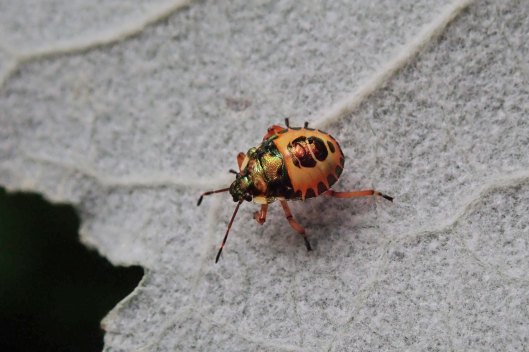
230801 Eurygaster testudinaria tortoise final instar

You might remember the lesson I learnt back in July 2022 (Blackberries, yum!) to always check a Blackberry before putting it in my mouth. Well, that held true again recently: I was about to pluck this luscious-looking berry when I noticed its occupant. This little critter is the final instar of the Tortoise shieldbug (Eurygaster testudinaria), a new shieldbug for me.

230801 red-legged shieldbug

And this last bug is not new at all but I liked the way it was posing, and the fact that I was able to get some shots of the lovely speckling on its belly. This is an adult Red-legged shieldbug (Pentatoma rufipes).

Like Loading...

Leafhopper: Typhlocyba quercus

31 Monday Jul 2023

Posted by sconzani in insects

≈ Leave a comment

Tags

British leafhoppers, Cicadellidae, leafhopper, leafhopper on Oak, Typhlocyba quercus

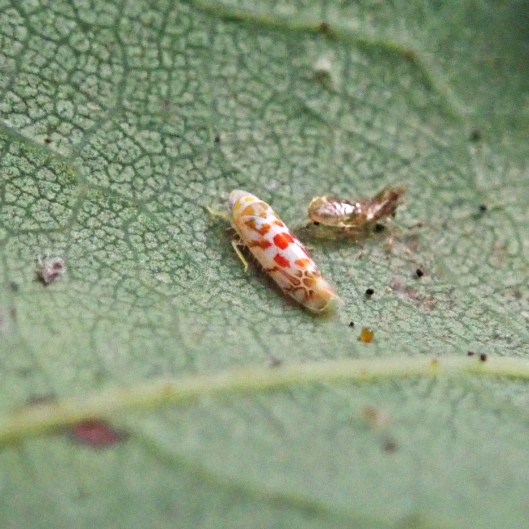
How adorable is this little leafhopper? And, even better than being adorable, its markings mean it is instantly recognisable as Typhlocyba quercus, the ‘quercus’ indicating that its preferred tree is the Oak, though it will also live on other trees.

230731 Typhlocyba quercus

Like Loading...

Hitching a ride

28 Friday Jul 2023

Posted by sconzani in insects

≈ Leave a comment

Tags

Common froghopper, Dark bush cricket, philaenus spumarius, Pholidoptera griseoaptera

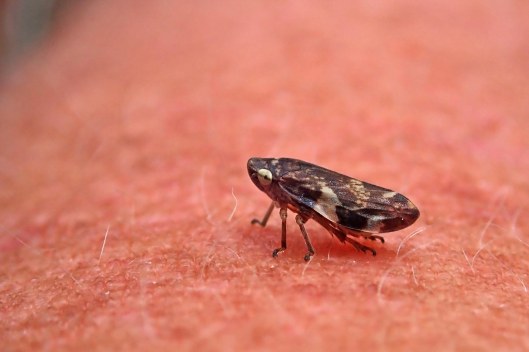
This was my Monday tweet: Critters were hitching rides today! First, Freddy froghopper tickled its way up my left arm.

230728 froghopper 1

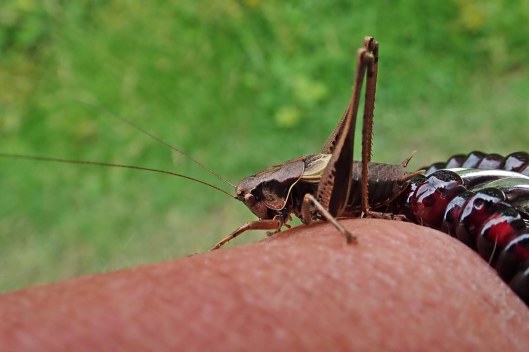
Then, Jiminy Dark bush cricket started crawling up my leg (bit freaky!) and jumped on to my arm when I pulled back my trouser leg.

230728 dark bush cricket

Next, Freddy’s cousin Fergus popped on to my right hand.

230728 froghopper 2

Like Loading...

Awkward oviposition

27 Thursday Jul 2023

Posted by sconzani in insects

≈ 2 Comments

Tags

British dragonflies, British odonata, dragonfly, Forest Farm Nature Reserve, Southern hawker, Southern hawker ovipositing

She was my first Southern hawker dragonfly of the year and she wasn’t making life easy for herself. There must have been a male Southern hawker in the vicinity as this lovely lady had already mated and was busy laying her eggs. However, she picked a very difficult location for ovipositing, underneath the wire netting that secures the wooden edge of the dragonfly pond at Forest Farm Nature Reserve. This did mean she was almost a captive subject for my lens, though the wire obscured her quite a bit, and the location wasn’t exactly easily accessible for her – I heard her wings rubbing against the wire as she entered. Her body was also squashed, making it a little difficult for her to manipulate herself in to the best position to place her eggs. I took a few photos and left her to her awkward endeavours.

230727 southern hawker

Like Loading...

Four-footed butterflies

25 Tuesday Jul 2023

Posted by sconzani in insects

≈ 2 Comments

Tags

British butterflies, brush-footed butterflies, butterfly, four-footed butterflies, Nymphalidae, Red Admiral, vestigial forelegs

I learn something new every single day and this is something so blindingly obvious that I can’t believe it hasn’t occurred to me before now. I was reading the entry about the Nymphalidae family of butterflies in my copy of Peter Eeles’s Life Cycles of British & Irish Butterflies when I came across this

the forelegs in both sexes are vestigial and useless for walking, and this family is sometimes referred to as the four-footed butterflies. The brush-like appearance of the forelegs has also resulted in the other common name for this family – the brush-footed butterflies.

Of course, I’d noticed that many species of butterfly sit on four legs (the skippers, for example, as well as most of the browns and the fritillaries, and the Red admiral pictured below) but I hadn’t realised that their forelegs are essentially useless for locomotion. And, indeed, according to an entry I’ve just read on Ray Cannon’s Nature Notes website, in some species of butterfly those forelegs have, during their long evolution, been adapted to function as sensory organs. Butterflies continue to amaze me!

230725 four-footed butterflies

Like Loading...

Fly: Nowickia ferox

24 Monday Jul 2023

Posted by sconzani in insects

≈ Leave a comment

Tags

Apamea monoglypha, British flies, Dark arches, endoparasitoid fly, fly parasite of moth, Nowickia ferox

I found a new fly! Okay, you may not be as excited about that as I am, but I’m always excited when I find something new, and it’s a bonus when I’m able to identify it quite easily because of its distinctive markings. So, meet Nowickia ferox, a bristly brute, with a less-than-appealing endoparasitoid life cycle – its larvae grow inside and eat the larvae of the Dark Arches moth (Apamea monoglypha), emerging only when ready to pupate.

230724 Nowickia ferox

Like Loading...

A White-letter hairstreak

22 Saturday Jul 2023

Posted by sconzani in insects, trees

≈ Leave a comment

Tags

British butterflies, butterfly, butterfly in Wych elm, White-letter hairstreak, Wych elm

Last Saturday’s weather was rather different to today’s constant rain – there was rain, but interspersed with warmer, sunny spells, and I managed to coincide my visit to local Dingle Park with one of those. This was my third time standing staring at the park’s Wych elms, and it was definitely a case of third time lucky.

230721 white-letter hairstreak (1)

Previously, the White-letter hairstreaks had stayed high in the tree but, this time, one little beauty came down lower, wandering slowly across the leaves, all the while with its tongue out, licking up the tasty honey dew.

230721 white-letter hairstreak (2)

Initially, it was quite distant but my patience paid off as it flitted from one cluster of leaves to another until it was really quite close. White-letter magic!

230721 white-letter hairstreak (3)

Like Loading...
← Older posts
Newer posts →

About me

sconzani

sconzani

I'm a writer and photographer; researcher and blogger; birder and nature lover; countryside rambler and city strider; volunteer and biodiversity recorder.

View Full Profile →

Follow earthstar on WordPress.com

Enter your email address to follow this blog and receive notifications of new posts by email.

Recent blog posts

  • Gorse and its weevil April 5, 2026
  • Chiffchaffs chiffchaffing April 4, 2026
  • Bearded tit!!! April 3, 2026
  • A Portland Bill Kestrel April 2, 2026
  • A proliferation of Peacocks April 1, 2026

From the archives

COPYRIGHT

Unless otherwise acknowledged, the text and photographs on this blog are my own and are subject to international copyright. Nothing may be downloaded or copied without my permission.

Fellow Earth Stars!

  • Unknown's avatar
  • Unknown's avatar
  • Unknown's avatar
  • Unknown's avatar
  • Unknown's avatar
  • Unknown's avatar
  • Unknown's avatar
  • Unknown's avatar
  • Unknown's avatar
  • Unknown's avatar
  • Unknown's avatar
  • Unknown's avatar
  • Unknown's avatar
  • Unknown's avatar
  • Unknown's avatar
  • Unknown's avatar
  • Unknown's avatar
  • Unknown's avatar
  • Unknown's avatar
  • Unknown's avatar
  • Unknown's avatar
  • Unknown's avatar
  • Unknown's avatar
  • Unknown's avatar
  • Unknown's avatar
  • Unknown's avatar
  • Unknown's avatar
  • Unknown's avatar
  • Unknown's avatar
  • Unknown's avatar
  • Unknown's avatar
  • Unknown's avatar
  • Unknown's avatar
  • Unknown's avatar
  • Unknown's avatar
  • Unknown's avatar
  • Unknown's avatar
  • Unknown's avatar
  • Unknown's avatar
  • Unknown's avatar
  • Unknown's avatar
  • Unknown's avatar
  • Unknown's avatar
  • Unknown's avatar
  • Unknown's avatar
  • Unknown's avatar
  • Unknown's avatar
  • Unknown's avatar
  • Unknown's avatar
  • Unknown's avatar

Blog at WordPress.com.

Privacy & Cookies: This site uses cookies. By continuing to use this website, you agree to their use.
To find out more, including how to control cookies, see here: Cookie Policy
  • Subscribe Subscribed
    • earthstar
    • Join 642 other subscribers
    • Already have a WordPress.com account? Log in now.
    • earthstar
    • Subscribe Subscribed
    • Sign up
    • Log in
    • Report this content
    • View site in Reader
    • Manage subscriptions
    • Collapse this bar
 

Loading Comments...
 

You must be logged in to post a comment.

    %d