• ABOUT
  • BIRDING 2018
  • Birding 2019
  • BLOG POSTS
  • Butterflies 2018
  • Resources

earthstar

~ a celebration of nature

earthstar

Category Archives: insects

240/366 Helophilus trivittatus

27 Thursday Aug 2020

Posted by sconzani in insects, nature

≈ 1 Comment

Tags

British hoverflies, Helophilus trivittatus, hoverfly

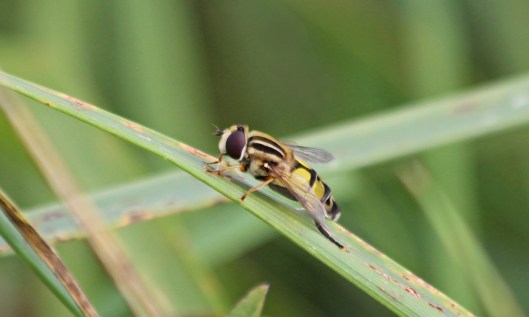
Somehow this splendid hoverfly had passed me by, probably many times, without my noticing its presence in my landscape. It wasn’t until one of my Twitter pals (thank you, Tate) posted a photo of his recent sighting at Cosmeston Lakes that I thought ‘Hang on a minute. Why haven’t I seen that?’, and duly set out to find one.

200827 helophilus trivittatus (1)

And, like buses, once one comes along, a whole fleet is soon whizzing past.
200827 helophilus trivittatus (2)

One of the possible reasons I hadn’t noticed it before is because it’s a migratory species so perhaps there haven’t been as many around in previous years.
200827 helophilus trivittatus (3)

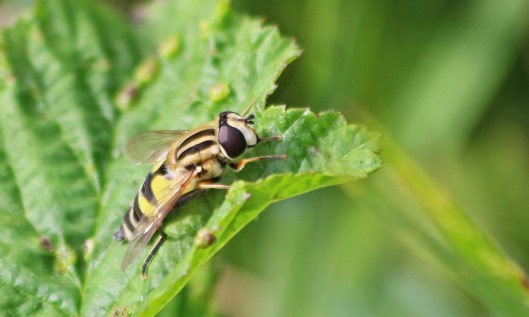
Also, Helophilus trivittatus looks a lot like its close relative Helophilus pendulus, but H. trivittatus is actually much more lemon-yellow in colour, and it’s a little longer in the body (which is noticeable once you get your eye in), and it doesn’t have the black stripe down the centre of its face that the other Helophilus species have.
200827 helophilus trivittatus (4)

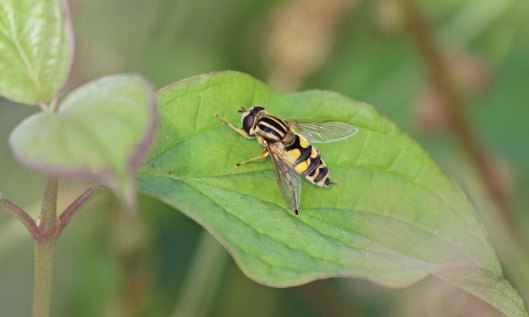
This handsome hoverfly tends to be found in coastal areas or, as it prefers a damp habitat, along the routes of Britain’s main river systems in the southern half of Britain.
Like Loading...

238/366 Midge galls

25 Tuesday Aug 2020

Posted by sconzani in autumn, insects, nature, plants, wildflowers

≈ 2 Comments

Tags

British galls, British insects, British wildflowers, Cosmeston Lakes Country Park, galls on wild carrot, Kiefferia pericarpiicola, midge gall, Wild carrot

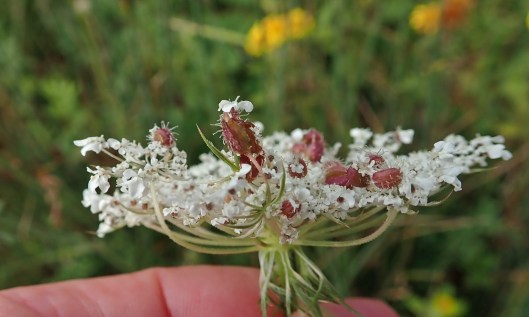
I was looking around at the various wildflowers yesterday at Cosmeston, seeing what insects might be about, when I noticed these odd growths on some of the Wild carrot flower heads. I split one open with my finger nail and a miniscule orange blob fell out; turns out that was the larva of a midge with the long-winded name of Kiefferia pericarpiicola.

200825 Kiefferia pericarpiicola (1)

The galls start off green (below left), before turning pinkish and eventually brown. According to the Nature Spot website, these galls can be seen from late summer through to autumn, after which the larvae will leave the gall and drop down to the soil to pupate. The midge only occurs in southern parts of Britain at the moment – and I only found two previous records in the Welsh biodiversity database – but perhaps that will change as our climate continues to warm and the midge flies further afield. It’s also possible, of course, that this insect is under-recorded – it seems the midge itself is almost never seen, only its gall creations.

OLYMPUS DIGITAL CAMERA
Like Loading...

236/366 On the fleabane

23 Sunday Aug 2020

Posted by sconzani in insects, nature, wildflowers

≈ 2 Comments

Tags

British butterflies, British insects, British wildflowers, Common fleabane, fleabane, insects on fleabane, Pulicaria dysenterica

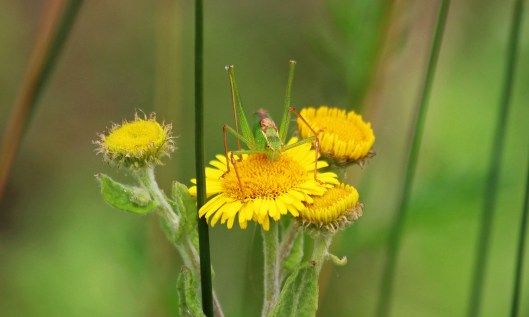
The local fields are ablaze with Common fleabane (Pulicaria dysenterica), which the Plantlife website says has a
‘curious scent, with hints of carbolic soap and chrysanthemum, [which] is an insect repellent. In the past it was kept in houses specifically for the purpose of driving away fleas. Bunches were dried and burned as a fumigant or hung in rooms.’
Well, it may be the bane of fleas and it may act as an insect repellent when it’s been dried but, from what I can see, when it’s alive and fresh, most insects love it!

200823 speckled bush-cricket

As well as that Speckled bush-cricket, I’ve found 9 species of butterfly and 1 moth nectaring on Fleabane flowers.

200823 b brimstone
200823 b brown argus
200823 b common blue
200823 b gatekeeper
200823 b painted lady
200823 b meadow brown
200823 b pyrausta purpuralis
200823 b small copper
200823 b small tortoiseshell
200823 b small white

And then there are the hoverflies and assorted other flies, bees and bumbles. It’s more like a magnet than a repellent.

200823 picture-winged fly
200823 honey bee
200823 Chrysotoxum bicinctum
200823 fly sp
200823 buff-tailed bumble
200823 syrphus sp
200823 helophilus pendulus
200823 Sphaerophoria sp
200823 eristalis pertinax
200823 eristalis horticola
200823 nomada sp
Like Loading...

235/366 Two Hawkers

22 Saturday Aug 2020

Posted by sconzani in insects, nature

≈ Leave a comment

Tags

British dragonflies, dragonfly, hawkers, Migrant hawker, Southern hawker

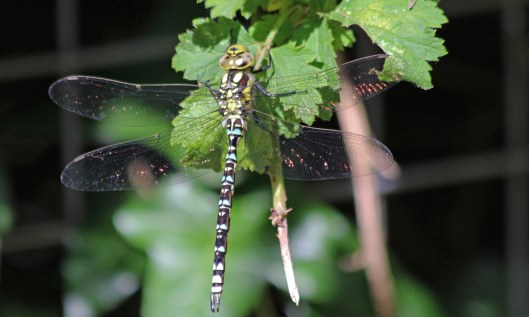
Though Common darters are now, well, common around my local haunts, I’ve seen very few of the larger dragonflies this year, perhaps because last year’s extremely dry summer caused many local ponds to dry up completely. These are two recent finds …

200822 southern hawker

This Southern hawker (Aeshna cyanea) was patrolling a section of a local bridle way/cycle path/walking track called Mile Road and, though I walk this lane quite often, I only saw the dragonfly once. Perhaps it decided the amount of horse/cycle/people traffic along the lane wasn’t conducive to good insect hunting.

200822 migrant hawker

I watched this Migrant hawker (Aeshna mixta) for several minutes on Thursday before it finally settled on a nearby tree (I often feel like my head is waving around like I’m a spectator at some kind of crazy tennis match when I’m watching dragonflies). The perch was a little high up for crisp photos but I was pleased to see this, my first Migrant hawker of the year.

Like Loading...

234/366 Tiger hunting

21 Friday Aug 2020

Posted by sconzani in insects, nature

≈ 2 Comments

Tags

British moths, Euplagia quadripunctaria, Jersey tiger, Lavernock Nature Reserve, moth, tiger moths

As many local events in Nature’s calendar have been tracking a couple of weeks earlier than usual this year, I first started this year’s tiger hunting ten days ago but it took three visits to Lavernock Nature Reserve and much staring at the flowers of Hemp-agrimony before I finally found a tiger.

200821 jersey tiger (1)

I am not, of course, talking about the big cats – I am vehemently opposed to all hunting! My hunt was for the gorgeous moth that is the Jersey tiger (Euplagia quadripunctaria).

200821 jersey tiger (2)

Having spread northwards in southern England, from Devon in to Somerset, these moths tackled the watery expanse of the Bristol Channel in stages, recorded on the island of Flat Holm in 2008 but not making the final flight across to the south Wales coast until 2012.

200821 jersey tiger (3)

Though they have avoided big city Cardiff – the single Cardiff record thus far was in 2017, the Jersey tiger now appears to be well established along a section of the Vale of Glamorgan coastline, from Penarth to Barry, and presumably it will spread further as climate and environmental conditions allow.

200821 jersey tiger (4)

Last Monday, 17 August, I spotted these two, feeding quite close together, at Lavernock (the first two photos here are one moth; the other three show the second tiger). Though they have been recorded on various flowers, I’ve only ever seen them on Hemp-agrimony, which is one of the food plants used by their larvae. I live in hope of finding one of their funky-looking caterpillars but I was over the moon to see my first tigers of the year.

200821 jersey tiger (5)

Like Loading...

232/366 Third time lucky

19 Wednesday Aug 2020

Posted by sconzani in insects, nature

≈ 7 Comments

Tags

British butterflies, butterfly, Clouded yellow, migrant butterfly

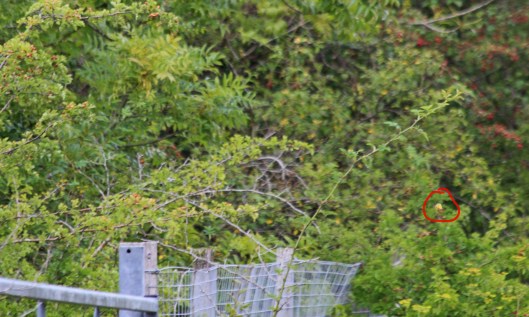
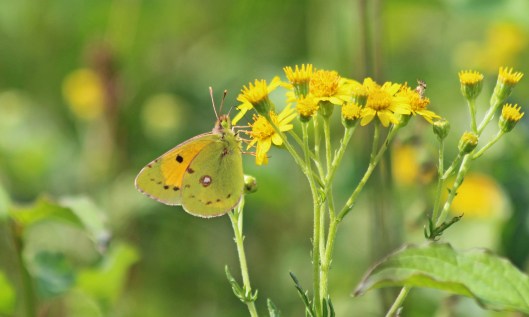
I had hoped the recent combination of southerly winds and heat wave would bring a wave of migrants to our shores and it did. The most exciting for me was the Clouded yellow butterfly. I saw my first on 10 August but, as is often the case with these beauties, their rapid flight can make them difficult to photograph, and this one flew over a fence into a shrubby area, disappearing immediately. My next Clouded yellow sighting came on 16 August, in a different location but with almost the same result – over the fence and gone! I managed to grab a single ‘record’ shot, below.

200819 clouded yellow (1)

Then, last Monday 17 August, I got lucky. I did have to follow this Clouded yellow around a sizeable field, watching intently, not following too closely so as not to spook it, waiting for it to settle but, finally, it paused briefly to feed and I got my photograph. They are such lovely butterflies, so different from anything else in Britain – I just wished they lived among us.

200819 clouded yellow (2)

Like Loading...

228/366 Mothing, accidentally

15 Saturday Aug 2020

Posted by sconzani in insects, nature

≈ Leave a comment

Tags

Agriphila tristella, Autographa gamma, British moths, Common grass-veneer, Common purple & gold, moths, Pyrausta purpuralis, Scotopteryx chenopodiata, Shaded broad-bar, Silver Y

It seems surprising to me that a rainy day walk can turn up moth sightings. I’m not talking about heavy rain – I probably wouldn’t be out in that – just a very slight drizzle, which in this week’s heat was actually quite refreshing. Only a few hardy Meadow brown butterflies flitted up as I passed by but the moths were more frequent than I expected.

200815 silver y

Silver Y (Autographa gamma)
Late summer through to mid autumn is probably the best time to see these distinctive immigrants, though some hardy souls do manage to breed in Britain. I imagine this one wafting in from the Continent on last week’s hot southerly winds.

200815 pyrausta purpuralis

Common purple-and-gold (Pyrausta purpuralis)
I’ve seen quite a few of these tiny moths during my daily meanders, presumably because they have two broods each year and the second brood emerges right about now, July-August.

200815 Shaded broad-bar

Shaded broad-bar (Scotopteryx chenopodiata)
Two of these beauties have popped up for me recently, one at Grangemoor Park, the other at Cosmeston, both quite light in colour, though a quick look at the images on the Butterfly Conservation website will show how variable they can be.

200815 Agriphila tristella

Common grass-veneer (Agriphila tristella)
I tend to avoid photographing the many grass moths that, like crickets and grasshoppers, flit up as my legs disturb them when I’m walking through longish grass or wildflowers, because they can be difficult to identify. Luckily, my local Twitter pal George, a senior moth ecologist at Butterfly Conservation, was able to put a name to this one very quickly. It’s a common grassland species that flies from June through to September.

Like Loading...

225/366 Battered & bird-pecked

12 Wednesday Aug 2020

Posted by sconzani in insects, nature

≈ 2 Comments

Tags

battered butterflies, bird-pecked butterflies, British butterflies, Brown argus, Comma, Essex skipper, Gatekeeper, Painted Lady, Peacock, Ringlet, Small copper

Though second-brood butterflies are still looking pristine, many of the others are now well past their best, as life is tough for such fragile creatures. Some butterflies are so battered that I’m amazed they’re able to fly at all, yet this Gatekeeper and Ringlet were still moving from plant to plant.

200812 battered gatekeeper
200812 battered ringlet

Birds looking for an easy snack often attack butterflies and it’s easy to see the tell-tale signs of bird pecks on butterflies’ wings, like those on these: a Ringlet, Comma, Small copper and Peacock, and another Gatekeeper.

200812 birdpecked ringlet

200812 birdpecked 1 comma
200812 birdpecked 2 small copper
200812 birdpecked 3 peacock

200812 birdpecked gatekeeper

Is it the blazing sun that has caused this Essex skipper’s orange to fade so dramatically or has it lost most of its wing scales?

200812 faded essex skipper

I’m 99% sure this is the same Brown argus, seen first on 1 August and again on 10 August. It already had some bird pecks when I first saw it but, nine days later, it was looking rather faded and more than a little ragged around the edges.

200812 faded brown argus 0108
200812 faded brown argus 1008

This Painted lady is looking battered, bird-pecked, faded and jaded, perhaps the affects of a long migration journey, or simply a tough life well survived.

200812 jaded painted lady

Like Loading...

224/366 Burdock beasties

11 Tuesday Aug 2020

Posted by sconzani in insects, nature, plants, wildflowers

≈ 1 Comment

Tags

Arctium minus, Banded burdock fly, British insects, Common Green Shieldbug, Lesser burdock, Palomena prasina, Terellia tussilaginis

Lesser burdock (Arctium minus) seems to be having a good year as I’ve been finding lots of vigorous, flowering plants during my local walks, and they’re home to some interesting mini-beasties. One I always look for is the Banded burdock fly (Terellia tussilaginis), and it also seems to be thriving locally.

200811 lesser burdock (4)200811 lesser burdock (5)200811 lesser burdock (6)

And, on one particular clump of burdock, I found a bounty of Common green shieldbugs (Palomena prasina), as I’ve done before (see my previous post Keeping it in the family, from September 2017). Once again, these were a mix of juvenile stages, 3rd and 4th instars, I think.

200811 lesser burdock (1)
200811 lesser burdock (2)
200811 lesser burdock (3)

Of course, there are lots of other mini-beasties that also find Burdock flower nectar delicious – these two bees are just a couple of examples. What beasties have you seen on Burdock?

200811 lesser burdock (7)
200811 lesser burdock (8)
Like Loading...

220/366 Second brood

07 Friday Aug 2020

Posted by sconzani in insects, nature

≈ 1 Comment

Tags

British butterflies, butterfly, Dingy Skipper, second brood butterflies, second brood Dingy skipper

In 2019, when I began keeping records of all my sightings and focused seriously on searching for and recording butterflies, I saw my first local Dingy skipper on 30 April and my last on 10 June. This year, I spotted my first on 6 May and what I thought was the last on 26 May, a relatively short season.

200807 dingy skipper 24july

Then, remarkably, on 24 July, I saw a pristine, obviously newly emerged Dingy skipper, and I’ve seen two more this week, one on 4 August and another the following day. These are second brood butterflies, the product of the breeding of the butterflies seen in May.

200807 dingy skipper 4aug

In his brilliant book Life Cycles of British & Irish Butterflies, Peter Eeles write that ‘Good summers may … result in a partial second brood in southern England that emerges in late July and August (a second brood is the norm in Southern Europe), and this may become a more frequent and widespread phenomenon in Britain and Ireland with a changing climate’. It seems, here in south Wales, that phenomenon is already happening.

200807 dingy skipper 5aug

Like Loading...
← Older posts
Newer posts →

About me

sconzani

sconzani

I'm a writer and photographer; researcher and blogger; birder and nature lover; countryside rambler and city strider; volunteer and biodiversity recorder.

View Full Profile →

Follow earthstar on WordPress.com

Enter your email address to follow this blog and receive notifications of new posts by email.

Recent blog posts

  • In flower now April 12, 2026
  • A surprise Slow-worm April 11, 2026
  • My first Holly blue April 10, 2026
  • Alder flies April 9, 2026
  • Lily beetle April 8, 2026

From the archives

COPYRIGHT

Unless otherwise acknowledged, the text and photographs on this blog are my own and are subject to international copyright. Nothing may be downloaded or copied without my permission.

Fellow Earth Stars!

  • Unknown's avatar
  • Unknown's avatar
  • Unknown's avatar
  • Unknown's avatar
  • Unknown's avatar
  • Unknown's avatar
  • Unknown's avatar
  • Unknown's avatar
  • Unknown's avatar
  • Unknown's avatar
  • Unknown's avatar
  • Unknown's avatar
  • Unknown's avatar
  • Unknown's avatar
  • Unknown's avatar
  • Unknown's avatar
  • Unknown's avatar
  • Unknown's avatar
  • Unknown's avatar
  • Unknown's avatar
  • Unknown's avatar
  • Unknown's avatar
  • Unknown's avatar
  • Unknown's avatar
  • Unknown's avatar
  • Unknown's avatar
  • Unknown's avatar
  • Unknown's avatar
  • Unknown's avatar
  • Unknown's avatar
  • Unknown's avatar
  • Unknown's avatar
  • Unknown's avatar
  • Unknown's avatar
  • Unknown's avatar
  • Unknown's avatar
  • Unknown's avatar
  • Unknown's avatar
  • Unknown's avatar
  • Unknown's avatar
  • Unknown's avatar
  • Unknown's avatar
  • Unknown's avatar
  • Unknown's avatar
  • Unknown's avatar
  • Unknown's avatar
  • Unknown's avatar
  • Unknown's avatar
  • Unknown's avatar
  • Unknown's avatar

Blog at WordPress.com.

Privacy & Cookies: This site uses cookies. By continuing to use this website, you agree to their use.
To find out more, including how to control cookies, see here: Cookie Policy
  • Subscribe Subscribed
    • earthstar
    • Join 642 other subscribers
    • Already have a WordPress.com account? Log in now.
    • earthstar
    • Subscribe Subscribed
    • Sign up
    • Log in
    • Report this content
    • View site in Reader
    • Manage subscriptions
    • Collapse this bar
 

Loading Comments...
 

You must be logged in to post a comment.

    %d