• ABOUT
  • BIRDING 2018
  • Birding 2019
  • BLOG POSTS
  • Butterflies 2018
  • Resources

earthstar

~ a celebration of nature

earthstar

Category Archives: insects

217/366 Lep larvae

04 Tuesday Aug 2020

Posted by sconzani in insects, nature

≈ 2 Comments

Tags

British butterflies, British moths, butterfly larvae, Cinnabar moth, Lepidoptera, moth larvae, Small tortoiseshell

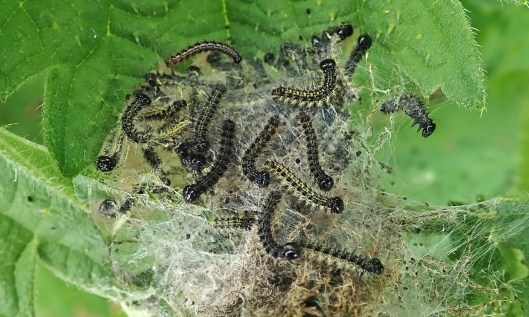
Last week we had a closer look at a couple of butterfly eggs; today we have some Lepidoptera larvae. First up, the caterpillars of the beautiful Small tortoiseshell butterfly, which has two generations of eggs and larvae each year – these will be second generation. The eggs are laid in batches and, when they hatch, the caterpillars stay together to create a communal web where they shelter when they’re not out basking in the sun or munching on nettles. The caterpillars go through five stages (instars) before pupating – these look to be 3rd instars.
200804 small tortoiseshell (1)

200804 small tortoiseshell (2)
200804 small tortoiseshell (3)

In total contrast to the Small tortoiseshell larvae, which are subtle and subdued in their colour and patterns, the larvae of the Cinnabar moth are vibrant, even flamboyant. Their bright orange and black stripes are designed to be seen, warning predators not to eat them as they are poisonous.

200804 cinnabar moth (1)200804 cinnabar moth (2)

Like Loading...

214/366 Butterfly eggs

01 Saturday Aug 2020

Posted by sconzani in insects, nature, plants

≈ 3 Comments

Tags

British butterflies, butterfly, butterfly egg, Common blue butterfly, Common blue butterfly egg, Painted Lady, Painted lady egg, thistle

This Painted lady is only the fourth individual I’ve seen this year but she was by far the best, not because of her appearance, which is a little ragged around the edges, but because she was laying eggs … and I’d never seen a Painted lady egg before.

200801 painted lady

At just 0.65mm high, the egg is tiny and, in my reference book, it’s described as green but, to my eye, this one is more of a pale turquoise – the plant stem is green. And the plant is a thistle – Creeping thistle, I think, though it was a young plant with no flowers, which makes it harder for me to identify but probably more nourishing for the teeny tiny caterpillar to munch on when it emerges. Now if I can only find this exact plant again in approximately a week’s time …
200801 painted lady egg (1)
200801 painted lady egg (2)

And following hot on the heels of finding that Painted lady egg, today I spotted a female Common blue butterfly laying her eggs in a sheltered clearing. You can perhaps see in the photo how she is angling her body to deposit an egg underneath the foliage.

200801 Common blue egg laying

So, once again, I was able to find the newly laid egg and take some photos. According to my book, these eggs are usually 0.5mm in diameter and just 0.25mm high, so really tiny. I have no chance of finding this egg again but I’m really glad I had the chance to see it.

200801 common blue egg (1)
200801 common blue egg (2)
Like Loading...

212/366 A tip top butterfly

30 Thursday Jul 2020

Posted by sconzani in insects, nature

≈ 2 Comments

Tags

Aberbargoed coal tip, British butterflies, butterflying, coal spoil biodiversity, Grayling

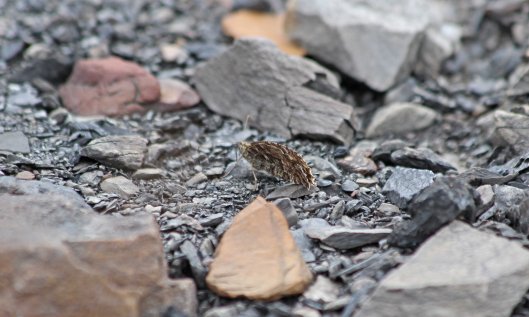
I had big plans to see more of Britain’s butterfly species this year but, in the immortal words of Robbie Burns, plans and schemes ‘gang aft agley’. The Covid 19 lockdown put a stop to all the butterflying plans I was hatching and I’ve missed seeing an awful lot of species this year. But, yesterday, I did manage one more species for 2020, that master of camouflage, the Grayling.

200730 grayling (1)

I have a friend who lives not far from Aberbargoed, with its Grasslands National Nature Reserve and the neighbouring coal spoil tip, so I was able to combine a delightful socially distanced walk with some butterflying. It was a little late in the month – last year I visited the tip in mid July – but we got lucky, with wonderful close sightings of just one individual.

200730 grayling (2)

In his Life Cycles of British & Irish Butterflies, Peter Eeles notes that the Grayling was once known as the Rock Underwing, a testament to its ability to blend in perfectly with the surrounding earth and pebbles when it lowers its forewings. Fortunately, when the Grayling is feeding, it raises its forewings and we were able to see more clearly its two eye spots.

200730 grayling (3)

Like Loading...

211/366 Rhubarb and custard

29 Wednesday Jul 2020

Posted by sconzani in insects, nature

≈ Leave a comment

Tags

British dragonflies, Common Darter, dragonfly, Sympetrum striolatum

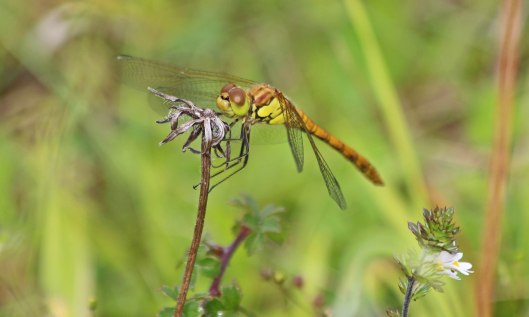
From Brett Westwood and Stephen Moss’s Wonderland: A Year of Britain’s Wildlife Day by Day:
‘Common and widespread though it may be, this small, neat dragonfly is always worth a second look. The males are brick red and the females yellow, so I use the aide-memoire “rhubarb and custard” to remember this.’

200729 common darter (1)

Which dragonfly is being described? I’m sure many of you worked out it was the Common darter, which is flying now in my local parks and reserves, though in quite small numbers so far.

200729 common darter (2)

Like Loading...

205/366 Sightings at Slade Wood

23 Thursday Jul 2020

Posted by sconzani in birds, insects, nature

≈ 1 Comment

Tags

British birds, British butterflies, Brown argus, Gatekeeper, juvenile Spotted flycatcher, mating Gatekeepers, Minnetts Field, Peacock butterfly, Siskin, Slade Wood, Spotted flycatcher

On Wednesday I ventured on to public transport for the first time in four months – suitably masked, of course – for a visit to Slade Wood, near Rogiet. This was a site where I’d seen Silver-washed fritillaries and White admiral butterflies last summer so I was hoping for more of those but, unfortunately, huge areas of the woodland have been felled over the winter months, which has destroyed a lot of the butterflies’ habitat.

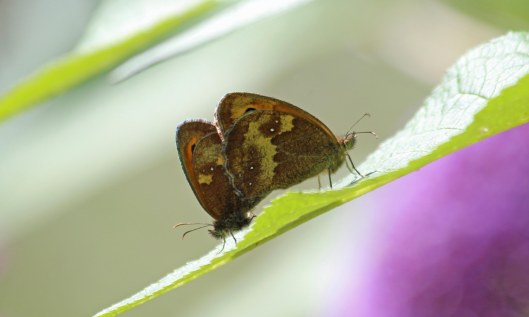
200723 1 peacock200723 2 gatekeepers

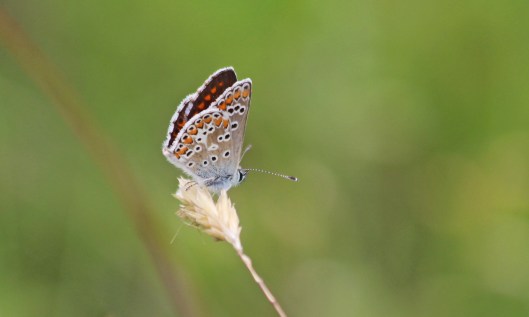
I did still see a lot of butterflies on the Buddleja bushes – in fact, probably more Peacocks than I’ve seen in one day before, and I got some pics of a pair of Gatekeepers mating – but only spotted one Silver-washed fritillary (and didn’t manage a photo) and no White admirals. There was also a butterfly consolation prize in the form of a Brown argus, a butterfly that’s not common locally, which was in Minnett’s Field, a nearby meadow managed by Gwent Wildlife Trust.

200723 3 brown argus

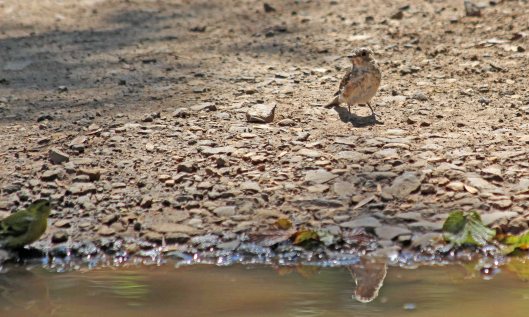
Though the butterflies were a little disappointing, the birds were a huge bonus as I managed to find a family of Spotted flycatchers, with two adults and a couple of juveniles (below left), which I’d not seen before.

200723 4 spotted flycatcher
200723 5 spotted flycatcher

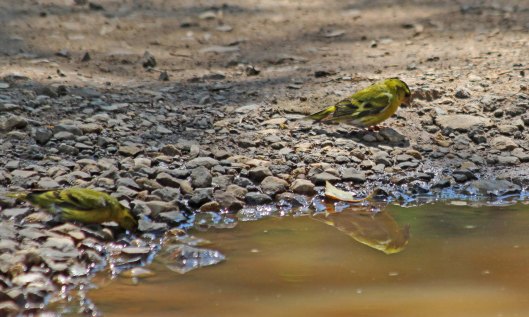
And the flycatchers were joined at their watering hole, a couple of muddy puddles, by two beautiful bright Siskin.

200723 6 siskin and spot fly200723 7 siskin

I may not have seen what I was expecting and I was saddened to see how many trees had been felled but I still had a wonderful day out. The sense of freedom was exhilarating, and Nature certainly didn’t disappoint!

Like Loading...

202/366 More misc minis

20 Monday Jul 2020

Posted by sconzani in insects, nature

≈ 4 Comments

Tags

bonking neetles, British butterflies, British crickets, British grasshoppers, Common red soldier beetle, Green-veined white, Long winged cone-head, Meadow grasshopper, Nettle weevil, Small copper, weevil

Some snippets from the insect world around me:

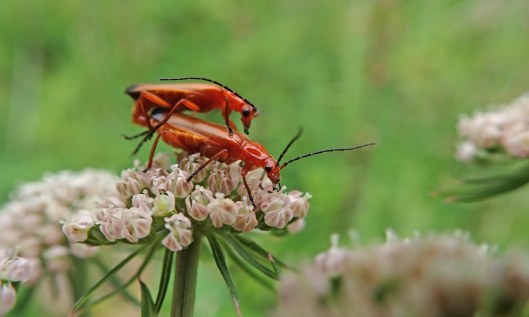
200720 common red soldier beetles

A sure sign that it’s now high summer, Common red soldier beetles (Rhagonycha fulva) can be seen everywhere, especially on the flowers of umbellifers, demonstrating why they are often called bonking beetles.

200720 green-veined white (1)
200720 green-veined white (2)

Also caught copulating, these Green-veined white butterflies (Pieris napi) were being annoyed by a third of their kind, trying to get involved in the action.

200720 small copper

On the subject of butterflies, the second brood of Small coppers (Lycaena phlaeas) is now on the wing. This stunning specimen was only the second Small copper I’d seen this year, so was a very welcome sighting.

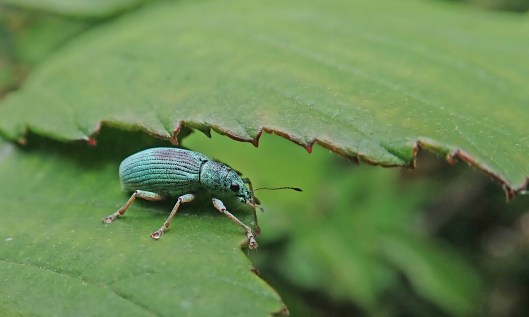
200720 nettle weevil

There’s nothing cuter than a weevil. This one is, I think, a Nettle weevil (Phyllobius pomaceus).

200720 ants on ragwort (1)
200720 ants on ragwort (2)

I found this odd: a colony of ants, farming a horde of aphids on this ragwort plant, have extended their nest up the very stem of the plant.

200720 meadow grasshopper

To finish this post, first, a Meadow grasshopper (Chorthippus parallelus) nymph and …

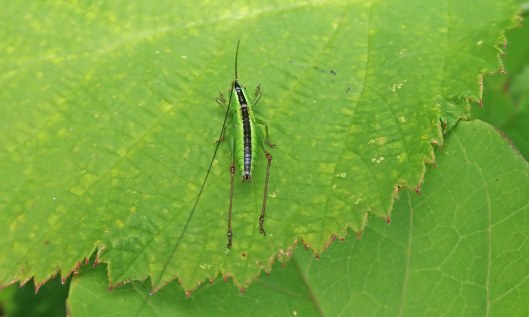
200720 long winged cone-head nymph

… another nymph, also often a meadow dweller, this time a cricket species, a Long winged cone-head (Conocephalus fuscus).

Like Loading...

200/366 Purple hairstreak

18 Saturday Jul 2020

Posted by sconzani in insects, nature, trees

≈ Leave a comment

Tags

British butterflies, butterfly, butterfly in Oak trees, Cosmeston Lakes Country Park, Favonius quercus, Oak butterfly, oak tree, Purple hairstreak

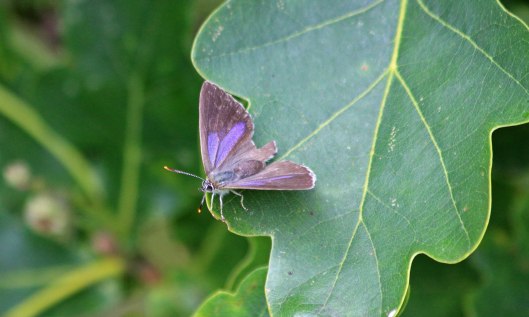
The key to where to locate this gorgeous butterfly, the Purple hairstreak, is in its scientific name Favonius quercus – quercus is the genus of the Oak tree – and I suspect that there are many more colonies of Purple hairstreaks living in our old Oak trees than we currently know about, as these butterflies spend much of their time unseen, high in the leafy boughs, feasting on honey dew.

200718 purple hairstreak (2)

There is a colony at Lavernock, and I’ve seen these butterflies at a couple of locations along the road that leads to Lavernock Point, but they were the only local sites I knew about. So, you can perhaps imagine my delight when, during Thursday’s walk at Cosmeston Lakes Country Park, I came face to snout with a female Purple hairstreak, which had ventured down to head height, and was happily running her yellow proboscis over the honey-dew-covered leaves.

200718 purple hairstreak (1)

This was the closest I’d been to one of these lovely creatures and had previously seen neither the purple sheen on their open wings nor the yellow proboscis. I was in butterfly heaven!

200718 purple hairstreak (3)

Like Loading...

199/366 A cycle of life and death

17 Friday Jul 2020

Posted by sconzani in insects, nature

≈ Leave a comment

Tags

British butterflies, butterfly, butterflying, cycle of life, Ringlet, Ringlets mating

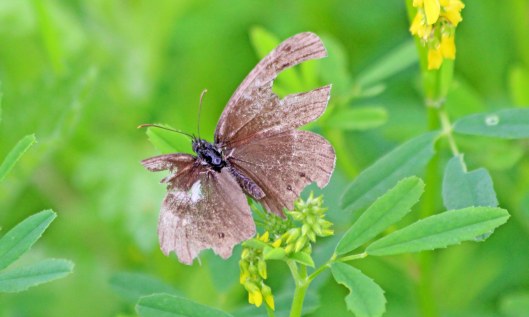
I am constantly reminded of how transitory life can be for the smaller creatures that share our planet. Take, for instance, the Ringlet butterfly. The adults usually emerge in the second half of June and only a few survive into August. In their few short weeks of life they experience a frantic rush to reproduce …

200717 1 ringlets mating

… a time full of danger from pecking birds, of collisions with damaging foliage …

200717 2 ragged ringlet

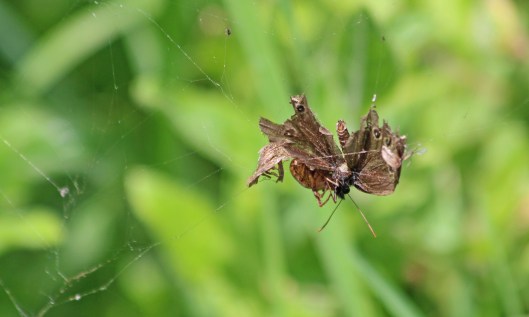
… before death takes them – unless, like this rather ragged creature, they are caught in a spider’s web, die prematurely but, in so doing, give life to another creature.

200717 2 ringlet caught by spider

Like Loading...

196/366 First Brown argus of 2020

14 Tuesday Jul 2020

Posted by sconzani in insects, nature

≈ 1 Comment

Tags

British butterflies, Brown argus, butterfly, butterflying, Grangemoor Park

By this date last year, I had managed to find Brown argus butterflies at two different local sites (and one of those was the first Cardiff record in eight years). This year I only spotted my first Brown argus last Saturday, almost two months later than last year. The Polyommatinae family (that’s the blues and arguses) are not faring well in my part of south Wales this year, which is a great shame, as they are all gorgeous little butterflies.

200714 brown argus (1)

If you’re having trouble telling a Brown argus from a Common blue female, my blog Flying on the wings of Confusion, July 2018, has ID pointers and photos that should help.

200714 brown argus (2)

Like Loading...

193/366 Moth macro

11 Saturday Jul 2020

Posted by sconzani in insects, nature

≈ 4 Comments

Tags

British moths, macro photography, moth, Silver Y, Silver Y moth

We’ve had cooler, greyer, wetter weather in recent days, which isn’t so good for seeing hosts of butterflies and other insects flying around the wildflowers but, if you can find them, it does slow those insects down a bit making macro photography a little easier … sometimes. A slow, quiet, stealthy approach is still required as, to take macro photos with my Olympus camera, I need to get as close as an inch to my subject. Mostly, the insects fly or scuttle off, but this stunning Silver Y moth was a rather lovely exception to my usual failures.

200711 Silver Y moth

Like Loading...
← Older posts
Newer posts →

About me

sconzani

sconzani

I'm a writer and photographer; researcher and blogger; birder and nature lover; countryside rambler and city strider; volunteer and biodiversity recorder.

View Full Profile →

Follow earthstar on WordPress.com

Enter your email address to follow this blog and receive notifications of new posts by email.

Recent blog posts

  • In flower now April 12, 2026
  • A surprise Slow-worm April 11, 2026
  • My first Holly blue April 10, 2026
  • Alder flies April 9, 2026
  • Lily beetle April 8, 2026

From the archives

COPYRIGHT

Unless otherwise acknowledged, the text and photographs on this blog are my own and are subject to international copyright. Nothing may be downloaded or copied without my permission.

Fellow Earth Stars!

  • Unknown's avatar
  • Unknown's avatar
  • Unknown's avatar
  • Unknown's avatar
  • Unknown's avatar
  • Unknown's avatar
  • Unknown's avatar
  • Unknown's avatar
  • Unknown's avatar
  • Unknown's avatar
  • Unknown's avatar
  • Unknown's avatar
  • Unknown's avatar
  • Unknown's avatar
  • Unknown's avatar
  • Unknown's avatar
  • Unknown's avatar
  • Unknown's avatar
  • Unknown's avatar
  • Unknown's avatar
  • Unknown's avatar
  • Unknown's avatar
  • Unknown's avatar
  • Unknown's avatar
  • Unknown's avatar
  • Unknown's avatar
  • Unknown's avatar
  • Unknown's avatar
  • Unknown's avatar
  • Unknown's avatar
  • Unknown's avatar
  • Unknown's avatar
  • Unknown's avatar
  • Unknown's avatar
  • Unknown's avatar
  • Unknown's avatar
  • Unknown's avatar
  • Unknown's avatar
  • Unknown's avatar
  • Unknown's avatar
  • Unknown's avatar
  • Unknown's avatar
  • Unknown's avatar
  • Unknown's avatar
  • Unknown's avatar
  • Unknown's avatar
  • Unknown's avatar
  • Unknown's avatar
  • Unknown's avatar
  • Unknown's avatar

Blog at WordPress.com.

Privacy & Cookies: This site uses cookies. By continuing to use this website, you agree to their use.
To find out more, including how to control cookies, see here: Cookie Policy
  • Subscribe Subscribed
    • earthstar
    • Join 642 other subscribers
    • Already have a WordPress.com account? Log in now.
    • earthstar
    • Subscribe Subscribed
    • Sign up
    • Log in
    • Report this content
    • View site in Reader
    • Manage subscriptions
    • Collapse this bar
 

Loading Comments...
 

You must be logged in to post a comment.

    %d