• ABOUT
  • BIRDING 2018
  • Birding 2019
  • BLOG POSTS
  • Butterflies 2018
  • Resources

earthstar

~ a celebration of nature

earthstar

Category Archives: insects

192/366 Damsels and dragons

10 Friday Jul 2020

Posted by sconzani in insects, nature

≈ 2 Comments

Tags

Blue-tailed damselfly, British damselflies, British dragonflies, Broad-bodied Chaser, Common blue damselfly, Common Darter, Emperor dragonfly

Last summer was so hot and dry that many of the local ponds dried up completely, which may be why I’m not seeing as many damselflies and dragonflies as I have in previous years – perhaps their larvae didn’t survive that dry period. Here are a few I have seen in recent weeks …
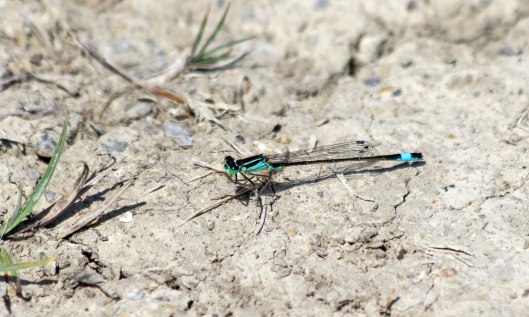
200710 blue-tailed damselfly

Blue-tailed damselfly: though the females come in several colour forms, both they and the males, like this one, have the blue spot on their lower abdomen, which is how they got their name.

200710 common blue immature female
200710 common blue male

Common blue damselflies, here an immature female, a male and, below, a pair in classic mating pose.
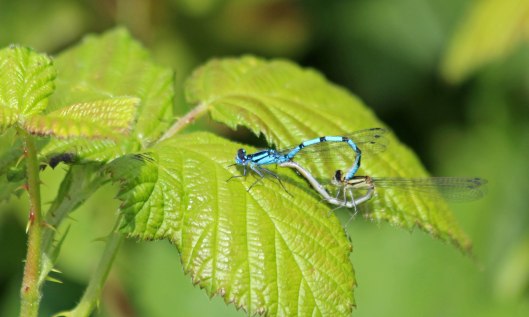
200710 common blues mating200710 broad-bodied chaser

And the dragons: a glowing female Broad-bodied chaser

200710 common darter

I’ve seen my first two Common darters in recent days, which is late, as they can appear as early as May.

200710 emperor female ovipositing

A female Emperor laying her eggs (ovipositing) under the vegetation of a local pond. Let’s hope that pond retains enough water this year for her offspring to survive the winter months.

Like Loading...

190/366 For the love of thistles

08 Wednesday Jul 2020

Posted by sconzani in insects, nature, plants, wildflowers

≈ 3 Comments

Tags

British insects, Cirsium arvense, Creeping thistle, insects on thistles, thistle

Many people would consider the thistle – any thistle, all thistles – to be a weed but one look at these photos will show just what a diverse range of insects find the humble thistle an essential source of food. From flies and hoverflies, bees and wasps, to beetles and butterflies, the Creeping thistle (Cirsium arvense) is a favourite of them all. And when the flowers are finished, it will be the turn of the birds to find nourishment in the thistle seeds. What an amazing wildflower this is!

This slideshow requires JavaScript.

Like Loading...

189/366 Keepers of the gate

07 Tuesday Jul 2020

Posted by sconzani in insects, nature

≈ 2 Comments

Tags

British butterflies, butterfly, Gatekeeper, Pyronia tithonus

It’s a week since I spotted my first Gatekeepers of the year and, in the past seven days, I’ve seen them in several of my local walking places, though so far only males .

200707 gatekeeper (1)

They grab the wandering eye, as their bright orange pops from the vibrant green of the hedgerows and woodland rides, and in the long grass of fence lines and the gates that divide them.

200707 gatekeeper (2)

You can read more about these gorgeous butterflies in my previous blogs The Gatekeeper, July 2018, and Sexing Gatekeepers, July 2019.

200707 gatekeeper (3)

Like Loading...

186/366 Miscellaneous minis

04 Saturday Jul 2020

Posted by sconzani in insects, nature

≈ Leave a comment

Tags

British insects, Common Green Shieldbug, Grypocoris stysi, harlequin ladybird, Ichneumonid wasp, Orange ladybird

These are a few recent insect that have caught my eye …

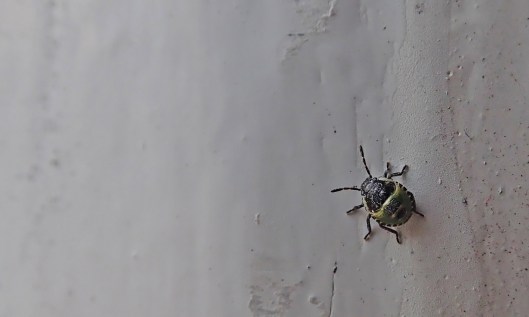
200704 1 common green shieldbug

First up, the 4th instar of a Common green shieldbug that was walking along the outside of a building as I passed. These mini-beasties go through five different instars (stages) before becoming adults. For more see A (shield)bug’s life, September 2016.

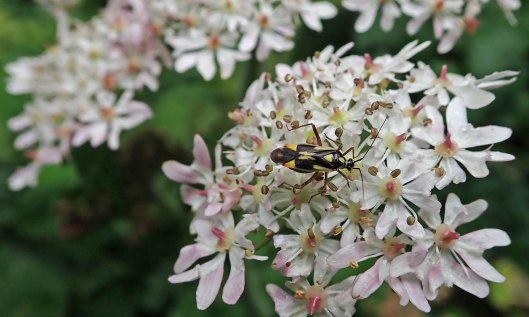
200704 2 Grypocoris stysi

A flower bug that loves umbellifers, Grypocoris stysi. You can read more about him/her in my previous blog, Get a Gryp-o!, July 2016.

200704 3 ladybird orange (1)
200704 4 ladybird orange (2)

I found this Orange ladybird browsing on leaves covered with a white mould, their favourite food. See more on these little cuties in A Blast of Orange, July 2017.

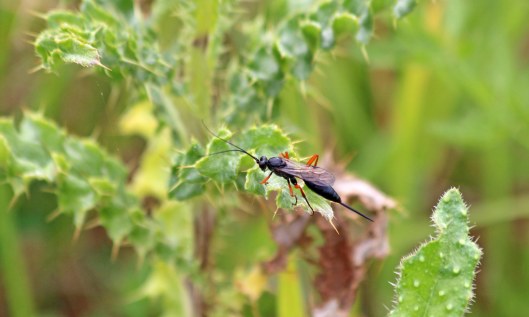
200704 5 wasp black ichneumonid

I’ve been spotting a lot of Ichneumonid wasps this year. Most are quite difficult to identify, as you need to photograph them from several different angles to capture all the identifying features and I find they don’t usually stay still long enough.

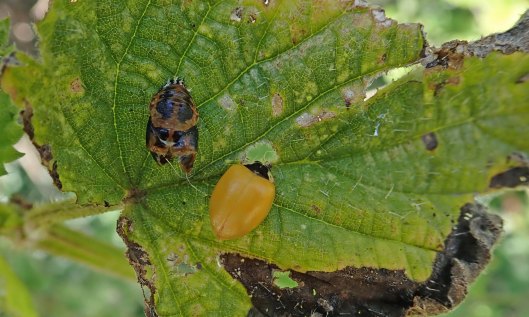
200704 6 ladybird harlequin

And, last for today, what I think is a Harlequin ladybird, judging from the patterns on the now-empty pupa case. When newly emerged, ladybirds are often pale coloured and dot-less – the colours darken and the spots emerge in their first few hours as adults.

Like Loading...

185/366 Grounded

03 Friday Jul 2020

Posted by sconzani in insects, ladybird, nature

≈ 2 Comments

Tags

7-spot ladybird, British ladybirds, ladybirds, Seven-spot ladybird

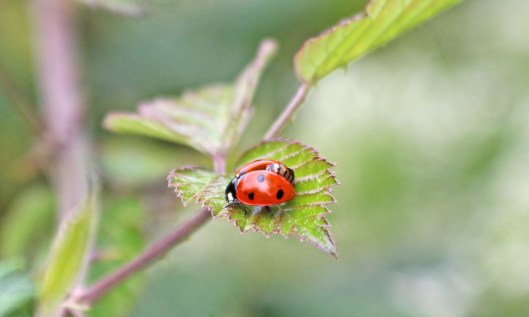
This is a bit of a sad story. During yesterday’s walk, I spotted this Seven-spot ladybird sitting on a leaf alongside the path.

200703 7spot ladybird (1)

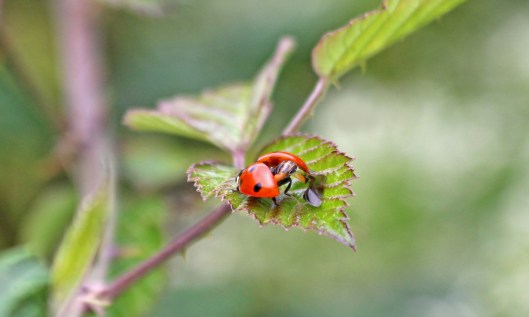
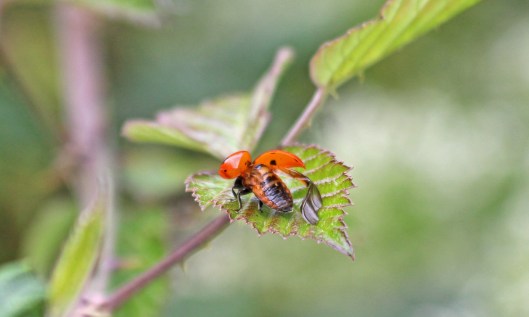
It was acting a bit strangely: opening its elytra (wing cases), raising its abdomen, shutting its elytra, over and over again. It took me a minute to realise that it only seemed to have one full-size wing; the other appeared stunted or perhaps it had been damaged and was no longer able to be extended.

200703 7spot ladybird (2)

I presume the ladybird was trying to remedy the problem through its movements but they didn’t seem to have any effect, and I fear this ladybird may be forever grounded.

200703 7spot ladybird (3)

Like Loading...

184/366 Eggs-citing!

02 Thursday Jul 2020

Posted by sconzani in insects, nature

≈ 2 Comments

Tags

British butterflies, butterflies, butterfly egg, Comma, Comma butterfly, Comma egg, Polygonia c-album

Though I set off on yesterday’s walk clad in a rain jacket, the first day of July brightened up and turned into a day full of butterflies, with sightings of my first Gatekeepers of the year, a couple of second-brood Holly blues and more than 20 second-brood Small whites, as well as seven other species. But the highlight for me was watching two Commas egg-laying on nettles, and then taking a look at their tiny eggs, which I’d not seen previously.

200702 commas egglaying (1)

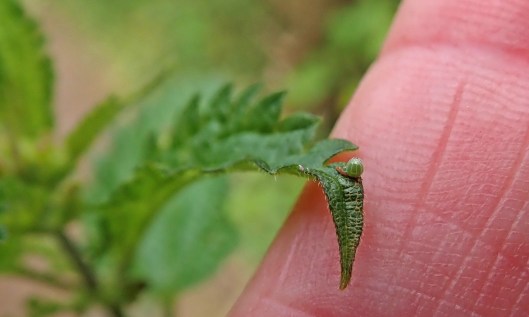
The butterflies were fluttering around, checking out nettle plants growing alongside the footpath I was walking and, when they found a plant to their liking, they would alight briefly on a leaf, lay a single egg, then flutter off again.

At less than 1mm tall, these eggs are tiny, and I would never have spotted them unless I’d seen them being laid. They’re pale green in colour, with 10 or 11 white ribs running vertically up the sides.

Comma egg one
Comma egg one
Comma egg two
Comma egg two

According to Peter Eeles’s Life Cycles of British & Irish Butterflies, each female Comma will lay about 250 eggs, usually on the upper side of a leaf, in a sheltered, sunny position. The eggs will gradually change colour to yellow and, in two or three weeks, to grey, before the little caterpillars hatch. Eggs-citing!

200702 commas egglaying (5)

Comma showing the distinctive marking that gave it its name

Like Loading...

183/366 It’s a Burnet’s life

01 Wednesday Jul 2020

Posted by sconzani in insects, nature

≈ 3 Comments

Tags

5-spot Burnet, 6-spot Burnet, British moths, Burnet moth, Five-spot burnet, Six-spot burnet, Zygaena species

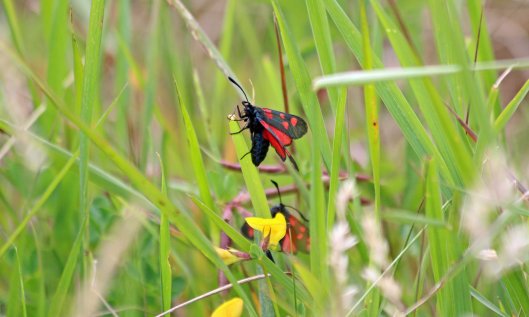
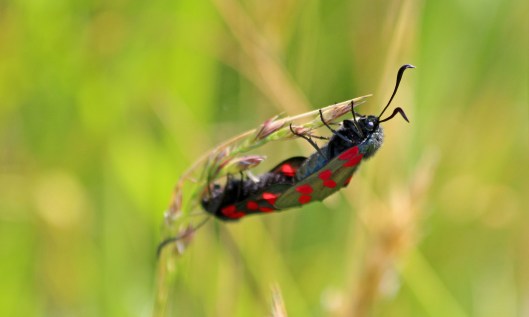
My new favourite field has a healthy population of Burnet moths, some of which are 6-spot Burnets (Zygaena filipendulae) and the others could either be 5-spot Burnets (Zygaena trifolii) or Narrow-bordered 5-spot Burnets (Zygaena lonicerae) – it’s almost impossible to tell these latter two species apart. Over the past few weeks, I’ve been lucky enough to see almost every part of their life cycle – only the eggs have eluded me.

200701 1 5spot and 6spot

A 5-spot above, a 6-spot below

200701 2 6spot burnets

6-spot Burnets mating

Today I spotted this larva, looking very close to pupating, and, nearby, a very fresh-looking cocoon.

200701 3 burnet larva
200701 4 burnet cocoon
200701 5 6spot burnet

A freshly emerged 6-spot Burnet moth

200701 6 5spot burnet

A pristine 5-spot Burnet moth

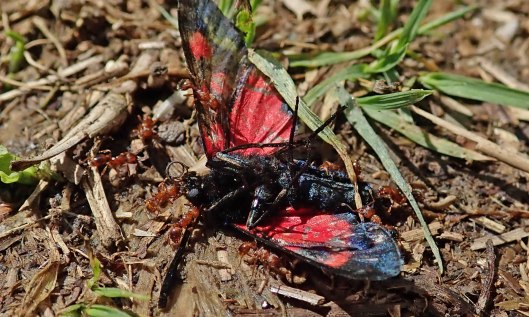
200701 7 5spot burnet dead n ants

Death is always sad to see but, in this case, the moth will support the life cycle of other creatures.


Like Loading...

181/366 Spot the beetle

29 Monday Jun 2020

Posted by sconzani in insects, nature, wildflowers

≈ 6 Comments

Tags

beetle, British beetles, Rutpela maculata, Spotted longhorn beetle, umbellifer flowers, umbellifers

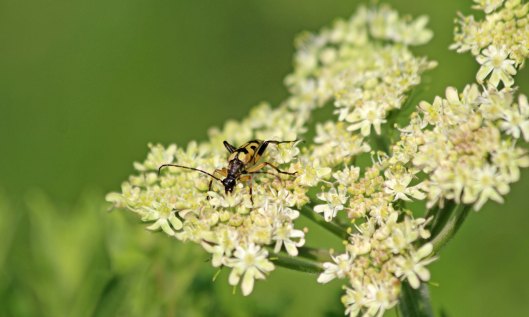
This Spotted longhorn (Rutpela maculata) was happily minding its own business, feeding on the umbellifer flowers growing along the edge of a woodland ride, as is its wont, when …

200629 spotted longhorn (1)

Incoming!

200629 spotted longhorn (2)

And so the necessity of life as a beetle takes over, the need to reproduce, to continue the species. Lunch might have to wait.

200629 spotted longhorn (3)

Like Loading...

178/366 Essex skippers

26 Friday Jun 2020

Posted by sconzani in insects, nature

≈ 4 Comments

Tags

British butterflies, butterfly, Essex skipper, Grangemoor Park, Skippers

I’ve been melting in this week’s heatwave but it’s been a wonderful week for butterflies: on Monday, a long-lost Small heath, on Wednesday my first Painted Lady of the year, and yesterday two Essex skippers.

200626 essex skipper (1)

I went early to Grangemoor Park to avoid the worst of the heat but it was already roasting, and the skippers, Large and Small, were scooting around the grasses and wildflowers so rapidly that I couldn’t get many photos. Then, along one path, two skippers flew up, one disappeared but the other found a perch and stayed there, most patiently, while I quietly edged my way around in front of it to check what I suspected from the rear view. And, bingo, black-tipped antennae – an Essex skipper.

200626 essex skipper (2)

A second path, an almost perfect repeat performance, a second Essex skipper. I do find these gorgeous little skippers will remain on a perch when they find one to their liking, which is extremely convenient for getting photos to confirm their identities.

Like Loading...

177/366 A Small heath and a Painted lady

25 Thursday Jun 2020

Posted by sconzani in insects, nature

≈ 1 Comment

Tags

British butterflies, butterflies, butterfly, Painted Lady, Small heath

As well as the Great crested grebes I wrote about yesterday (and many other birds, of course), I also found a little treasure on Monday’s Cardiff Bay walk, a Small heath butterfly. These are common butterflies in many parts of Britain but, for some unknown reason, they are now rare in my part of south Wales. In almost five years of looking, this is the first I’ve found, and Monday’s find is only the third confirmed local record in ten years. Sadly, I only managed a couple of not-very-good photos so I’ll need to try to re-find it.

200625 small heath

Yesterday’s walk, in the meadows next to a local woodland, also produced a treasure. As well as many other butterflies (Meadow browns and Ringlets, Large and Small skippers, a couple each of Commas and Red admirals, a Speckled wood and a few flyby white species), I saw my first Painted lady of 2020. I love both the top and side markings of this beautiful creature.

200625 painted lady (1)200625 painted lady (2)

Like Loading...
← Older posts
Newer posts →

About me

sconzani

sconzani

I'm a writer and photographer; researcher and blogger; birder and nature lover; countryside rambler and city strider; volunteer and biodiversity recorder.

View Full Profile →

Follow earthstar on WordPress.com

Enter your email address to follow this blog and receive notifications of new posts by email.

Recent blog posts

  • In flower now April 12, 2026
  • A surprise Slow-worm April 11, 2026
  • My first Holly blue April 10, 2026
  • Alder flies April 9, 2026
  • Lily beetle April 8, 2026

From the archives

COPYRIGHT

Unless otherwise acknowledged, the text and photographs on this blog are my own and are subject to international copyright. Nothing may be downloaded or copied without my permission.

Fellow Earth Stars!

  • Unknown's avatar
  • Unknown's avatar
  • Unknown's avatar
  • Unknown's avatar
  • Unknown's avatar
  • Unknown's avatar
  • Unknown's avatar
  • Unknown's avatar
  • Unknown's avatar
  • Unknown's avatar
  • Unknown's avatar
  • Unknown's avatar
  • Unknown's avatar
  • Unknown's avatar
  • Unknown's avatar
  • Unknown's avatar
  • Unknown's avatar
  • Unknown's avatar
  • Unknown's avatar
  • Unknown's avatar
  • Unknown's avatar
  • Unknown's avatar
  • Unknown's avatar
  • Unknown's avatar
  • Unknown's avatar
  • Unknown's avatar
  • Unknown's avatar
  • Unknown's avatar
  • Unknown's avatar
  • Unknown's avatar
  • Unknown's avatar
  • Unknown's avatar
  • Unknown's avatar
  • Unknown's avatar
  • Unknown's avatar
  • Unknown's avatar
  • Unknown's avatar
  • Unknown's avatar
  • Unknown's avatar
  • Unknown's avatar
  • Unknown's avatar
  • Unknown's avatar
  • Unknown's avatar
  • Unknown's avatar
  • Unknown's avatar
  • Unknown's avatar
  • Unknown's avatar
  • Unknown's avatar
  • Unknown's avatar
  • Unknown's avatar

Blog at WordPress.com.

Privacy & Cookies: This site uses cookies. By continuing to use this website, you agree to their use.
To find out more, including how to control cookies, see here: Cookie Policy
  • Subscribe Subscribed
    • earthstar
    • Join 642 other subscribers
    • Already have a WordPress.com account? Log in now.
    • earthstar
    • Subscribe Subscribed
    • Sign up
    • Log in
    • Report this content
    • View site in Reader
    • Manage subscriptions
    • Collapse this bar
 

Loading Comments...
 

You must be logged in to post a comment.

    %d