• ABOUT
  • BIRDING 2018
  • Birding 2019
  • BLOG POSTS
  • Butterflies 2018
  • Resources

earthstar

~ a celebration of nature

earthstar

Category Archives: nature

207/366 At home in the bindweed

25 Saturday Jul 2020

Posted by sconzani in flowers, molluscs, nature, wildflowers

≈ Leave a comment

Tags

Bindweed flower, slugs, slugs in bindweed flowers

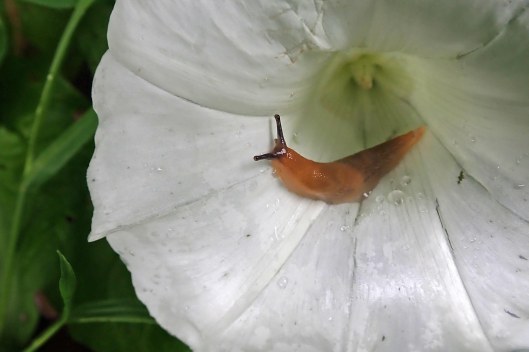
I had to chuckle during this morning’s brief stomp between bouts of heavy rain. The local slugs, which I thought would be at home in such conditions, sliding on the grass, slithering over leaves, were more literally ‘at home’, sheltering in the deep flower cups of bindweed.

200725 slugs in bindweed (1)200725 slugs in bindweed (2)200725 slugs in bindweed (3)

Like Loading...

206/366 Fledging

24 Friday Jul 2020

Posted by sconzani in birds, nature

≈ 1 Comment

Tags

birding, birdwatching, British birds, gull chick learning to fly, gull chicks, Lesser black-backed gull, urban gull nest

From an initial count of three chicks, the local Lesser black-backed gulls nesting amongst a neighbour’s chimney pots have managed to raise one to fledging. I’ve been watching it practising its flying skills over recent days and, finally this morning, it has left the shelter of its nest site.

This slideshow requires JavaScript.

Though it was pottering around the rooftops for a while, I can no longer see the chick. Now follows the dangerous time for this fledgling of learning to find its own food, finding shelter against bad weather, escaping domestic cats and dogs in the various neighbours’ gardens, and avoiding cars on roads…. Good luck, little one!

200724 lbb chick (18)

Like Loading...

205/366 Sightings at Slade Wood

23 Thursday Jul 2020

Posted by sconzani in birds, insects, nature

≈ 1 Comment

Tags

British birds, British butterflies, Brown argus, Gatekeeper, juvenile Spotted flycatcher, mating Gatekeepers, Minnetts Field, Peacock butterfly, Siskin, Slade Wood, Spotted flycatcher

On Wednesday I ventured on to public transport for the first time in four months – suitably masked, of course – for a visit to Slade Wood, near Rogiet. This was a site where I’d seen Silver-washed fritillaries and White admiral butterflies last summer so I was hoping for more of those but, unfortunately, huge areas of the woodland have been felled over the winter months, which has destroyed a lot of the butterflies’ habitat.

200723 1 peacock200723 2 gatekeepers

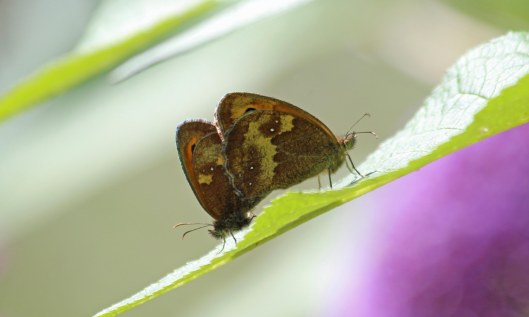
I did still see a lot of butterflies on the Buddleja bushes – in fact, probably more Peacocks than I’ve seen in one day before, and I got some pics of a pair of Gatekeepers mating – but only spotted one Silver-washed fritillary (and didn’t manage a photo) and no White admirals. There was also a butterfly consolation prize in the form of a Brown argus, a butterfly that’s not common locally, which was in Minnett’s Field, a nearby meadow managed by Gwent Wildlife Trust.

200723 3 brown argus

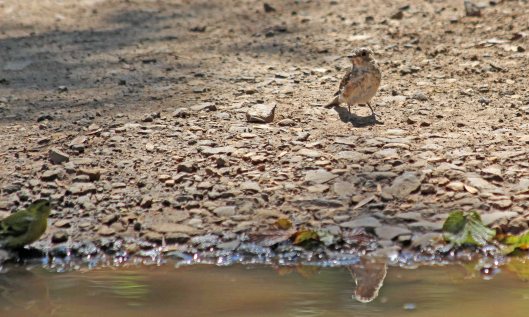
Though the butterflies were a little disappointing, the birds were a huge bonus as I managed to find a family of Spotted flycatchers, with two adults and a couple of juveniles (below left), which I’d not seen before.

200723 4 spotted flycatcher
200723 5 spotted flycatcher

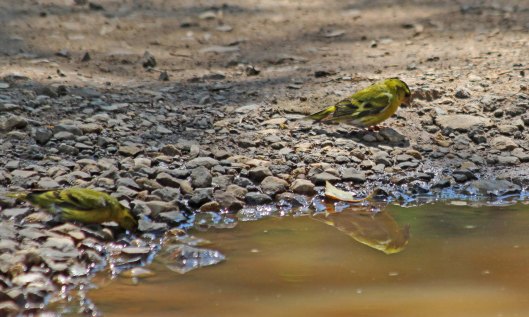
And the flycatchers were joined at their watering hole, a couple of muddy puddles, by two beautiful bright Siskin.

200723 6 siskin and spot fly200723 7 siskin

I may not have seen what I was expecting and I was saddened to see how many trees had been felled but I still had a wonderful day out. The sense of freedom was exhilarating, and Nature certainly didn’t disappoint!

Like Loading...

204/366 Musk thistle

22 Wednesday Jul 2020

Posted by sconzani in nature, plants, wildflowers

≈ 4 Comments

Tags

British wildflowers, Carduus nutans, Musk thistle, Nodding thistle, thistle

This gorgeous thistle was a new plant for me when I discovered it in a local farm field a couple of days ago. It’s a Musk thistle (Carduus nutans), also known as Nodding thistle, and it’s precisely the nodding habit of its growth that alerted me to something new.

200722 musk thistle (1)

Its flowers, though a glorious and vibrant pinky purple, droop downwards, nodding on long spineless stems and, in fact, compared to the upright habit of other thistles I see, this one’s growth habit overall is very droopy. It’s a bit of a sloucher, though, as its name suggests, those flowers have a musky smell that bees find particularly attractive, and several butterflies seemed to like it too.

200722 musk thistle (2)

The Plantlife website provides some interesting facts about the Musk thistle: apparently ‘its fleshy stem is edible and said to be delicious after peeling and boiling’ and ‘medicinally, the leaves have been used as a tonic to stimulate liver function, whereas the flowers have been used to reduce fevers and purify the blood.’

200722 musk thistle (3)

Like Loading...

203/366 Preening Stonechat

21 Tuesday Jul 2020

Posted by sconzani in birds, nature

≈ Leave a comment

Tags

birding, birdwatching, British birds, Cosmeston Lakes Country Park, juvenile Stonechat, Stonechat, Stonechat preening video

For the first time in who knows how long a pair of Stonechats overwintered at Cosmeston Lakes Country Park and, came the Spring, they bred, the first time this has ever been recorded at Cosmeston. The two offspring are now well grown juveniles and, if you’re lucky, the family can be seen feeding and flitting about together along the hedgerows and amongst the wildflowers in Cosmeston’s meadows. I caught up with them during a walk last Thursday and was delighted that at least one of the family was happy to be photographed and videoed.

Like Loading...

202/366 More misc minis

20 Monday Jul 2020

Posted by sconzani in insects, nature

≈ 4 Comments

Tags

bonking neetles, British butterflies, British crickets, British grasshoppers, Common red soldier beetle, Green-veined white, Long winged cone-head, Meadow grasshopper, Nettle weevil, Small copper, weevil

Some snippets from the insect world around me:

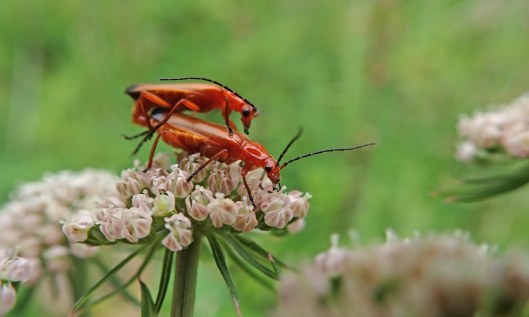
200720 common red soldier beetles

A sure sign that it’s now high summer, Common red soldier beetles (Rhagonycha fulva) can be seen everywhere, especially on the flowers of umbellifers, demonstrating why they are often called bonking beetles.

200720 green-veined white (1)
200720 green-veined white (2)

Also caught copulating, these Green-veined white butterflies (Pieris napi) were being annoyed by a third of their kind, trying to get involved in the action.

200720 small copper

On the subject of butterflies, the second brood of Small coppers (Lycaena phlaeas) is now on the wing. This stunning specimen was only the second Small copper I’d seen this year, so was a very welcome sighting.

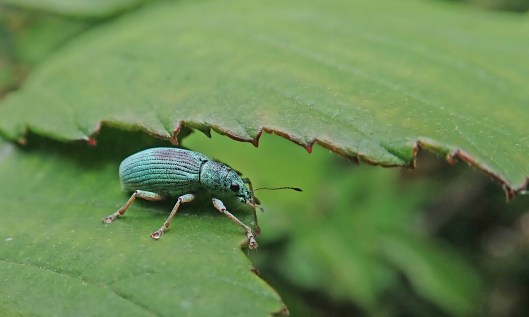
200720 nettle weevil

There’s nothing cuter than a weevil. This one is, I think, a Nettle weevil (Phyllobius pomaceus).

200720 ants on ragwort (1)
200720 ants on ragwort (2)

I found this odd: a colony of ants, farming a horde of aphids on this ragwort plant, have extended their nest up the very stem of the plant.

200720 meadow grasshopper

To finish this post, first, a Meadow grasshopper (Chorthippus parallelus) nymph and …

200720 long winged cone-head nymph

… another nymph, also often a meadow dweller, this time a cricket species, a Long winged cone-head (Conocephalus fuscus).

Like Loading...

201/366 Small and white

19 Sunday Jul 2020

Posted by sconzani in nature, wildflowers

≈ 2 Comments

Tags

British wildflowers, Common centaury, Common mouse-ear, Eyebright, Fairy flax, Hedge bedstraw, white-flowered wildflowers

Many of the local wildflowers currently in bloom have small, white flowers. These are some of them …

200719 fairy flax

Fairy flax (Linum catharticum): this is the smallest, a tiny delicate plant that appears to shake and quiver even in the lightest breeze. It is also known as Purging flax as, in past times, herbalists prescribed it as a laxative.

200719 hedge bedstraw (1)
200719 hedge bedstraw (2)

Hedge bedstraw (Galium mollugo): not the bedstraw that was used to sweeten the smell of straw mattresses (which is the yellow-flowered Lady’s bedstraw), but its close cousin, which can be found scrambling along hedgerows, particularly on calcareous soils.

200719 common eyebright (1)
200719 common eyebright (2)

Eyebright (Euphrasia sp.): I didn’t know until I checked this plant on the Plantlife website that the various species of Eyebright are semi-parasitic, stealing the nutrients of other plants, like grasses.

200719 common mouse ear

Common mouse-ear (Cerastium fontanum): A type of chickweed, which many gardeners will know as a persistent ‘weed’, this little plant gets its mouse-ear name from its hairy leaves that grow in pairs on either side of the plant’s stem.

200719 common centaury (1)

Common centaury (Centaurium erythraea) is usually pink flowered (see the variations below) but many of the plants I see locally, like those above, have white flowers. The Plantlife website gives the fascinating information that centaury is ‘named after the centaur Chiron, who, according to legend, discovered its healing power and used it to cure himself from the effects of a poisoned arrow.’

200719 common centaury (2)
200719 common centaury (3)
Like Loading...

200/366 Purple hairstreak

18 Saturday Jul 2020

Posted by sconzani in insects, nature, trees

≈ Leave a comment

Tags

British butterflies, butterfly, butterfly in Oak trees, Cosmeston Lakes Country Park, Favonius quercus, Oak butterfly, oak tree, Purple hairstreak

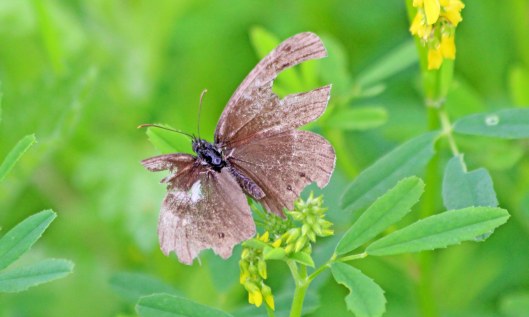
The key to where to locate this gorgeous butterfly, the Purple hairstreak, is in its scientific name Favonius quercus – quercus is the genus of the Oak tree – and I suspect that there are many more colonies of Purple hairstreaks living in our old Oak trees than we currently know about, as these butterflies spend much of their time unseen, high in the leafy boughs, feasting on honey dew.

200718 purple hairstreak (2)

There is a colony at Lavernock, and I’ve seen these butterflies at a couple of locations along the road that leads to Lavernock Point, but they were the only local sites I knew about. So, you can perhaps imagine my delight when, during Thursday’s walk at Cosmeston Lakes Country Park, I came face to snout with a female Purple hairstreak, which had ventured down to head height, and was happily running her yellow proboscis over the honey-dew-covered leaves.
200718 purple hairstreak (1)

This was the closest I’d been to one of these lovely creatures and had previously seen neither the purple sheen on their open wings nor the yellow proboscis. I was in butterfly heaven!
200718 purple hairstreak (3)

Like Loading...

199/366 A cycle of life and death

17 Friday Jul 2020

Posted by sconzani in insects, nature

≈ Leave a comment

Tags

British butterflies, butterfly, butterflying, cycle of life, Ringlet, Ringlets mating

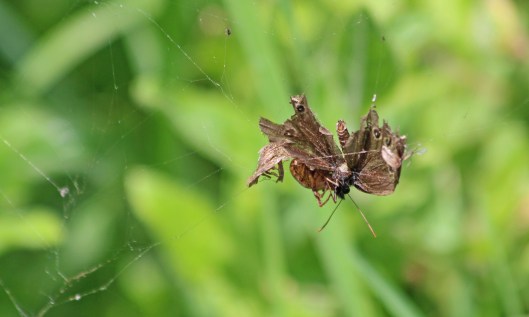
I am constantly reminded of how transitory life can be for the smaller creatures that share our planet. Take, for instance, the Ringlet butterfly. The adults usually emerge in the second half of June and only a few survive into August. In their few short weeks of life they experience a frantic rush to reproduce …

200717 1 ringlets mating

… a time full of danger from pecking birds, of collisions with damaging foliage …

200717 2 ragged ringlet

… before death takes them – unless, like this rather ragged creature, they are caught in a spider’s web, die prematurely but, in so doing, give life to another creature.

200717 2 ringlet caught by spider

Like Loading...

198/366 Sneezewort

16 Thursday Jul 2020

Posted by sconzani in flowers, nature, wildflowers

≈ Leave a comment

Tags

Achillea ptarmica, British wildflowers, Sneezeweed, Sneezewort, wildflower

Sneezewort (Achillea ptarmica) is not a wildflower I see very often so I was delighted to find a few plants of it blooming in a local meadow during yesterday’s wander.

200716 sneezewort (1)

The First Nature website explains its scientific name: Achillea ‘stems from the belief that Achilles used flowers of this genus to cure his soldiers’ wounds; ptarmica … comes from the Greek and means to cause a sneeze’. And, as well as Sneezewort, it has a host of other wonderful common names, including Sneezeweed, Bastard pellitory, Fair-maid-of-France, and Goose tongue.

OLYMPUS DIGITAL CAMERA
Like Loading...
← Older posts
Newer posts →

About me

sconzani

sconzani

I'm a writer and photographer; researcher and blogger; birder and nature lover; countryside rambler and city strider; volunteer and biodiversity recorder.

View Full Profile →

Follow earthstar on WordPress.com

Enter your email address to follow this blog and receive notifications of new posts by email.

Recent blog posts

  • Three Common sandpipers February 17, 2026
  • Beetle: Athous bicolor February 16, 2026
  • Crocus flower power February 15, 2026
  • Delightful doves February 14, 2026
  • Fan-like fungi February 13, 2026

From the archives

COPYRIGHT

Unless otherwise acknowledged, the text and photographs on this blog are my own and are subject to international copyright. Nothing may be downloaded or copied without my permission.

Fellow Earth Stars!

  • Unknown's avatar
  • Unknown's avatar
  • Unknown's avatar
  • Unknown's avatar
  • Unknown's avatar
  • Unknown's avatar
  • Unknown's avatar
  • Unknown's avatar
  • Unknown's avatar
  • Unknown's avatar
  • Unknown's avatar
  • Unknown's avatar
  • Unknown's avatar
  • Unknown's avatar
  • Unknown's avatar
  • Unknown's avatar
  • Unknown's avatar
  • Unknown's avatar
  • Unknown's avatar
  • Unknown's avatar
  • Unknown's avatar
  • Unknown's avatar
  • Unknown's avatar
  • Unknown's avatar
  • Unknown's avatar
  • Unknown's avatar
  • Unknown's avatar
  • Unknown's avatar
  • Unknown's avatar
  • Unknown's avatar
  • Unknown's avatar
  • Unknown's avatar
  • Unknown's avatar
  • Unknown's avatar
  • Unknown's avatar
  • Unknown's avatar
  • Unknown's avatar
  • Unknown's avatar
  • Unknown's avatar
  • Unknown's avatar
  • Unknown's avatar
  • Unknown's avatar
  • Unknown's avatar
  • Unknown's avatar
  • Unknown's avatar
  • Unknown's avatar
  • Unknown's avatar
  • Unknown's avatar
  • Unknown's avatar
  • Unknown's avatar

Blog at WordPress.com.

Privacy & Cookies: This site uses cookies. By continuing to use this website, you agree to their use.
To find out more, including how to control cookies, see here: Cookie Policy
  • Subscribe Subscribed
    • earthstar
    • Join 670 other subscribers
    • Already have a WordPress.com account? Log in now.
    • earthstar
    • Subscribe Subscribed
    • Sign up
    • Log in
    • Report this content
    • View site in Reader
    • Manage subscriptions
    • Collapse this bar
 

Loading Comments...
 

You must be logged in to post a comment.

    %d