• ABOUT
  • BIRDING 2018
  • Birding 2019
  • BLOG POSTS
  • Butterflies 2018
  • Resources

earthstar

~ a celebration of nature

earthstar

Category Archives: nature

A Jersey tiger!

12 Saturday Aug 2017

Posted by sconzani in insects, nature

≈ 7 Comments

Tags

British moth, Euplagia quadripunctaria, Jersey tiger, Lavernock Nature Reserve, moth

170812 Jersey tiger (1)

Ooo look, a Red admiral … hang on a minute … what’s that???!!!

I went looking for migrant birds at high tide at Sully beach – and found nothing more exotic than some Rock pipits and Turnstones – but my walk home, along the coastal path, took me through Lavernock Nature Reserve and there I got lucky. There I found an altogether different migrant, a beautiful Jersey tiger (Euplagia quadripunctaria).

170812 Jersey tiger (3)

Obviously, it’s not a mammal that’s swum across the Channel from Jersey: it’s a moth. It may also not have been an immigrant, as colonies have become established in a couple of places along the southern English coast in recent years. It is still, however, not so common in Wales, with only 24 records in the national database.

170812 Jersey tiger (4)
170812 Jersey tiger (5)

As you can see, it has gorgeous and quite distinctive markings – just look at that bright orange underwing! – so there was no mistaking what it was. Let’s hope a few other Jersey tigers arrive to establish a colony in Lavernock’s wonderful wildflower meadows.

170812 Jersey tiger (2)

Like Loading...

The almost inedible parsnip

11 Friday Aug 2017

Posted by sconzani in flowers, insects, nature, wildflowers

≈ Leave a comment

Tags

British flora, British wildflowers, Cosmeston Lakes Country Park, parsnip, Pastinaca sativa, umbellifers, Wild parsnip, wildflowers

While we’re on the subject of wild vegetables (see yesterday’s Wild carrot post), I must mention the other umbellifer that’s currently in full bloom, the Wild parsnip (Pastinaca sativa). Unlike the Wild carrot, the root of the Wild parsnip is, in fact, edible, though it’s described as hard and wiry so doesn’t sound worth the bother to me. I’ve also read that the sap of the plants can cause severe rashes and burns in some people so handling doesn’t seem advisable. And, anyway, who would want to deprive the insects of their tasty feast or spoil the glorious sight of a field of parsnip in full bloom?


170810 Wild parsnip (2)
170810 Wild parsnip (3)
170810 Wild parsnip (4)

The Wild parsnip is the ancestor of the cultivated parsnip, which is one of my favourite winter vegetables – roasted, in soup, stir-fried, yum! – and its culinary use probably dates from the early Middle Ages. The wild variety can be found growing, often in large groupings, on the chalky grasslands of southern England and Wales. In Cosmeston Lakes Country Park, one particular field is like a forest of yellow, some plants taller than my 168cm, and you can smell the scent of parsnips as you walk along the tracks through the field. Delicious!

170810 Wild parsnip (1)

Like Loading...

The inedible carrot

10 Thursday Aug 2017

Posted by sconzani in flowers, nature, wildflowers

≈ Leave a comment

Tags

British flora, British wildflowers, carrot, Daucus carota, umbel, umbellifer, Wild carrot, wildflowers

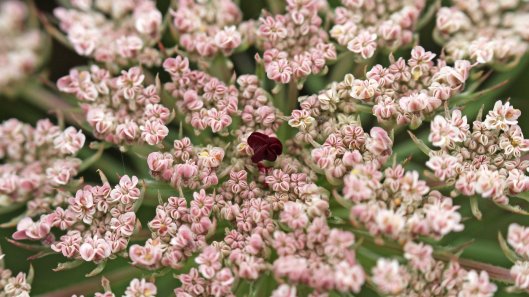
I’m finally starting to get a handle on the various umbellifers to be found in this land and the progression of their flowering through the seasons. Here in Wales, one of those currently in full flower is the Wild carrot (Daucus carota).

wild carrot (1)

Its leaves smell of the edible carrot but I’ve read that the roots of this wild variety are ‘thin and wiry and bear little resemblance to the thick, orange tap-roots of the cultivated vegetable’ so that firmly rules out any foraging! I also read, in my copy of Richard Mabey’s trusty Flora Britannica, that edible carrots ‘were developed from a distinct subspecies, ssp.sativa, probably native to the Mediterranean, and brought to Britain in the 15th century’. Fascinating!

wild carrot (3)
wild carrot (4)
wild carrot (5)
wild carrot (6)
wild carrot (7)

Meanwhile, the Wild carrots continue to grow straight and about 3 feet tall in my local wild places, to the delight of the hoverflies, sawflies, soldier beetles and other assorted insects that seem particularly to enjoy them. They have quite distinctive feathery leaves and often, but not always, a very tiny pinkish-red flower in the exact centre of their umbel. Also, when they’ve finished flowering, the umbels contract to a nest-like shape, which is why one of their common names is Bird’s-nest.

wild carrot (2)

Like Loading...

Three Aeshnidae

09 Wednesday Aug 2017

Posted by sconzani in insects, nature

≈ Leave a comment

Tags

Aeshna cyanea, Aeshna mixta, Aeshnidae, Anax imperator, British dragonflies, dragonflies, dragonfly, Emperor dragonfly, Migrant hawker, Southern hawker

The Aeshnidae are one of the five families of dragonflies to be found in Britain, and the family is made up of twelve Emperors and Hawkers. In the past week I have been privileged to see three members of the family during my local walks.

170809 Southern hawker
170809 Migrant hawker

The Southern hawker (Aeshna cyanea) (above left) is relatively common in Wales. In Aderyn, the national biodiversity recording database, there are 3312 records of Southern Hawker sightings and these are spread across 225 of the 275 10-kilometre grid squares that divide up Wales.

If the recorded numbers are anything to go by, the Migrant hawker (Aeshna mixta) (above right) is half as common as the Southern, with 1662 records in 143 grid squares, and its coverage across Wales is more spasmodic. This was only my second sighting of this slightly smaller Hawker but then I have only been living in Wales two years so my personal statistics aren’t really relevant.

170809 Emperor

This last creature is the most recorded of the Aeshnidae, with 4098 records in 221 of Wales’s grid squares, but, rather than reflecting how common it is, that may be because it’s one of the easiest dragonflies to identify because it’s the biggest. This is the Emperor (Anax imperator). I often get buzzed by these stunning creatures hawking over fields of wildflowers when I’m out walking – and they sound like a small helicopter approaching! – but I rarely get lucky enough to see them perched so I was particularly chuffed to get this photo.

Like Loading...

Fungi at Cefn Onn

08 Tuesday Aug 2017

Posted by sconzani in fungi, nature

≈ 2 Comments

Tags

bracket fungus, Cefn Onn, fungi, fungus, mushroom, slime mould, Smut on Red campion

I braved the rain showers and intermittent rumbles of thunder for a wander around Cefn Onn Park, in north Cardiff, last weekend. I hadn’t been there for quite a while and, after the recent rains, I had an inkling there might be some fungi around. I was right! There were actually rather a lot of crusty, brackety, slimy, smutty and generally mushroomy things to be found. (No, I’m not going to ID them – I just enjoyed seeing some fungi again.)

170808 Bolete (1)
170808 Bracket (2)
170808 Bracket (3)
170808 Bracket
170808 Ganoderma sp
170808 Marasmius rotula
170808 Mushroom (2)
170808 Mushroom (3)
170808 Mushroom (4)
170808 Mushroom (6)
170808 Mushroom
170808 Slime Ceratiomyxa fruticulosa
170808 Slime Fuligo septica
170808 Smut on Red campion
Like Loading...

Chifflets

07 Monday Aug 2017

Posted by sconzani in birds, nature

≈ Leave a comment

Tags

birding, birdwatching, British birds, Chiffchaff, Chiffchaff fledglings, Phylloscopus collybita, young Chiffchaff

Luckily, I was walking quietly, stalking butterflies, when I realised there was a family of young Chiffchaffs flitting through the shrubs and umbellifers near me, intent on discovering and devouring as many insects as they could find.

170807 Chiffchaff (1)

I wasn’t entirely sure they were Chiffchaffs (Phylloscopus collybita), as many young warblers look very similar and there wasn’t an adult around singing the distinctive Chiffchaff song. But they were in an area where I had heard that song many times before, and a couple of helpful folks on the Facebook birding page I belong to have confirmed my identification.

170807 Chiffchaff (4)
170807 Chiffchaff (3)
170807 Chiffchaff (7)
170807 Chiffchaff (2)
170807 Chiffchaff (6)
170807 Chiffchaff (5)

Apparently, one of the tell-tale signs is their dark legs, and they also have ‘relatively short primary projection compared with Willow warblers’. I had to google that one, and discovered: ‘Primary projection is the distance between the tip of the tertial feathers and the tip of the primary feathers, usually given as a ratio of the projection to the tertial length, vis. 1/2 tertials double the primary projection which is typical of Chiffchaff, whilst 3/4 (projection three quarters of tertial length) is more typical of Willow Warbler.’ If you’re still baffled, there’s an excellent visual comparison here, and I found a great BTO video, comparing the two species, on Youtube.

170807 Chiffchaff (8)

Like Loading...

A riot of butterflies

06 Sunday Aug 2017

Posted by sconzani in insects, nature, nature photography

≈ 2 Comments

Tags

British butterflies, butterflies, butterfly, Common blue, Meadow Brown, Painted Lady, Red Admiral, Vanessa cardui

The Painted lady (Vanessa cardui) is supposed to be quite a common butterfly but I’d only seen two this year until this morning’s butterfly fest at Cardiff Bay, in a tucked-away spot full of Buddleja, Ragwort, Hemp agrimony and other assorted wildflowers.

170806 Painted lady (3)
170806 Painted lady (2)
170806 Painted lady (1)
170806 Painted lady (4)

The nectar bonanza was being licked up by four Painted ladies, two Red admirals, one Small white, two Meadow browns, and two Common blues. What a riot of colour they made!

170806 Common blue (2)
170806 Common blue (1)
170806 Red admiral
170806 Meadow brown
Like Loading...

Ratty!

05 Saturday Aug 2017

Posted by sconzani in animals, nature

≈ 6 Comments

Tags

Arvicola amphibius, British mammals, Ratty, Water vole, Wind in the Willows

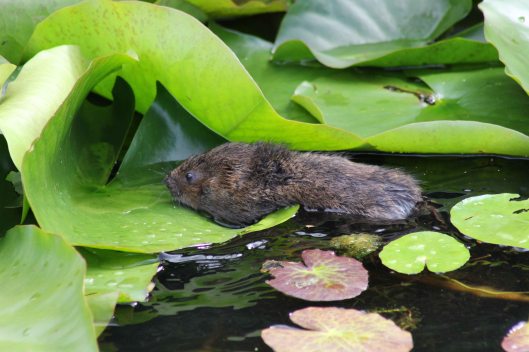
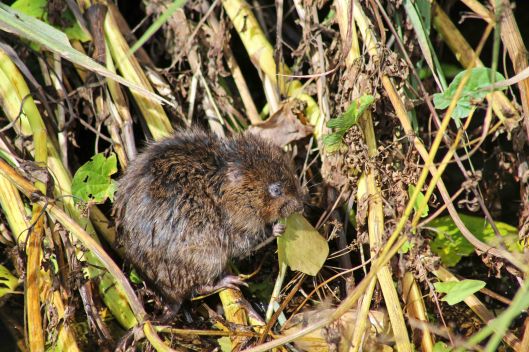
Of course, the ‘Ratty’ in Kenneth Grahame’s much-loved tale The Wind in the Willows is not, in fact, a rat, it’s a Water vole (Arvicola amphibius), as are the gorgeous little creatures in my photographs.

170805 Water vole (2)

Water vole numbers have declined hugely in recent years, partly, it seems, due to predation by American minks and partly due to loss of habitat. Luckily for me, one hundred Ratties were recently reintroduced at one of my local country parks, and a few of them have made themselves at home in a location where they are easily visible.

170805 Water vole (1)

You have only to be quiet and watchful to see them swim out from their hiding places amongst the reeds at the edge of a pond, nip off a leaf from the floating water lilies, swim back to the pond edge, and sit contentedly nibbling away. They are the cutest wee creatures!

170805 Water vole (3)

Like Loading...

Pulling the little blossom threads

04 Friday Aug 2017

Posted by sconzani in flowers, nature, wildflowers

≈ 2 Comments

Tags

Centaurea nigra, Common knapweed, John Clare poem, John Clare poem May, knapweed, love divination game with knapweed

170804 Common Knapweed (1)

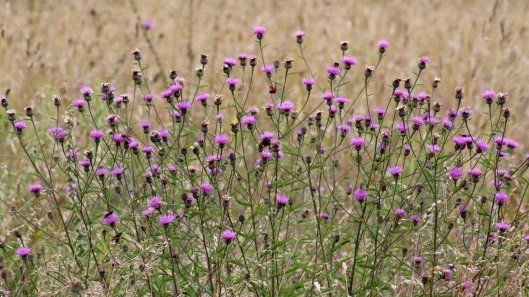
In days of old a love divination game would be played with the flowers of the Common knapweed (Centaurea nigra), as described here by English poet John Clare (1793 – 1864) in his poem ‘May’:

170804 Common Knapweed (3)
170804 Common Knapweed (4)

They pull the little blossom threads
From out the knapweeds button heads
And put the husk wi many a smile
In their white bosoms for awhile
Who if they guess aright the swain
That loves sweet fancys trys to gain
Tis said that ere its lain an hour
Twill blossom wi a second flower
And from her white breasts hankerchief
Bloom as they ne’er had lost a leaf

170804 Common Knapweed (5)
170804 Common Knapweed (6)

170804 Common Knapweed (2)

Like Loading...

Sneaky

03 Thursday Aug 2017

Posted by sconzani in insects, nature, wildflowers

≈ 4 Comments

Tags

British spiders, Daucus carota, Enoplognatha ovata, hoverflies, Pastinaca sativa, spiders, Wild carrot, Wild parsnip

I’ve got nothing against spiders: like all creatures they need to eat, but they can be rather cunning about how they ensnare their prey.

170803 Enoplognatha ovata sensu lato (1)

These Enoplognatha ovata, which come in several colourways, were taking advantage of the umbrella-shaped flowers of Wild carrot (Daucus carota) and Wild parsnip (Pastinaca sativa), lurking under the canopy created by the flower stems then darting rapidly through the gaps to grab hoverflies and other mini-beasties while they were feeding. Very sneaky!

170803 Enoplognatha ovata sensu lato (3)
170803 Enoplognatha ovata sensu lato (2)


Like Loading...
← Older posts
Newer posts →

About me

sconzani

sconzani

I'm a writer and photographer; researcher and blogger; birder and nature lover; countryside rambler and city strider; volunteer and biodiversity recorder.

View Full Profile →

Follow earthstar on WordPress.com

Enter your email address to follow this blog and receive notifications of new posts by email.

Recent blog posts

  • Peak Wild garlic April 26, 2026
  • First damsels of 2026 April 25, 2026
  • NFY: Green-veined white April 24, 2026
  • The return of the Willow warblers April 23, 2026
  • Bug: Harpocera thoracica April 22, 2026

From the archives

COPYRIGHT

Unless otherwise acknowledged, the text and photographs on this blog are my own and are subject to international copyright. Nothing may be downloaded or copied without my permission.

Fellow Earth Stars!

  • Unknown's avatar
  • Unknown's avatar
  • Unknown's avatar
  • Unknown's avatar
  • Unknown's avatar
  • Unknown's avatar
  • Unknown's avatar
  • Unknown's avatar
  • Unknown's avatar
  • Unknown's avatar
  • Unknown's avatar
  • Unknown's avatar
  • Unknown's avatar
  • Unknown's avatar
  • Unknown's avatar
  • Unknown's avatar
  • Unknown's avatar
  • Unknown's avatar
  • Unknown's avatar
  • Unknown's avatar
  • Unknown's avatar
  • Unknown's avatar
  • Unknown's avatar
  • Unknown's avatar
  • Unknown's avatar
  • Unknown's avatar
  • Unknown's avatar
  • Unknown's avatar
  • Unknown's avatar
  • Unknown's avatar
  • Unknown's avatar
  • Unknown's avatar
  • Unknown's avatar
  • Unknown's avatar
  • Unknown's avatar
  • Unknown's avatar
  • Unknown's avatar
  • Unknown's avatar
  • Unknown's avatar
  • Unknown's avatar
  • Unknown's avatar
  • Unknown's avatar
  • Unknown's avatar
  • Unknown's avatar
  • Unknown's avatar
  • Unknown's avatar
  • Unknown's avatar
  • Unknown's avatar
  • Unknown's avatar
  • Unknown's avatar

Blog at WordPress.com.

Privacy & Cookies: This site uses cookies. By continuing to use this website, you agree to their use.
To find out more, including how to control cookies, see here: Cookie Policy
  • Subscribe Subscribed
    • earthstar
    • Join 642 other subscribers
    • Already have a WordPress.com account? Log in now.
    • earthstar
    • Subscribe Subscribed
    • Sign up
    • Log in
    • Report this content
    • View site in Reader
    • Manage subscriptions
    • Collapse this bar
 

Loading Comments...
 

You must be logged in to post a comment.

    %d