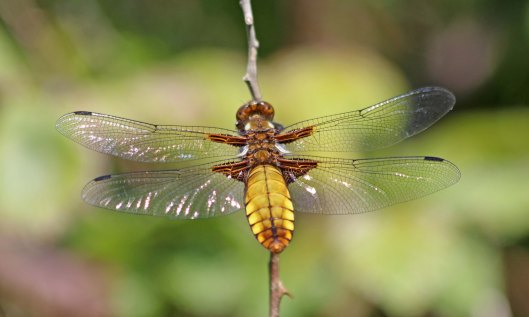
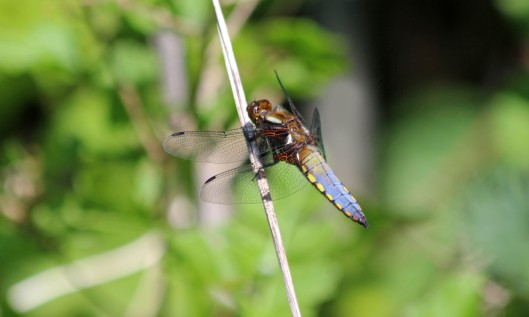
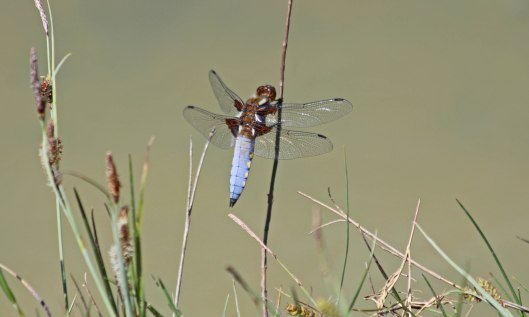
I was delighted to see my first dragonflies of the year at Lavernock Nature Reserve during this morning’s walk: two female (with the golden abdomen) and two male (blue abdomen) Broad-bodied chasers.

06 Wednesday May 2020
I was delighted to see my first dragonflies of the year at Lavernock Nature Reserve during this morning’s walk: two female (with the golden abdomen) and two male (blue abdomen) Broad-bodied chasers.
05 Tuesday May 2020
I know I already posted about seeing my first Orange-tip butterfly of the year (The ostentatious Orange-tip, 15 April) but, for those not familiar with this lovely springtime butterfly, I thought it might be useful to see a bit more detail. So, here is a typical male Orange-tip, from the top and the side. The speckling on the lower wings looks green but that’s an optical illusion – the colours are actually yellow and black.


And here’s a female from both angles. If you only see her from the top, you might confuse her with one of the other white butterflies, though the dark patches are different in all the whites, and the Orange-tip also has a distinctive wing shape.


I managed to find several eggs during a recent walk – the newly laid eggs are white but turn orange very quickly. You’ll find them on the caterpillar food plants: Cuckooflower, Garlic mustard and Honesty are three wildflowers this butterfly favours. And, for the first time ever, I found a caterpillar. This is a 2nd instar (i.e. stage) – the larvae proceed through 5 instars, progressively growing larger, until they are ready to pupate.


You might be wondering why I gave this post the title of ‘the Lady of the Woods’. Well, according to Peter Eeles’s superb publication Life Cycles of British & Irish Butterflies (every home should have one!), this is the name given to the Orange-tip by Benjamin Wilkes in his Twelve New Designs of English Butterflies, published in 1742.
04 Monday May 2020
During the past couple of weeks, it’s been fascinating to watch two Lesser black-backed gulls – presumably, the same two who nested amongst a group of neighbouring chimney pots last year – renewing their pair bonds and practising their seduction techniques. The process goes a bit like this …

They circle each other, beaks thrust towards the sky in unison, and there’s some low bird-speak (as opposed to gull shrieking) …

One bird (the female, I think) begs the other for food, as if it is a chick, and the second bird regurgitates a niblet of food …

There’s more circling and beak thrusting and chatter …

Finally, the males jumps on the back of the female, though it takes them a couple of minutes to spread their wings, tails, feathers to reach the right angle to achieve copulation …

And this happens more than once, the male remaining on the female’s back until they’ve copulated three times during this one session …
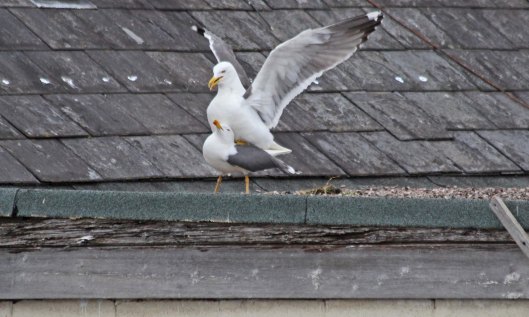
Once finished, he jumps off, she puts her head down and waggles her rear end, and there is more low chatter, and a little beak bumping, before they both fly off.

03 Sunday May 2020
Posted in nature, spring, wildflowers
Tags
Bee-fly, British wildflowers, Grangemoor Park, Lychnis flos-cuculi, Ragged robin, Silene flos-cuculi, Spring colour, spring flowers
At Grangemoor Park on Friday, I spotted my first flowering Ragged robin for the year.

This gorgeous wildflower was formerly known as Lychnis flos-cuculi, but is now Silene flos-cuculi – from a scientific article I browsed, this seems a complicated story of almost constant reclassification of the species! You will still see both names used in books and on line, which is why I’ve mentioned both here.

According to a couple of books I discovered on the ‘language of flowers’, Ragged robin’s symbolic meaning is ‘wit’, and it is dedicated to Saint Barnabas. The ever-informative First Nature website says:
Lychnis, the genus name, comes from the Greek noun lychnos, meaning lamp; it refers to the use of a plant in this genus as the wick of an oil lamp. The specific epithet flos-cuculi means ‘flower of the cuckoo’ and was probably chosen because the first flowers of Ragged Robin appear just as the first cuckoos are being heard (in Britain and Ireland at least) in May.
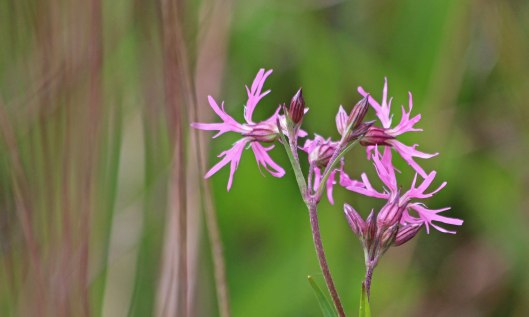
A special moment: to try to stop it swaying in the breeze so I could get a sharp photo, I was holding one of the blooms when a bee-fly decided to zoom in for a feed of nectar. That super long proboscis comes in handy for long narrow flowers like these.

02 Saturday May 2020
Tags
beetles, beetles on dock plants, British beetles, dock beetles, Gastrophysa viridula, Green dock beetle
Iridescent Green dock beetles are out in force now on the Dock plants in one of my local parks. I’ve blogged about these gorgeous mini-beasties before (Green dock beetles, May 2016) so today I’m just going to share a few photos. Keep an eye out for these on your exercise walks, and don’t forget to check carefully under the holey leaves for eggs and their little grey grubs.


01 Friday May 2020
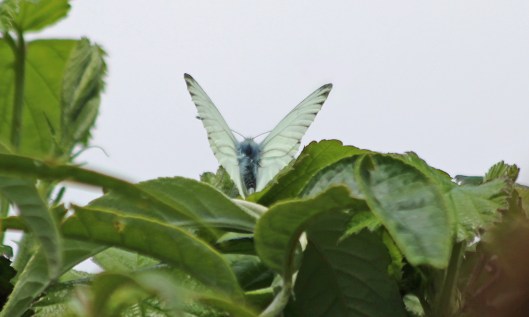
With the current restrictions on movement, my butterflying has got off to a slower start than usual but today I spotted my first Green-veined white butterfly of 2020, my tenth species for the year, during my walk around Cardiff’s Grangemoor Park.
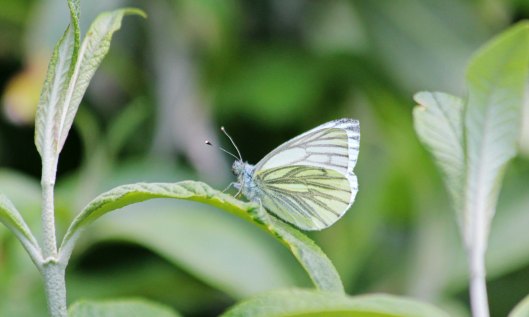
This pristine male only appeared briefly, before disappearing amongst the leafy trees, but it was a joy to see him. These spring-brood Green-veined whites are often very pale – I can’t even see the small dark spots on his upper wings and he has only a hint of yellow colouring on his undersides. The summer brood, when they emerge in July and August, usually show darker markings – I’ll try and do a comparison post later in the year to show the differences.
30 Thursday Apr 2020
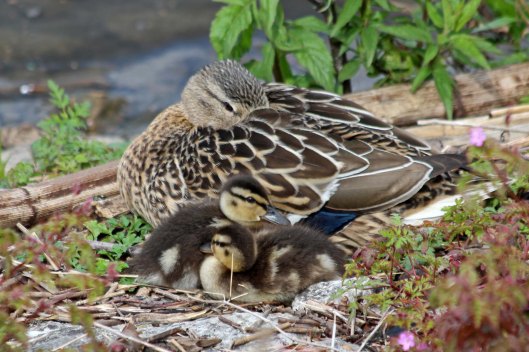
Some days we all need a dose of cuteness!
29 Wednesday Apr 2020
Tags
British galls, British wasps, parasite of Urophora cardui, parasitic wasp, Thistle gall fly, Thistle gall fly gall, Urophora cardui
Back in October 2017, I blogged about a gall I’d found (More galls, part 2), the gall created by the Thistle gall fly (Urophora cardui). Here are two photos of those galls: on the left, the gall growing on the thistle (in fact, there are two galls – there’s a second one, still quite small, in the background to the left) and, on the right, a dried version, which I harvested from a thistle plant at the end of last year and which I’ve since been keeping at home in a jar.


According to my research, the Thistle gall flies don’t usually emerge until June but last week flying creatures began emerging from the gall. On closer examination, I found the empty pupae case (pictured below right) poking out of one of several holes in the gall.


So far, five little critters have hatched but these are not Thistle gall flies. They appear to be some kind of parasitic wasp, which I have not yet managed to identify – there are thousands of species of parasitic wasp and these are not the species that is normally considered the primary parasite of the Urophora cardui (which is a wasp called Eurytoma robusta).
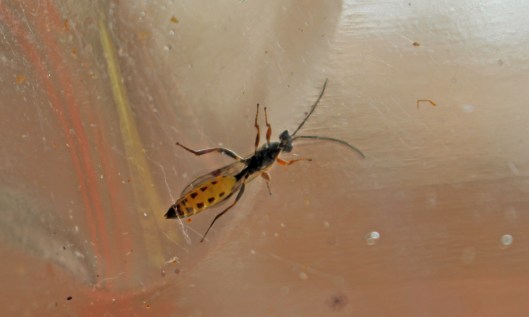
Underside of wasp, photographed through glass of jar
I don’t know whether any Thistle gall fly larvae or pupae still survive within the gall or, indeed, whether anything else will yet emerge. So, for now, the gall remains in its jar, and I’ll post again if any other aliens appear.
This story has a sequel as all in this gall was not as it seemed – here’s a link to part 2, A Tale of two galls, May 2020.
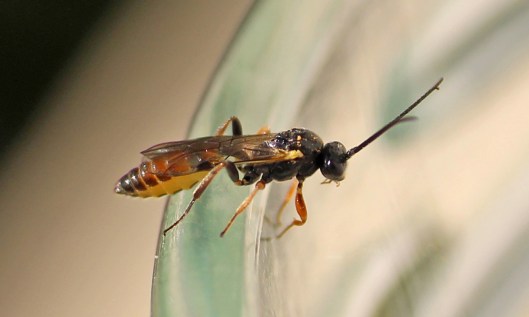
One of the mystery wasps, sitting on the edge of the jar, as it was being released
28 Tuesday Apr 2020
My local Jackdaws are excellent weather indicators. If I haven’t already realised how wet it is outside, I have only to glance out my bedroom window to see where they are. If they’re sitting under the eaves on the old-fashioned gutter supports, then I know it must be teaming down.

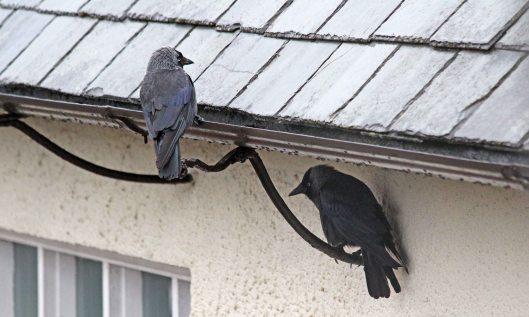
Sometimes they look really miserable sitting there, each on their own bracket. Other times, they snooze, or use the opportunity for a groom and feather spruce up.
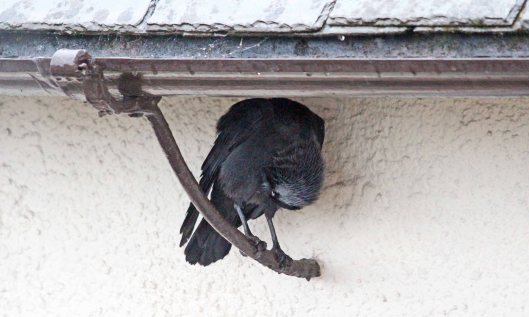
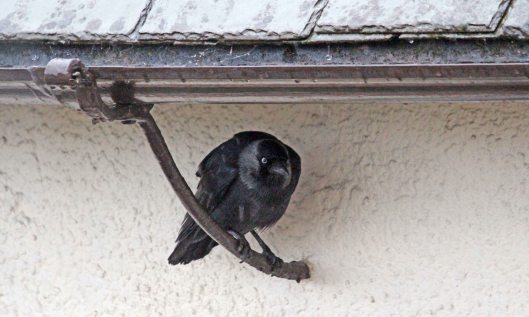
I have to be careful trying to get photos of them, as those alert blue eyes are always aware of what’s happening around them, even when I think they’re not.
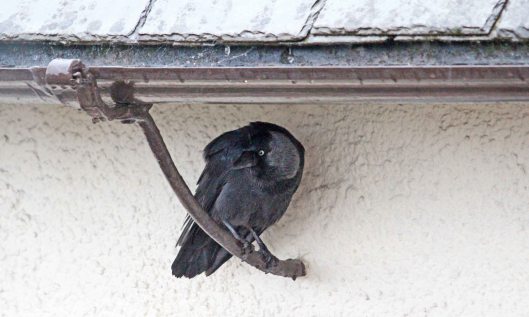
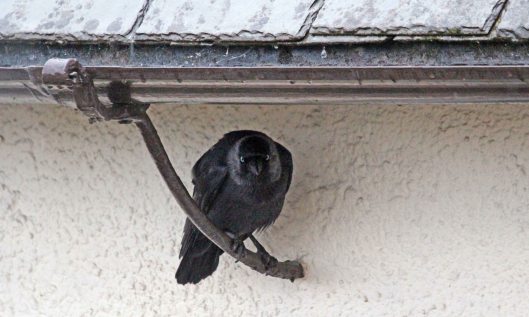
27 Monday Apr 2020
Tags
birding, British birds, Cardiff Bay, Coot, Ely embankment, Pied wagtail, Rock pipit, Shelduck, starling, Turnstone
I felt the need to see some birds today so headed down to Cardiff Bay for my exercise walk. First up, this pair of Shelducks were working their way around the water’s edge near the Barrage – first I’ve seen since the lockdown began.

This Starling had a beakful of caterpillar and flies so I presume it had hungry mouths to feed somewhere nearby.

At least fourteen Turnstones were picking and poking their way along the stones of the embankment, this one looking very handsome in its breeding colours.

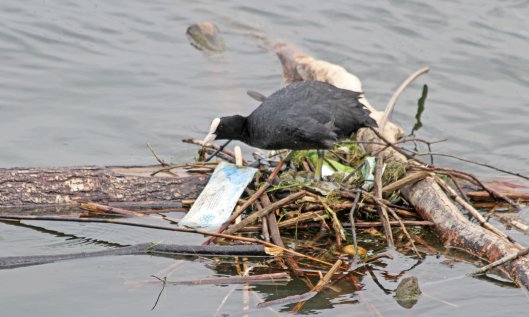
This Coot was busy pulling bits of rubbish into the pile of sticks it has begun shaping into a nest. Its mate was nearby, hauling a branch to weave into the growing structure.
This was the first Rock pipit I’ve seen for a little while. It was busily prospecting for nibbles so perhaps it also has offspring to feed.

Most of the wagtails have moved away to breed but this Pied wagtail looked very handsome amongst the Herb Robert and Red valerian that now covers much of the embankment.

 earthstar
You must be logged in to post a comment.