Duckling

Tags

, , ,

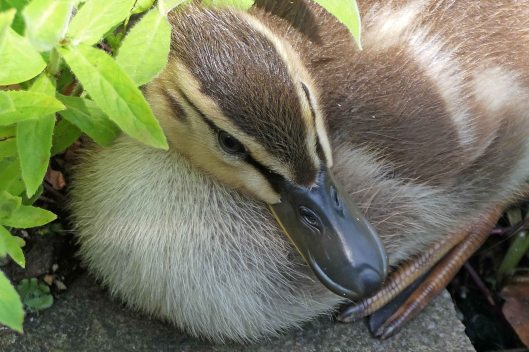
I have a ton of photos of Mallard ducklings but I just couldn’t resist taking a few shots of this little cutie that was snoozing with its mum and three siblings on the water’s edge about 20 feet below me. At the very least, the angle, looking straight down from above, gave a different perspective to most of my other duckling photos.

230711 mallard duckling

When my luck runs out

Tags

, , ,

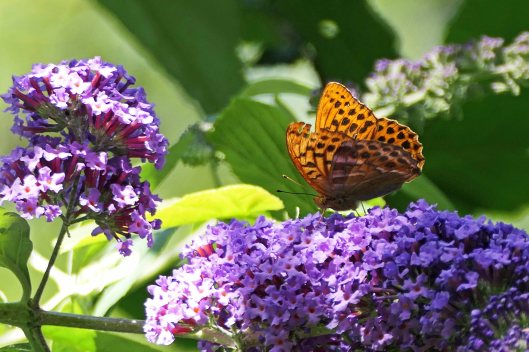
Though I’m generally very fortunate with my butterfly sightings, sometimes my luck’s just not in. Twice now I’ve visited the woodland where I usually see lots of Silver-washed fritillaries and manage to get reasonable photos of those I see. My first visit was on a windy day, with lots of big clouds rolling through – not ideal butterfly weather and, though I did see several fritillaries, they were mostly flying strongly along the woodland rides, only settling out of sight behind the shrubbery. This was my best shot from that visit.

230710 silver-washed frit (1)

Last Friday I tried again – it was warm and sunny with little wind. Conditions should’ve been perfect yet, once again, the butterflies just weren’t cooperating. I really enjoyed seeing those gorgeous vibrant fritillaries that zoomed past me but, once again, they weren’t stopping, so this is the best of few images I managed to get. Still, there’s always next year …

230710 silver-washed frit (2)

A couple of mallows

Tags

, , , , ,

There are a lot of wildflowers I can recognise at a glance – ‘Oh, that’s a forget-me-not, knapweed, mallow …’ – but, in many cases, there are several species of these flowers and I’m not sure which I’m seeing. So, I’m trying to make more of an effort to work out which is which. Here’s an example.

These two species of mallow look very similar to me, and they grow in similar habitats, in waste ground, along our road verges, beside footpaths. Their beautiful flowers are much of a muchness, though the flowers of Common mallow have dark purple stripes, whereas those of Musk mallow are finer and pale pink, and their petal shapes are also different. However, it’s the leaves that really clinch their identification, as you can see from the photos below.

230709 common mallow

Common mallow (Malva sylvestris)
According to the Wildlife Trusts website, ‘Certain parts of common mallow are edible (leaves, flowers and seeds) and there is evidence that the Romans may have deliberately cultivated the plant to be used for food and medicine’.

230709 musk mallow

Musk mallow (Malva moschata)
As well as the deeply lobed leaves that distinguish Musk mallow from Common mallow, the flowers also emit a musky perfume, which the Common mallow does not have. And that smell is, of course, how this plant got its common name.

Cocoon

Tags

, , , , , ,

At this time of year, whenever I spot a Wych elm tree, I spend a bit of time staring at the leaves. I look for two things in particular: the first is to see if I can spot any White-letter hairstreak butterflies flitting around, usually at the top of the tree but also lower down; and the second is to see if anything has been nibbling at the leaves. My searching paid off last week when I spotted the distinctive signs of leaf damage caused by the larvae of the Elm zigzag sawfly (Aproceros leucopoda), not necessarily a good thing as this is an invasive species, which I found new to Wales in October 2021 (Zorro comes to Wales) and which is now slowly spreading westwards. But, more interestingly in this particular case, I found one of the cocoons the larvae pupate in, a very delicate, woven-silk structure (you can see an occupied cocoon on the Forest Research website). This one was empty so I guess that’s one more adult sawfly helping to spread the species further.

230708 elm zigzag sawfly cocoon

The tiniest moth

Tags

, , , ,

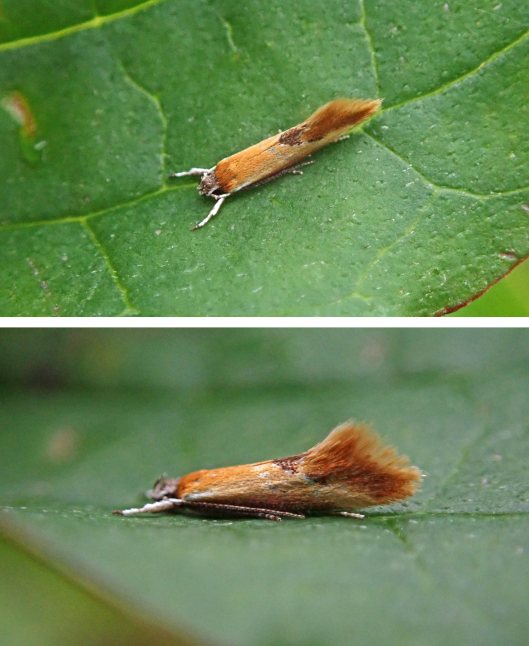
At first I thought this was just a scrap of dried leaf or something similar, but then I looked more closely and could see that the two white bits sticking out one end were in fact tiny legs. It was a moth, a Lesser tawny tubic (Batia lunaris), hands down the smallest moth I’ve ever seen.

230707 Batia lunaris (1)

According to the UK Moths website, it has a wingspan of 7-10mm, is present throughout England (it doesn’t mention the rest of the UK but, obviously, it’s here in Wales!), and can generally be found in woodland areas – if you can find it at all, that is. I’m so glad I decided to check it out rather than ignore it.

230707 Batia lunaris (2)

Little Gorse shieldbugs

Tags

, , , ,

I’ve blogged about Gorse shieldbugs (Piezodorus lituratus) before, in particular the adult bugs and their amazing little barrel-shaped eggs (in A bug and its eggs, April 2022) but I’ve only once before seen one of the intermediate stages of the nymphs between egg and adult (a second instar – see A shieldbug selection, September 2021). Until last week, that is. And these Gorse shieldbugs, of various instars, were actually grazing on Broom rather than Gorse. (The British Bugs website has both photographs and a chart of the diversely coloured nymphs, if you’re interested in more information.)

230706 gorse shieldbug instars

Little Long-tailed tit

Tags

, , , , ,

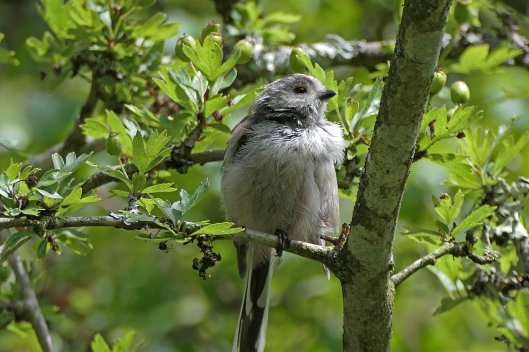
As I was standing perfectly still and silent in the thick of a copse of trees and shrubs, staring at leaves and insects and leafmines, the small flock of juvenile Long-tailed tits moving through the greenery, foraging for tiny insects, didn’t notice me, which meant I was able to get a few photos of these adorable wee youngsters.

230705 long-tailed tit juvenile

The cryptic Grayling

Tags

, , , ,

Their cryptic colouring is so effective that if you blink, you lose them, so I consider myself very fortunate to have found at least a dozen Grayling on top of the Aberbargoed spoil tip during my annual visit last Thursday.

230704 grayling (1)

It’s only when these butterflies display their upper wing, with the Meadow-brown-like dot and orange colouring, or perch in an uncluttered spot, like this rock, that they can be seen more clearly.

230704 grayling (2)

And, even then, if you’re standing more than a few feet away on a slope covered in dry vegetation and coal-mining spoil, unless you see where they land they can be extremely tricky to locate. The word cryptic was invented for these beauties.

230704 grayling (3)

Broom leaf-beetle

Tags

, , , , ,

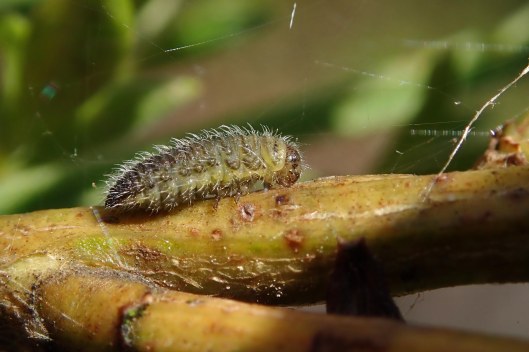
I spent an hour going through my guidebooks on British caterpillars and butterfly life cycles but couldn’t find a match for this little critter, found on a stem of Common broom (Cytisus scoparius) growing on the side of the Aberbargoed spoil tip. So, I put a query on Twitter, tagged a couple of friendly experts, and within five minutes I had an answer. It wasn’t a Lepidoptera larva at all – this is the larva of the Broom leaf-beetle (Gonioctena olivacea) (click on this link to the UK Beetles website to read more). Of course, now I’m going to have to go back to see if I can find the adult beetle, which is apparently active between April and late summer, and which I’ve never seen.

230703 Broom leaf-beetle larva

Lady’s-mantle

Tags

, , , ,

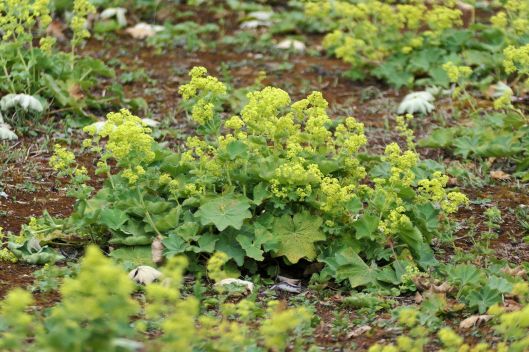
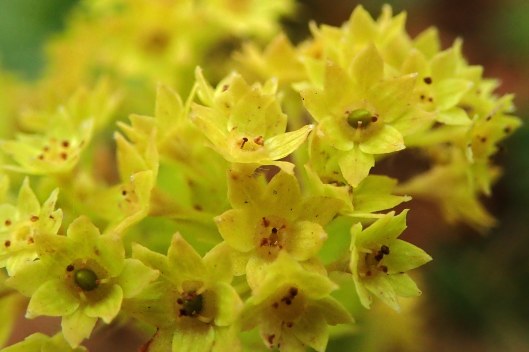
Lady’s-mantle is one of those plants that’s difficult to determine to exact species. The large Garden lady’s-mantle (Alchemilla mollis) has escaped its original garden setting and become naturalised in many places, and, just to increase identification difficulties, some species have hybridised with others. It’s a plant I’ve found growing in a variety of places: in grassland at the local country park, along a nearby woodland ride, on a former coal spoil tip and, below, in a former quarry.

230702 Lady's-mantle (1)

Richard Mabey provides some interesting information about this plant in Flora Britannica:

The often nine-lobed leaves of lady’s-mantle, like cloaks or umbrellas, fold up overnight and catch the dew on their soft hairs. Plant-dew was highly valued by early herbalists … and this made Alchemilla prized as a simple [sic], prescribed for wounds, infertility, and impotence. The alchemists also required the purest dew for turning base metal into gold – hence the name Alchemilla, ‘little alchemist’. Such a powerful and magical herb was bound to be christianised, and some time in the Middle Ages it was named Our Lady’s Mantle, and eventually lady’s-mantle.

230702 Lady's-mantle (2)