Purple sheen

Tags

, , ,

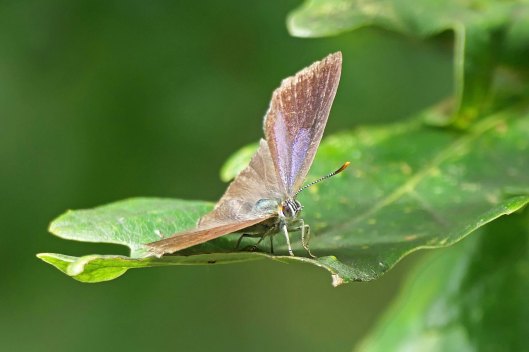
First I saw one distantly in the Oak trees opposite Lavernock Nature Reserve, and I was glad.

230721 purple hairstreak (1)

Then I saw one very close in the Oak trees at Casehill Woodland (as it flitted right on to the leaves in front of me), and I was overjoyed.

230721 purple hairstreak (2)

They’re Purple hairstreaks, of course, and they are beautiful, and I was very lucky.

230721 purple hairstreak (3)

Streaks of teal and turquoise

Tags

, , , ,

I timed yesterday’s arrival at the second hide at Forest Farm Nature Reserve perfectly – some birders sit patiently in the hide for hours waiting for a Kingfisher to fly in and perch on the strategically placed stick.

230720 kingfisher (1)

And, in fact, I was doubly lucky as I later had two Kingfishers streak past as I walked along the canal path. They are the most gorgeous birds!

230720 kingfisher (2)

Barkfly: Graphopsocus cruciatus

Tags

, , ,

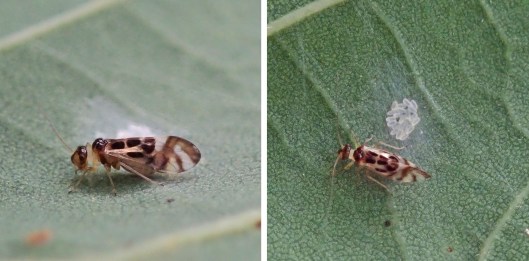
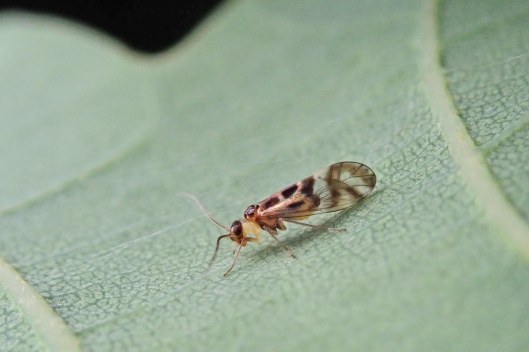
By sheer coincidence, on the very morning I got the email notification that I had correctly identified my first Graphopsocus cruciatus species of barkfly, found on 4 July at Cosmeston Lakes Country Park, I went out and found two more of the same species. And it was particularly nice to find one that was sitting next to its clutch of eggs, kept secure beneath a net of silken threads.

230819 Graphopsocus cruciatus (2)

These are tiny flies that I never even knew existed until late 2021 (A Barkfly, 24 November). Many are quite common but you need to turn over leaves to spot them lingering underneath – or, at least, that’s where I find them. I’m sure they spend time on tree trunks too, hence the name. You can read more about them on the National Barkfly Recording Scheme website, where there is an excellent gallery of photos that makes identification much easier.

230819 Graphopsocus cruciatus (1)

Poplar hawk-moth larva

Tags

, , , , , ,

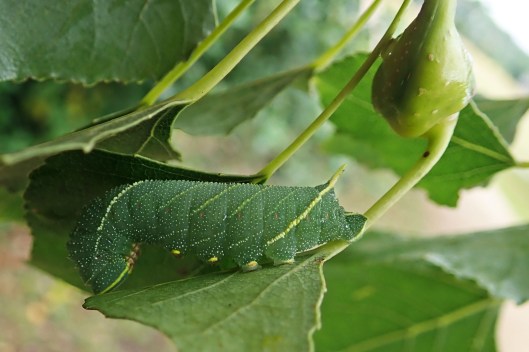
The leaf-staring story I related yesterday didn’t end with me seeing my first Poplar spiral galls – oh no! There was a bonus sighting that was much more exciting. Lurking behind one of the leaves I turned to more easily photograph a gall was this caterpillar, the larva of a Poplar hawk-moth (Laothoe populi). What a magnificent beast it was!

230718 hawk-moth poplar

Galls: Pemphigus spyrothecae

Tags

, , , , , ,

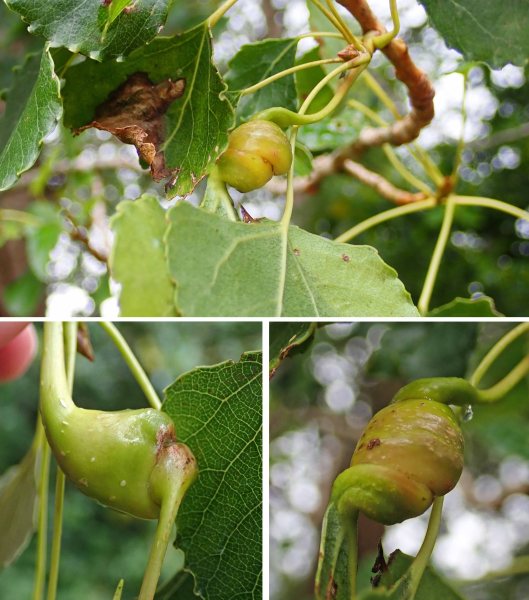
During our recent wet and windy weather I’ve taken to leaving my good camera at home, going out in wet weather gear with just my point-and-shoot camera tucked in a jacket pocket. As that camera is really only good for macro shots, I’ve been forced to look at things more closely – no bad thing, and, given the frequent heavy showers, I’ve been spending more time than usual sheltering under trees. And that, of course, means I’ve been looking at trunks and branches and leaves, which is how I came to notice these odd swellings on a Poplar tree in a local park. The aphid Pemphigus spyrothecae causes the leaf petiole to twist two or three times, forming a chamber in which the aphid’s larvae can develop. I didn’t open any of the galls but, if you want to see images of what’s inside, and read more about the life cycle of these aphids, the Influential Points website is the place to go.

230717 Pemphigus spyrothecae galls

Back lane wildflowers

Tags

, ,

I almost want to whisper this post, as it’s a miracle the local council hasn’t poisoned these wildflowers out of existence as they usually do a couple of times over the summer months, this despite the dangers of those herbicides to humans, insects and birds, even the dogs that get walked along the back lanes, and despite the council having declared a ‘nature emergency’! So, for now, the back lane between my street and the next is alive with wildflowers, some of which I’ve featured in this little video.

My Crow family

Tags

, , , , ,

I first introduced you to my Carrion crow friend back in May last year (A crow companion) and then wrote about our continuing ‘friendship’ in October 2022 (The look, the glare). Our relationship has continued in the intervening months; whenever I walk through his territory, he flies over, walks with me, expects food. He even manages to find me when I’m walking along the woodland path adjacent to his paddock, and I don’t know how he does that!

230715 crow

Earlier this year, he began bringing another Crow with him, his mate I immediately presumed. She was initially very timid but is now much less so, and is sometimes the first to spot me and fly over. A couple of months back they both became much more demanding and were flying away, their beaks jammed with food, towards a specific part of the woodland. Chicks! And now here they are – three well-grown, raucous and difficult-to-photograph-because-never-still youngsters, who are also being brought to see and taught about the food-bearing human. I couldn’t be more proud!

230715 crow family

The cycle goes round and round

Tags

, , , , ,

All that’s missing from this illustration of the life cycle of the Dock beetle is the pupation stage but I’m not going to disturb their underground pupae to show you that. Though common, I still find them fascinating and, because they’re common, they’re a good insect to show children how a beetle’s life cycle functions.

230714 dock beetle life cycle

n.b. There may be an extra insect in the photo of the larvae. I suspect those tiny white dots might be hoverfly eggs, as the larvae of some species enjoying feasting on various leaf beetle eggs and larvae. I’ll be doing more leaf-turning to check.

Scarlet tiger moths

Tags

, , ,

When you read the words ‘tiger moth’, you probably think plane, after the flying machines engineered by Geoffrey de Havilland (the first of these was designed with foldable wings, so as to fit into a small space – hence the name moth]. I hadn’t realised until I read up about him that de Havilland designed lots of planes, with variations of the moth name – no surprise then to read he was apparently an enthusiastic lepidopterist.
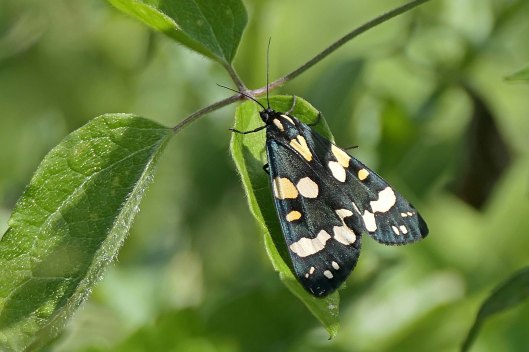
230713 scarlet tiger (1)

However, I digress. In this blog, the tiger moths are actually moths not planes, Scarlet tiger moths – in fact, the two Scarlet tigers seen during last week’s perambulations. The Scarlet tiger is the tiger moth I see most often, though it is only one of six tiger moths regularly seen in the UK – the others are Ruby, Wood, Garden, Cream-spot and Jersey tiger.


230713 scarlet tiger (2)