Ms Gadwall finds a friend

Tags

, , ,

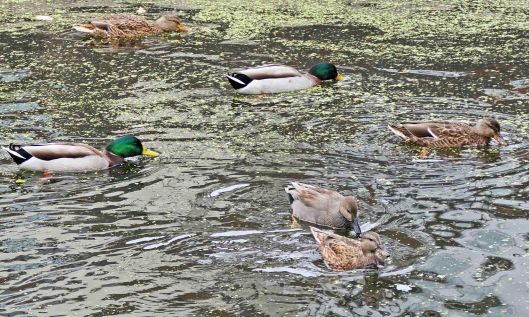
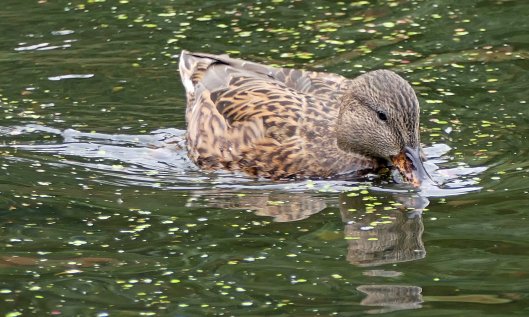
Do you remember my piece back in July about The Gadwall that thinks she’s a Mallard? Well, she’s back – or perhaps she’s been lingering unnoticed in the more sheltered spots around Cardiff Bay – and, though I still think she thinks she’s a Mallard, she now has a male Gadwall friend who’s trying to convince her otherwise.
221015 gadwalls (1)

Personally, I hope he succeeds, not from any notion that a pairing would somehow be romantic but rather because in the area where they are now several birds (and a large fish) have been found dead in recent weeks. This might be due to avian flu (it has been reported to the appropriate authorities) or it could be the poor water quality, but it would certainly be better for all the local ducks if they moved elsewhere.
221015 gadwalls (2)

The only positive thing about their location, in the old canals of Cardiff’s Atlantic Wharf area, is that you can get very close views. And so I couldn’t resist a visit, partly to say hello to Ms Gadwall again but also to get some good photographs of the drake.

221015 gadwalls (3)

A single silent parrot

Tags

, , ,

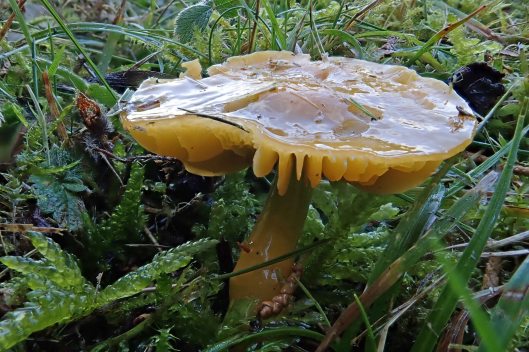
Yesterday saw me back on my old stomping grounds in north Cardiff and along the way I popped in briefly to the new section of Cathays Cemetery. Although both the old and new sections of this huge cemetery are recognised hotspots for fungi and enjoy SSSI designation, the council chooses to ignore recommendations for the site’s management and so I have noted that with each passing year the quantity and diversity of fungi has declined. Though I didn’t linger long yesterday (it’s depressing to see the sparsity where once there was abundance), I did manage to find a single Parrot waxcap, saved from the strimmer’s plastic blade by its location between two old gravestones, stunning in its solitary beauty. If only this Parrot could scream ‘Save us!’ … but would anyone be listening?

221014 parrot waxcap

p.s. I have previously approached the council about their management of these places but, as is typical when I try to communicate reasonably with the various local authorities, their responses contain mostly excuses for their actions. They will not listen to the Parrot!

Feed up, fly south

Tags

, , , , ,

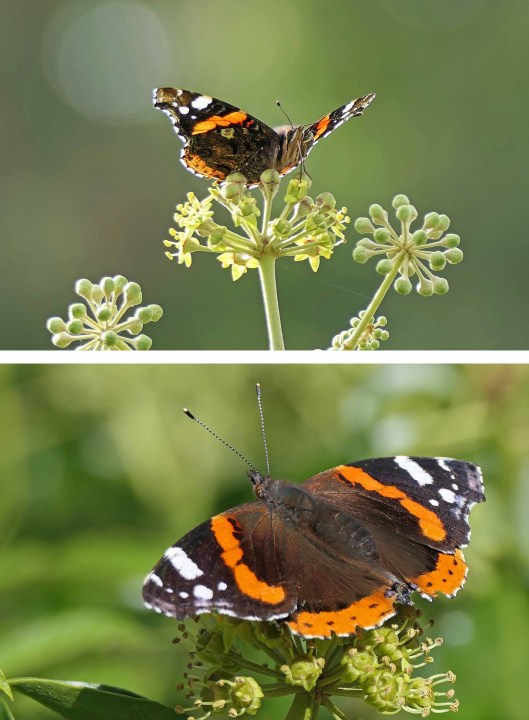
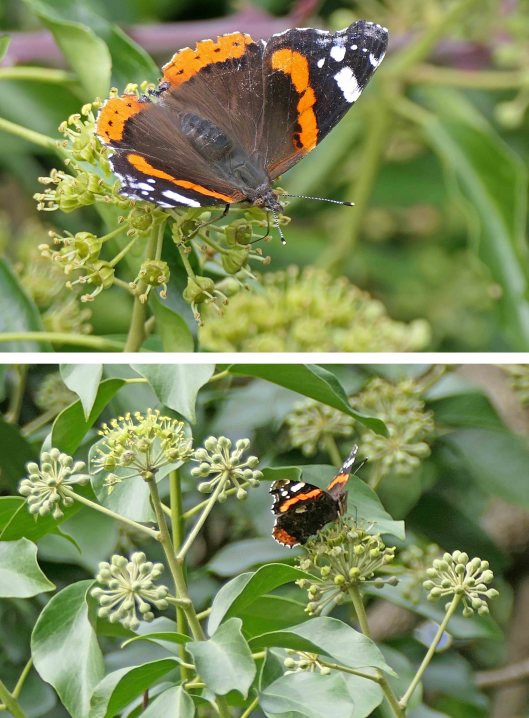
It’s not only the birds that head south in the autumn. During a walk along the coastal path earlier this week, I noticed several Red admirals getting ready to migrate.

221013 red admiral (1)

Ivy flowers are essential for them at this time of year when they need to take on as many nutrients as possible before they take the big plunge and fly off over the cliffs, a feat that never ceases to amaze.

221013 red admiral (2)

Winding down with waders, 3

Tags

, , , ,

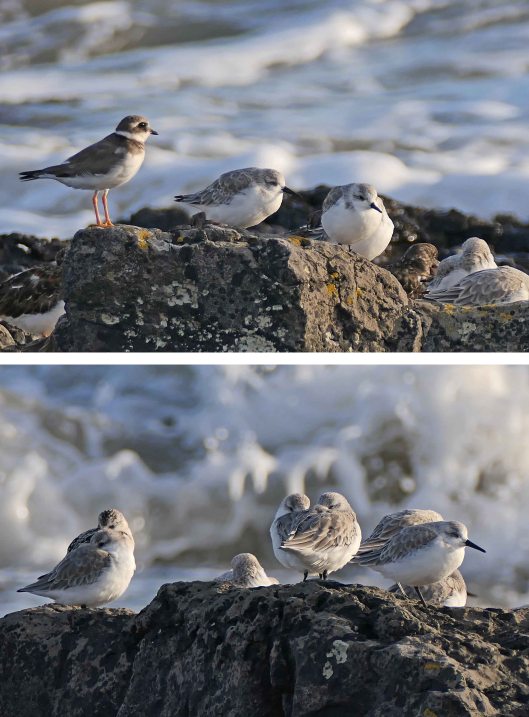
A single Dunlin, which appeared to fly in to the rocks at Newton Point with a flock of Ringed plovers, was my first sighting of this handsome wader species this year. Though initially standing alone on the quickly disappearing patch of sand at the base of the rocks, it soon moved on to a large rock to hunker down with the other roosting waders, the Turnstones, Ringed plovers and Sanderlings.

221012 dunlin

Winding down with waders, 2

Tags

, , , ,

Sanderlings are stunning small waders, usually hyperactive sand scurriers, though these particular beauties were trying to settle in for a night’s sleep. When splashed by a high wave from the incoming tide, they seemed almost to mutter crossly and fluttered forward to the next dry spot.

221011 sanderling (1)

These were my first Sanderling sightings for the year and an absolute joy to be near as they settled to roost, some just closing their eyes and hunching down, others tucking their heads under one wing. Watching these little waders winding down made me feel quite sleepy too.

221011 sanderling (2)

Winding down with waders, 1

Tags

, , , , , ,

My Saturday was wonderful, a day’s birding along the Vale of Glamorgan coastline with my friend Della, checking clifftops for Choughs (unsuccessfully), stumbling over Stonechats along shorelines, scanning blue skies for Kestrels and Fulmar (the latter also unsuccessfully), hoping for (but not finding) the gold nuggets of Yellowhammers in hedgerows, nabbing a snippet of a Little owl in a crumbing barn roof.

221010 newton point birding

We wound down by watching waders settling in for the night at Newton Point. Arriving about two hours before high tide, we were able to find a couple of spots amongst the rocks where we could sit quietly, almost obscured from the birds, and watch their antics, listen to their chatter as the encroaching tide pushed the birds closer to us. It was the perfect end to a magical day (and I’ll share more about the birds tomorrow and Wednesday).

Gypsywort

Tags

, , ,

I was initially puzzled by this wildflower, growing lush and plentiful along the southern and eastern edges of the old Bute East Dock in central Cardiff. The structure reminded me of a dead-nettle but it wasn’t till I got home, checked my photos and did some online research that I discovered this is Gypsywort (or Gipsywort, depending on how you choose to spell that word) (Lycopus europaeus). It’s a wildflower I’ve only seen a couple of times previously and never in such profusion.

221009 gypsywort (1)

The intriguing name, according to Richard Mabey in Flora Britannica, comes from the fact that the plant can be used to produce a black dye that, people once believed, was used by Gypsies to darken their skin. More likely it was used by Gypsy fortune tellers, as the WildflowerFinder website suggests, to dye their clothes black.

221009 gypsywort (2)

Rush veneer

Tags

, , , ,

The migrants just keep coming, and I love to see them because it always seems so amazing to me that a little moth like this, with a wingspan of just 26-32mm, can fly all the way to south Wales from somewhere in Europe.

221007 rush veneer

Meet the Rush veneer (Nomophila noctuella), which the UK Moths website says ‘can often be found in large numbers at coastal watch-points, and tends to occur in the adult stage between May and September’. At least six of these little migrants flew up from the path as I walked through a local field earlier this week.

Old man, elegant ballerina

Tags

, , ,

I’ve had two close encounters with Grey herons in recent days, this first in a tree near the bridge between the lakes at Cosmeston Country Park (which is why I was at eye level with the bird).

221006 grey heron (1)

The second was along the canals in Cardiff, the bird this time standing on a log at water level. When I posted this photo on Twitter one of my followers commented that she thought the heron could ‘change from an old man to an elegant ballerina depending on stance’ – thank you, Jane. I think she was absolutely right – the bird above is the elegant ballerina, and below is the grumpy old man.

221006 grey heron (2)