Leafmines: Phyllonorycter coryli

Tags

, , , , ,

For those of you who are new to leafmines, here’s one that’s appearing on leaves right about now, is common in Britain and easy to identify.

210913 phyllonorycter coryli (1)

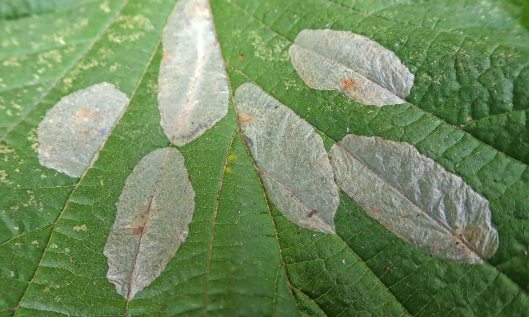
These blisters on Hazel leaves are made by the larvae of the perfectly named Nut leaf blister moth (Phyllonorycter coryli) – you can see what the adult moth looks like on the UK Moths website. In fact, if you’re sharp-eyed, you may have noticed these blisters in July, as this little moth has two broods each year. You can get more details and see more images on the excellent British Leafminers website.

Fruits

Tags

, , , , , , , ,

This was @wildflower_hour’s tweet announcing this week’s #WildflowerHour challenge:

Samaras, siliques, nuts, drupes, berries, hips and capsules, how many different types of wild fruit can you find? That’s the challenge this week for #WildflowerHour. Share your pics this Sunday 8-9pm using the hashtag #fruits.

I’m saving my samaras, siliques, nuts and capsules for another day but here are my drupes, berries and hips: an assortment of Black bryony, Bramble, Buckthorn, Crab apple, Dewberry, Red-osier dogwood (with vivid red stems and white fruit) and Common dogwood, Guelder rose, Hawthorn, the hips of Japanese rose (these grow wild at the local country park) and Dog-rose, Sloe, Whitebeam, Woody nightshade and Yew.

Migrating Reed warbler

Tags

, , , , , ,

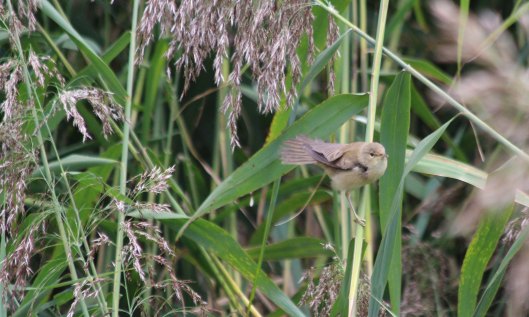
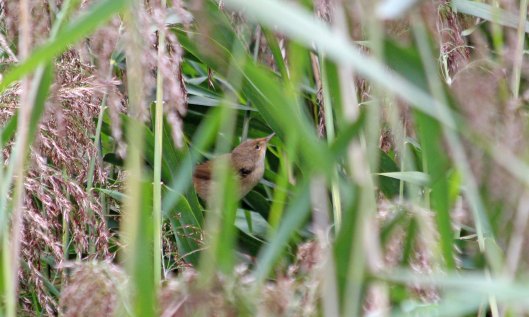
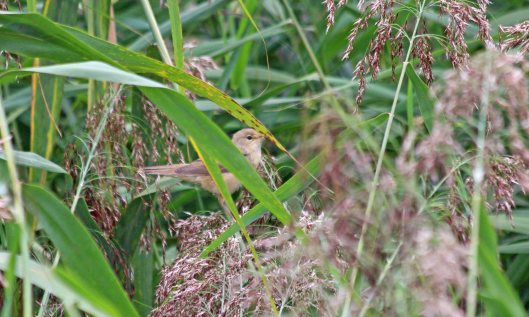
As is often the case with this little brown bird, I heard it before I saw it, not the song but the short nasal ‘churring’ call these warblers make to keep in touch with each other deep within the reed beds.

210911 reed warbler (1)

Luckily for me, as this particularly Reed warbler foraged its way along the brook, I could follow its movement by the bending and shaking of reed stems, and when it occasionally ventured out to the edge of the reeds, I was able to grab some images.

210911 reed warbler (2)

Small though it is – around 13cm in length, the Reed warbler (Acrocephalus scirpaceus) migrates from Britain to over-winter in sub-Saharan Africa, so this little bird has quite the journey ahead of it.

210911 reed warbler (3)

Chicken-of-the-woods

Tags

, , ,

This glorious cascade of brackets was a delightful surprise during a recent woodland meander.

This is the wonderfully named Chicken-of-the-woods (Laetiporus sulphurous), which apparently tastes like chicken, hence the name. However, as Pat O’Reilly writes in Fascinated by Fungi: ‘Young caps taste rather like chicken; old ones taste more like the wood!’ and ‘Never eat Chicken of the Woods gathered from Yews’ because, of course, almost every part of the Yew is poisonous.

210910 chicken-of-the-woods (3)

I’ve only seen these bright yellow-and-orange brackets growing on Oak, though they can also be found on Beech and Sweet chestnut as well as Yew. They are large, growing up to 40cm across, with a velvety upper surface and pores below.

Return of the Great tits

Tags

, , ,

It’s so lovely to see the little birds out and about again, recovered from the strain of raising at least one, probably more, brood(s) of chicks, and looking spick and span in their newly moulted plumage.

210908 great tit (1)

When I was bimbling about in the woods last week, I was visited by a number of Great tits, checking out what I was doing, looking for any insects I might have disturbed. It was a delight!

Where the warmth is

Tags

,

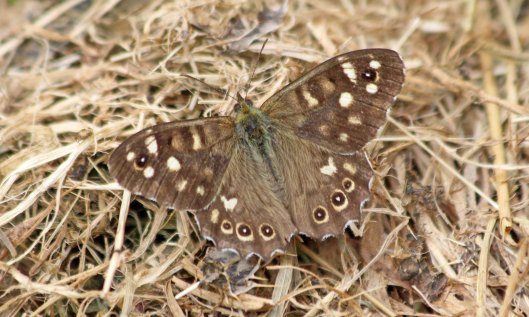
Butterflies are smart!

210907 speckled wood (1)

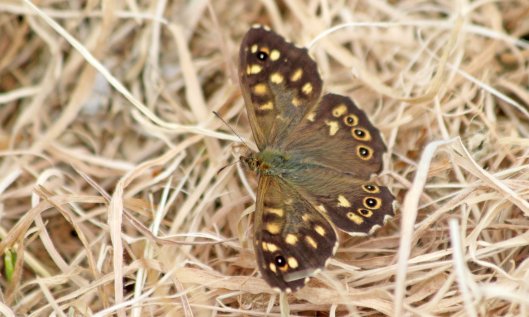
The Speckled wood may be a woodland butterfly, able to cope without as much sunshine as most butterflies need, but it still needs some heat. And, when the sun’s not shining, the warmest places in this area of local woodland are where the rides were recently cut and the grass clippings are beginning to decompose. I found seven Speckled woods in one very small area, all taking advantage of the heat of the rotting process.

210907 speckled wood (2)

Leafmines: a first for Wales!

Tags

, , , , , ,

Back on 18 August, I noticed Rob Edmunds’ post on Twitter about his find of Liriomyza pisivora mines on the Everlasting pea in his garden, which led me to check, the next day, the plants growing at Cardiff’s Grangemoor Park. I found plenty of leafmines but my finds were inconclusive – there are several species that form similar mines so I needed to get better photos, if possible transparent images that showed the frass distribution in the mines.

210906 Liriomyza pisivora (1)

So, when I visited Grangemoor again on 28 August to look for the Wasp spiders that had been reported the previous day, I also took the opportunity to look again at the Everlasting pea plants and took several more photographs. From them, I could see that in some of the mines the frass had been deposited as thin lines alternating from one side of gallery to the other.

Those images were good enough for Barry Warrington, the national recorder of the Agromyzidae family of flies, to confirm that I had indeed found Liriomyza pisivora and, a splendid surprise, that this was the first ever record of these flies in Wales!

210906 Liriomyza pisivora (4)

The host plant in this instance, Broad-leaved everlasting-pea (Lathyrus latifolius), is a relatively recent arrival at Grangemoor, though it is now sprawling abundantly over bramble bushes and along scrubby hedgerows in several parts of the park. So far, I’ve only found Liriomyza pisivora mines in one relatively small area but, perhaps, in time, they will spread throughout the park.

Spiralling orchids

Tags

, , , , ,

A botanical treat I look forward to at this time of year is the final show of native orchids for the year, the delicately formed and perfectly named Autumn lady’s-tresses (Spiranthes spiralis).

210905 autumn lady's-tresses (1)

When I first started visiting Cosmeston Lakes Country Park only one small clump of these little beauties was known but a couple of years ago another much large colony was discovered. I didn’t do an exact count but there were easily 30 stems, many not yet open, and probably more obscured by the other wildflowers.

They grow perilously close to a children’s playground area and are in constant danger of being trampled so let’s hope they survive to bloom another year.

210905 autumn lady's-tresses (4)

Scaeva pyrastri

Tags

, , , ,

It’s quite the transformation, from this green larva that looks a bit like a cross between a slug and a caterpillar …

210904 scaeva pyrastri (1)

to this black-and-white flying creature.

210904 scaeva pyrastri (2)

This is the hoverfly Scaeva pyrastri and, amazingly, it’s a migrant from mainland Europe. A bit like the Red admiral butterfly, Scaeva pyrastri has good years and bad years, sometimes visiting lowland Britain in large numbers, sometimes hardly at all. And, when it comes here, it does often breed locally (and here, I must add a caveat – the larva in my first image may actually be the other Scaeva species, S. selentica, though that species hasn’t actually been recorded in my area).

210904 scaeva pyrastri (3)