The spider and the fly

Tags

, , , ,

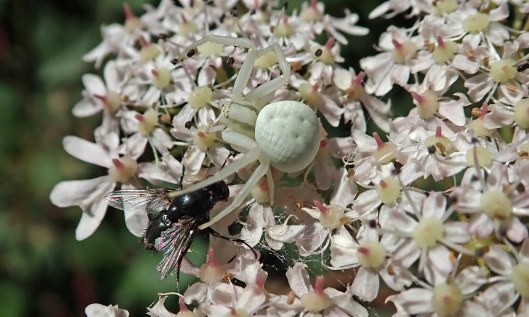
I was watching this well-camouflaged Crab spider (probably Misumena vatia) restraining its prey when a mother and young son came walking along the path towards me. I could see and hear that the woman was pointing out various flowers and insects to her son so, rather than immediately step out of their way, I asked the boy if he wanted to see something cool. I pointed to where he should look and moved away a little, still conscious of maintaining a Covid-safe distance.
210814 spider and fly (1)

He was spellbound as I explained that the spider had been sitting on a white flower so it could use its white colour to trap the fly. He thought the spider was ‘sneaky’, and I could hear him and his mother still talking about the spider and ‘amazing Nature’ as they walked on. Well done to his mum for encouraging the boy’s interest. I think it’s so important that young people are inspired to look closer at the amazing natural world that surrounds them.

210814 spider and fly (2)

Gone, swiftly

Tags

, , , ,

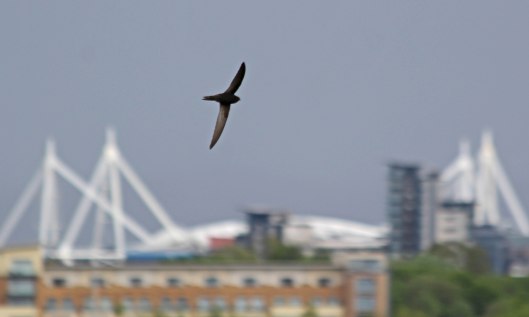
It’s been two days now since I last heard them, so I have to assume they’ve gone, the Swifts that nest in several local buildings and streak as fast as speeding bullets along the local streets, screaming all the while.

210813 swifts (1)

Records show that Swifts usually depart Britain in late July, though I’ve read a report on line this morning that says they’ve stayed a little longer this year, perhaps because they appear to have arrived a little later in the spring. I also watched a short video on Twitter of thousands of Swifts streaming through mist and cloud as they crossed the Swiss Alps – what a sight! And this year they have also to cope with the incredible heat that’s currently bubbling up out of north Africa. Go safely, you beauties!

Raggedy wing

Tags

, , , , , ,

With the precision we can rely on from the Germans, the Comma is called the C-falter, the C butterfly. In France it is known as Robert-le-Diable, Robert the devil, which, according to a 2017 article in the Guardian newspaper, ‘is also the name of a favourite 19th-century Centifolia rose with a unique purple-cerise-scarlet-grey flower and a wonderful old rose fragrance; an 1831 opera by Giacomo Meyerbeer about the moral redemption of the son of a mortal and a demon; and the father of William the Conqueror, who was said to be the son of the Devil.’ Why the Comma also bears this name the Guardian writer does not specify. Here in Wales the Comma is appropriately named Adain garpiog, which translates as raggedy wing.

Balm

Tags

, , ,

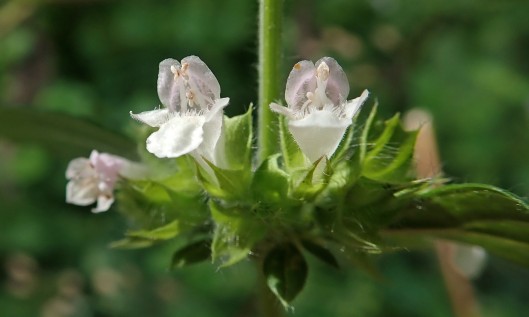
This is a new plant for me, an odd one to find growing at the edge of a local lane that’s only used for pedestrian, cycle and horse traffic, at some distance from houses and gardens. Perhaps it’s a result of a seed dropped from a walker’s shoe or a bird dropping.

210811 balm (1)

This is Balm (Melissa officinalis), also known as Lemon balm, a native plant of the Mediterranean and most often found in Britain as a garden plant, though also sometimes naturalised in nearby waste ground.

From the shape of the leaves I originally thought it some kind of mint, though the white flowers didn’t fit with that possibility. A rub of the foliage between my fingers provided an aromatic clue, as the leaves are often used in herbal teas and remedies.

210811 balm (4)

I thought about harvesting a few leaves to try but this particular Balm is low growing and sprawling along the lane edge, and the sight of a dog peeing just a little ahead of where this plant is growing put me off the idea.

Fledgling Whitethroats

Tags

, , , , ,

We’re still in that quiet birding time when most birds are hiding away in trees and bushes while they undergo their annual moult and autumn migration is only just beginning. Luckily, the fledglings are still providing occasional moments of birding joy.

210810 whitethroat (1)

When I was wandering a local nature reserve last week, I heard the nasal buzzer-like call of two Whitethroats foraging in the scrubby field edges and was delighted to watch them for ten minutes or more as they moved in and out of the bushes, scavenging very successfully for juicy insects and their larvae.

210810 whitethroat (2)

Wayfaring berries

Tags

, , , , ,

I’ve been resisting taking berry photos, trying to deny the fact that the days are shortening and the summer heat slowly fading, but I have been watching the Wayfaring trees I featured earlier this year, in the post The Wayfarer, and I couldn’t resist documenting how the glorious flowers from May have gradually been developing into luscious shiny red berries.

The brown blue

Tags

, , , , , ,

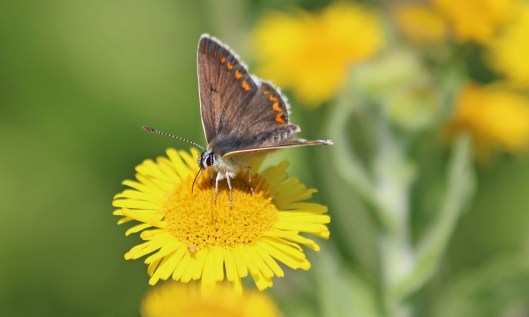
According to my Life Cycles of British & Irish Butterflies, William Lewin named this butterfly the ‘Brown blue’ in his 1795 publication The Papilios of Great Britain, but its current name comes from the earlier 1702 work Gazophylacium naturae et artis by James Pettiver, who gave it the name the ‘edg’d brown Argus’. The argus part of the Brown argus’s name comes from ‘the many-eyed shepherd of Greek mythology, which is a reference to the numerous spots on the butterfly’s underside’.

210807 brown argus (1)

The beauties in my photos are from this year’s second generation of Brown argus, seen in two locations earlier this week. I only saw three of the first generation back in June as, like many local butterflies, their numbers were well down after a very wet spring. I’m hoping this second brood fares better.

210807 brown argus (2)

I was interested, and just a little revolted, when I watched one of these Brown argus butterflies stocking up on nutrients, probably salts and amino acids, by slurping at a damp mixture of mud and horse pooh, an activity known as puddling or mud-puddling. Don’t try this at home!

210807 brown argus (3)

The return of the Turnstones

Tags

, , , , , ,

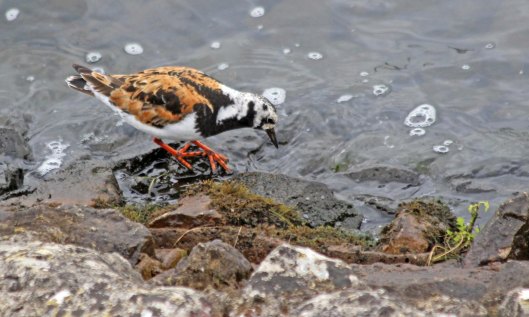
That sounds like a movie title, and the journey Turnstones make to their breeding grounds (in northern Europe, Greenland and North America) and back would undoubtedly make a good wildlife documentary. But a filmmaker I am not. I am simply excited to see these beautiful Turnstones have returned to their usual stone-turning antics on the embankment where the River Ely flows in to Cardiff Bay. Many are still sporting the remnants of their bright breeding plumage, which they will gradually moult in the coming weeks.

210806 turnstone

22-spots

Tags

, , , ,

Yesterday was the first time I’ve seen the larvae of the 22-spot ladybird (Psyllobora vigintiduopunctata).

210805 22-spot (2)

I was checking Lesser burdock plants for their special fly Terellia tussilaginis when I noticed first the distinctive yellow-and-black markings of the adult 22-spot and then, lower down on the big floppy burdock leaves at ground level, several of the also distinctive larvae. I do like it when insects are easy to identify!

210805 22-spot (1)