Second generation

Tags

, , ,

The second generation of Holly blue butterflies has now hatched and the males can be seen whizzing rapidly along the hedgerows and woodland ride edges in search of a mate. Fortunately, this one paused for a short time so I was able to get a few photos. For more information on their two annual broods and the switch from Holly to Ivy as their larval food plants, see my earlier post Holly blues, the second generation, August 2018.

210804 holly blue

Common sandpiper

Tags

, , , , , ,

Autumn’s in the air, not only with slightly cooler temperatures but also because birds are beginning to move to their over-wintering locations. Though the odd Common sandpiper (Actitis hypoleucos) will remain in Britain, most make the long flight to the warm climes of West Africa, and the only time we see these little birds locally is when they are on passage in the spring and autumn. This little beauty stopped in at Cardiff Bay yesterday to top up on food for its journey.

210803 common sandpiper

Mole paws

Tags

, , , , ,

It’s always sad to find a dead creature (and this was only my second ever Mole sighting, both dead) but it was a chance to take a closer look at one, in this case at its amazing front paws.

210802 mole paw (2)

These are highly specialised digging tools, of course, but I’ve only just found out while researching this post that Moles have an extra thumb, called a prepollex, though it’s not really a thumb but rather an extended wrist bone. As the Live Science website explains:

the mole’s extra thumb sprouts from a bone in its wrist, with the thumb-bone growing parallel to the “normal” inner thumb; but that’s where the similarities stop. The outer thumb doesn’t have any moving joints, consisting of a single, sickle-shaped bone that develops later than the inner thumb and the rest of the mole’s fingers.

210802 mole paw (1)

As the extra bone is rigid and extends the width of the Mole’s palm, it is thought to help this little mammal dig its underground tunnels more efficiently. Amazing!

Helleborines

Tags

, , ,

I’ve been watching these Broad-leaved helleborines since I first noticed their flower stems emerging through the grasses and wildflowers in a local park in early June.

They are plentiful and lush this year – presumably the very wet spring encouraged their growth but, unfortunately, our week-long heat wave has caused many to shrivel and dry before opening fully. Still, I find their flowers rather beautiful.

210801 broad-leaved helleborine (3)210801 broad-leaved helleborine (4)

An aberrant Gatekeeper

Tags

, , , ,

210731 gatekeeper (1)

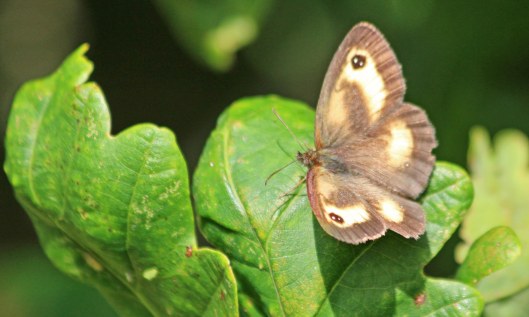
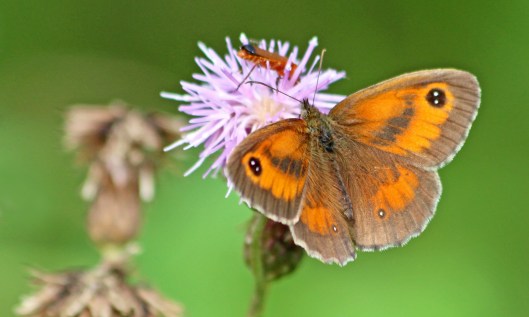
This striking little Gatekeeper caught my eye during a recent walk. Instead of the vibrant orange hue usually seen in their wings (normal male colouring shown below), this little fellow’s colouring was a pale cream. Looking at the known variations for these butterflies on the UK Butterflies website, this appears to be the aberration subalbida.

210731 gatekeeper (2)

A green result

Tags

, , , ,

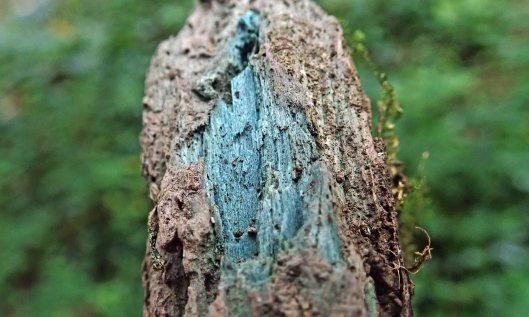
Don’t you love it when a plan comes together? A couple of months ago I found this small bit of wood with tell-tale green colouring so secreted it in a damp place in the woodland.

210730 green elfcup (1)

When I checked it yesterday, result! These are Green elfcups, still tiny but hopefully there will be more next time I look as they usually fruit in the autumn.

210730 green elfcup (2)

A golden surprise

Tags

, , ,

My walks in Casehill Woods delivered yet another delightful surprise on Monday, this stunning male Silver-washed fritillary.

210728 silver-washed fritillary (1)

I have, in fact, been looking for these butterflies in the Dinas Powys woodlands in recent weeks as this is the closest area to where I live that Silver-washed fritillaries were last seen on a regular basis. Though they were once recorded quite frequently in Cwm George woodland, none have been reported there since 2003. It seems to my untrained eye that the trees in Cwm George have grown too tall so the area no longer provides the sunlit rides and glades, the flourishing banks of nectar-rich brambles, thistles and other wildflowers, and the quantities of its larval food plant Common dog-violet that the Silver-washed fritillary needs to thrive.

210728 silver-washed fritillary (2)

Fortunately, this particular butterfly has discovered the younger Millennium woodland area of Casehill Woods, which caters exactly to his needs. Now, let’s hope this male can attract a female so that together they can build a new local population. Fingers crossed!

Leafmines: on Teasel, 2

Tags

, , , , ,

Another day, another leafmine on Teasel. This is not what I’d planned to blog about today but, by sheer coincidence, I discovered this new-to-me leafmine during yesterday’s walk so thought I’d share. And, in fact, once I had the national expert check my identification, he also confirmed that this is the first record of these mines in south Wales.

210727 Chromatomyia ramosa (1)

The larvae of the tiny fly Chromatomyia ramosa are responsible for these mines, feeding both on Teasel and on the various Scabious plant species. As you can see in my photos, the larvae feed along the midrib of the leaf and also in short galleries leading off from the midrib. Though under-recorded, this fly is thought to be widespread in Britain, so I’ll certainly be on the look out for more of its leafmines.

Leafmines: on Teasel

Tags

, , , , , ,

I wasn’t aware of any leafmines on Teasel until I saw a post on Twitter on 23 June by @leafminerman Rob Edmunds. Since then, I’ve been checking the newly sprouted leaves of Teasel whenever I see them. And, finally, on Friday I spotted some mines on a small group of Teasel plants at Cosmeston Lakes Country Park.

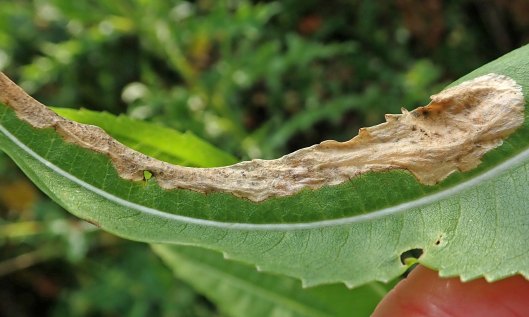
These are the mines of the fly Agromyza dipsaci, another tiny creature I’ll probably never see but I know it’s around from seeing its larval home. The mines appear in early summer once the Teasel leaves start growing, the blotch usually starting at the edge of the leaf and broadening as the larva consumes more and grows. Its large grains of frass can often be seen inside the mine, as shown in the photo on the right above.

210726 Agromyza dipsaci (3)

The British leafminers website reports that this is an uncommon miner in the UK so I thought I’d check the records. Sure enough, there are only four Welsh records showing in Aderyn, the country’s biodiversity database – five when my record is included, and only seventeen records (including the four Welsh ones) on the NBN Atlas, the British database. It may be, though, that like many invertebrate species, this little fly is under-recorded. So, if you spot these mines on Teasel near you, please make sure to record your sightings.

210726 Agromyza dipsaci (4)