The 7-spot cycle

Tags

, , , ,

A few weeks ago I wrote about going insecting and showed a few of my recent finds, including what I suspected was a photo of ladybird eggs. Sure enough, when I revisited that particular spot last week, I found ladybirds in various stages of development. When I add in a photo, taken in a previous year, of ladybirds about to mate on a gorse bush, we have the full lifecycle: mating, eggs, larva, larva beginning to pupate, pupa and recently emerged adult (they often emerge quite pale), all of the 7-spot ladybird (Coccinella septempunctata).

Heath spotted-orchids

Tags

, , , , ,

From the often-boggy, mostly acid grasslands at Aberbargoed direct to your screens, this week’s native British orchid is the appropriately named Heath spotted-orchid (remember, the spotted part of that name refers to the marks on its leaves, not its petals). Its scientific name is Dactylorhiza maculata, which the Plantlife website explains as follows: ‘The genus name Dactylorhiza is formed from the Greek words daktylos meaning finger and rhiza meaning root’ – so, this orchid has a multi-fingered root, rather than a single tuber. And maculata means spotted – those leaves.

210704 Heath spotted-orchid (1)

As you can see from the flower spikes below, this is another orchid with some variation in both its colours, which range from white through pink to pale purple, and its markings, which, though they look spotted from a distance, actually have various combinations of streaks and little loops. The shape of the petals is also distinctive, the lower one in particular is less deeply lobed than, for example, the Common spotted-orchid, which the Heath spotted does superficially resemble.

Leafmines: Enchanter’s nightshade

Tags

, , , , , ,

I’ve been lingering over leafmines again and have a new one to show you, this time on the lovely little plant that carpets the woodland floor at this time of year, Enchanter’s nightshade (Circaea lutetiana).

The mines, which start off as galleries but are often subsumed into the later blotches, are made during June and July by the larvae of Mompha langiella, a rather nondescript little brown moth. The larvae, as described on the British leafminers website, are ‘light yellow, with darker thoracic legs’ (see photo left below), and, most fortunately, I also found a pupa (below right), which are located ‘occasionally in a mined leaf or in a cocoon between the leaves or on the leaves’.

Though Enchanter’s nightshade is widespread in the places where I walk, I’ve only found one site with these leafmines so far. Can you spot them in your local woodland?

Wolf’s milk update

Tags

, , ,

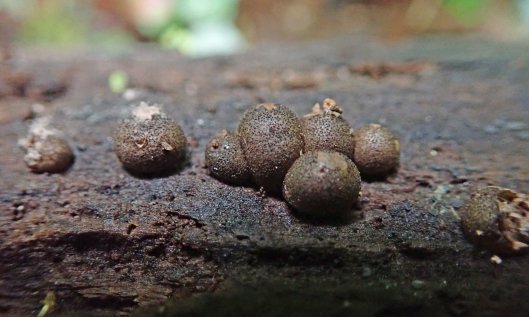
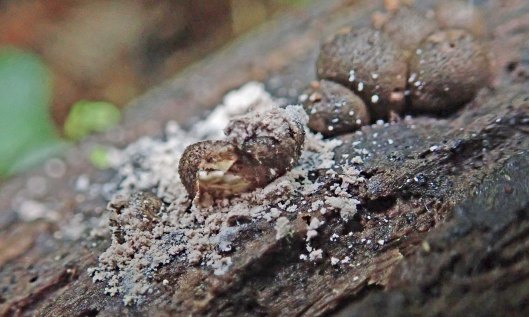
You might remember that on 18 June I blogged about Wolf’s milk, one of the Lycogala species of slime moulds, and noted that I couldn’t positively identify it until I saw the colour of its spores. Well, I’ve been back to recheck these slime balls. They took a bit of finding, as the dense tree canopy of the woodland makes the area quite dark and their change of colour as the slime balls have matured made them blend in with the log they were growing on, as you can see below.

210702 Lycogala terrestre (1)

The good news is that I have been able to identify them. I ‘popped’ one – not a bad thing for the slime as this released its spores for distribution – and found the spore colour to have a pinkish hue, which confirmed the species as Lycogala terrestre.

210702 Lycogala terrestre (2)

Going for a spin

Tags

, , , ,

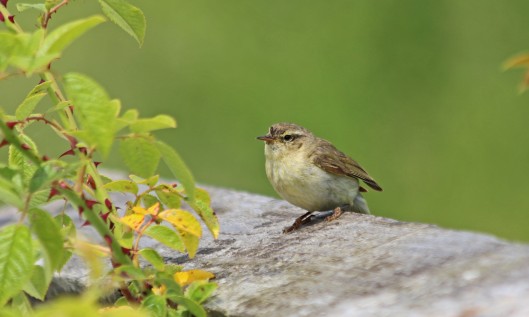
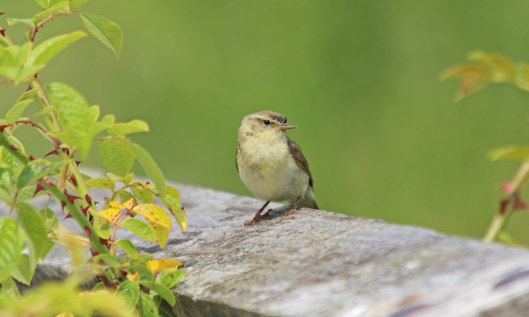
This made me laugh out loud. I was watching a young Chiffchaff hunting for insects along a fence and around a signboard.

210701 chiffchaff (1)

Being young and not wary yet of humans, the cute wee bird mostly ignored me so I was able to edge closer for some photos.

210701 chiffchaff (2)

Then it spotted a spider’s web chock full of tiny creatures, a pix-and-mix for a hungry fledgling.

210701 chiffchaff (3)

But it hadn’t twigged to the fact that a wire fence can be slippery and went for a backwards spin as it tried to pluck out the tasty morsels.

210701 chiffchaff (4)

Small pearl-bordered fritillaries

Tags

, , , ,

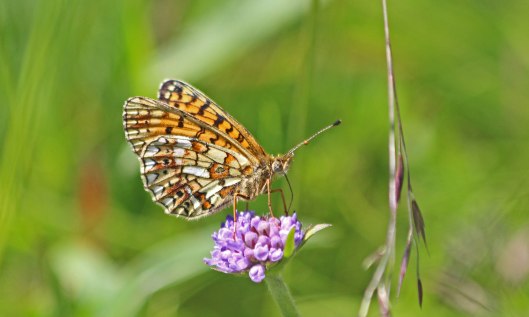
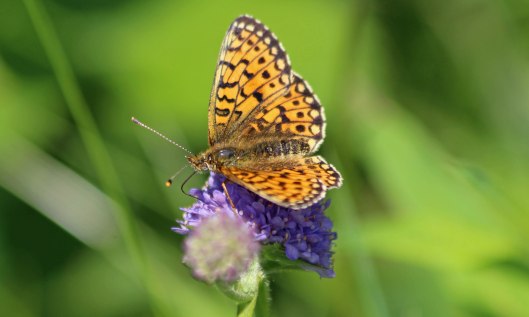
Another visit to Aberbargoed Grasslands National Nature Reserve last week produced my best ever views of Small pearl-bordered fritillaries so I thought I’d share a couple of photos of these stunning little butterflies.

210630 small pearl-bordered fritillary (1)

They get their name from the series of pearl-like markings that can be seen along the outside edge of the underside of their hind wings, though I personally think all their markings, on both the upper- and under-sides of their wings are as exquisite as pearls.

210630 small pearl-bordered fritillary (2)

Humongous Hornet

Tags

, , ,

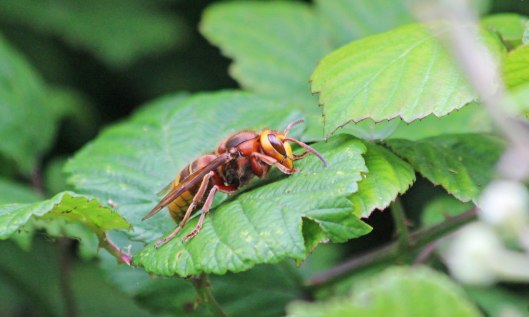
There’s no doubt about it – the European hornet (Vespa crabro) is an imposing, awe-inspiring creature, a giant of the apian world.

210629 european hornet (2)

I spotted this one resting on a bramble bush during a woodland walk on Saturday and, as I rarely see them stationary, couldn’t resist getting some close-up photos. But not too close: these shots were taken using my 300mm zoom lens, so I was about two metres away. And I admit that, when the hornet became aware of me and turned to check me out, I did back off a little further. They rarely sting – only when stressed or threatened; it’s their sheer size (between 25-35mm) that I find a little intimidating.

210629 european hornet (1)

But this beautiful creature obviously didn’t see me as a threat and proceeded to clean its wings and eyes while I looked on in awe. A special encounter!

A flash of turquoise

Tags

, , , , ,

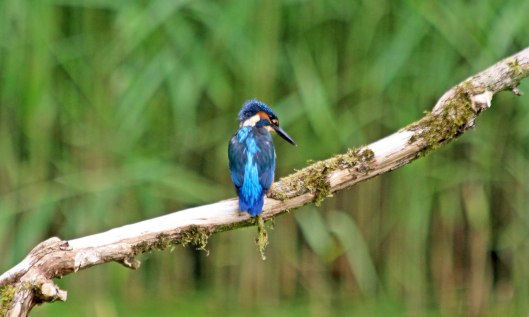
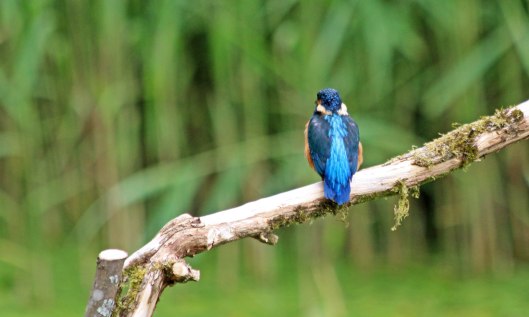
I mentioned in Saturday’s blog that I saw one particularly beautiful bird during my visit to Forest Farm Nature Reserve on Thursday, and this is it, a Kingfisher.

210628 kingfisher (1)

And I was lucky – I saw it twice, visiting the ponds in front of first one bird hide and then the other.

210628 kingfisher (2)

It didn’t linger long at either, announcing its departure with the trade-mark peep, peep, peeping as it flew off with a flash of vibrant turquoise.

210628 kingfisher (3)

A viperish plant

Tags

, , ,

Of Viper’s-bugloss (Echium vulgare), Richard Mabey writes in Flora Britannica:

[It] is a viperish plant in all its parts. The sprays of flowers that spiral up the stem are half-coiled; the long red stamens protrude from the mouths of the blue and purple flowers like tongues; the fruits resemble adders’ heads. Even the ‘speckled’ stem (it is hairy in fact) suggested snakes’ skins to early herbalists.

And like all members of the Echium family, this glorious plant is much loved and visited by insects, especially (from my own observations) bumblebees.

Baby bunny

Tags

, , , ,

It’s not only birds you can see from a bird hide. When I enjoyed my first (post-lockdown) wander in 18 months at Forest Farm Nature Reserve yesterday, I naturally visited both bird hides to see what was about. I didn’t venture inside the hides, thought it safer to peer through the slots in the tall fences on either side, and, though I did see one particularly beautiful bird, it was actually the family of young rabbits that held my attention. This little cutie was adorable. Those ears!

210626 baby bunny