• ABOUT
  • BIRDING 2018
  • Birding 2019
  • BLOG POSTS
  • Butterflies 2018
  • Resources

earthstar

~ a celebration of nature

earthstar

Yearly Archives: 2020

306/366 Anti-gloom

01 Sunday Nov 2020

Posted by sconzani in autumn, flowers, wildflowers

≈ 4 Comments

Tags

British wildflowers, yellow wildflowers

I’ve been feeling the need for bright cheery sunshine yellow this week, to combat the dull weather, the short days, and the almost constant doom and gloom in the news, and the wildflowers have provided it. These are Black medick, a Dandelion species, Meadow buttercup, Nipplewort (actually photographed in sunshine!), Ragwort, and Yellow-wort.

201101 black meddick
201101 dandelion
201101 meadow buttercup
201101 nipplewort
201101 ragwort
201101 yellow-wort
Like Loading...

305/366 Insecting

31 Saturday Oct 2020

Posted by sconzani in autumn, insects

≈ Leave a comment

Tags

British bees, British insects, Buff-tailed bumblebee, Common carder bee, Common Darter, Common earwig, Ivy bee, Ivy bee burrow

Despite the appalling weather – frequent heavy rain and occasional strong winds – we’ve been experiencing over the last couple of weeks, I have managed still to find a few hardy insects, persisting by cunningly finding sheltered places to avoid the worst of the inclement conditions.

201031 buff-tailed bumble
201031 common carder

These bees seem to have the right idea. On the left is a Buff-tailed bumblebee, which I watched emerging from inside the cosy, fluffy duvet of an Old man’s beard seedhead and, on the right, a Common carder that seems to have the same idea and be looking for a place to snuggle down.

201031 earwigs (1)
201031 earwigs (2)

Also looking cosy, these Common earwigs were huddling in the cups of umbellifer seedheads.

201031 common darters

Common darters have still been active in the more sheltered spots during the occasional sunny periods, these at Cosmeston Lakes Country Park.

201031 ivy bees (1)
201031 ivy bees (2)

The last of this year’s brood of Ivy bees were still feeding their grubs. They had made use of a rabbit scrape to excavate the underground burrows where their eggs are laid, grubs hatch and pupate and will remain until emerging as adult bees next autumn.

Like Loading...

304/366 Wild word: deliquesce

30 Friday Oct 2020

Posted by sconzani in autumn, fungi, molluscs

≈ Leave a comment

Tags

British fungi, Coprinus comatus, deliquesce, deliquescence, inkcap fungus, inkcaps, Shaggy inkcap, slug, slug eating fungus

Deliquesce: verb; (of organic matter) become liquid, typically during decomposition. Mid 18th century from Latin deliquescere ‘dissolve’, from de- ‘down’ + liquescere ‘become liquid’ (Oxford Dictionary).

201030 shaggy inkcap (1)

These Shaggy inkcaps (Coprinus comatus) may look sturdy and robust but, like all inkcaps and many other species of fungi, they only last a few days, sometimes as little as 24 hours, before turning into a rather disgusting-looking liquid mush, as shown by the specimen below. If you want to read more about the how and why of that process, about the inkcaps’ ‘habit of destroying themselves with their own enzymes’, check out The Dish on Deliquescence in Coprinus Species by Jonathan Landsman on the Cornell Mushroom blog.

201030 shaggy inkcap (4)
201030 shaggy inkcap (5)

Many humans may not know that inkcaps quickly deliquesce but slugs do. This slimy beastie was digging in to a Shaggy inkcap delicacy before the fungus had a chance to digest itself.

201030 shaggy inkcap (6)

Like Loading...

303/366 Ring-necked ducks

29 Thursday Oct 2020

Posted by sconzani in birds

≈ Leave a comment

Tags

Aythya collaris, birding, birdwatching, British birds, Cardiff Bay, Cardiff Bay birding, Cosmeston Lakes Country Park, Ring-necked duck

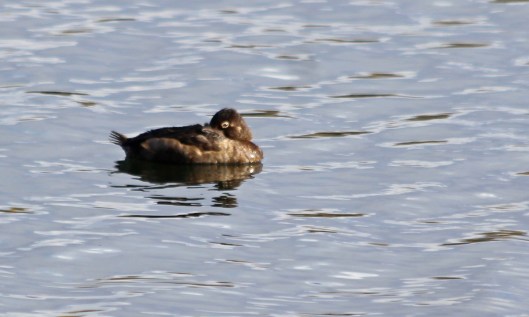
I can count on one hand the number of times I’ve seen a Ring-necked duck (Aythya collaris) so I was delighted when, ten days ago, a juvenile female was spotted at Cosmeston Lakes Country Park, and I managed to get a very distant view of it on 18 October.
201029 ring-necked ducks (1)

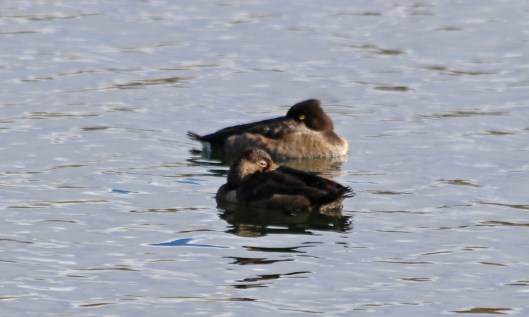
I’m the first to admit I would not have been able to identify this bird without the local, much more experienced birders sharing their photos on social media. When its head is tucked in, which seems to be most of the time, only its pale eye ring distinguishes this bird from the female Tufted ducks that surround it, at least to my inexperienced eye.
201029 ring-necked ducks (2)

Late last Sunday, 25 October, the exciting news came that a second Ring-necked duck had been sighted at Cosmeston, this one a 1st winter drake, so I headed along on Monday for a look. I got much closer views of the first bird, the juvenile, but couldn’t find the other – turns out, it had flown over to Cardiff Bay. This is a common phenomenon during the winter months – the various duck species fly regularly back and forth between the lakes and the Bay.
201029 ring-necked ducks (3)

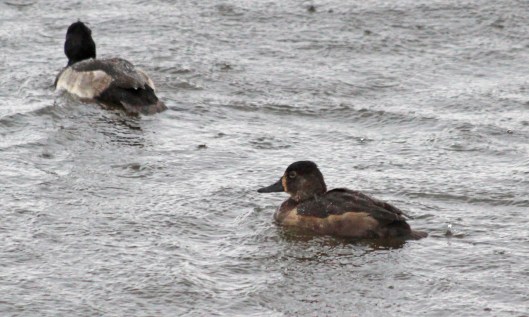
So, for yesterday’s exercise walk I headed down to Cardiff Bay where, in spite of occasional heavy rain showers, I managed to locate both Ring-necked ducks, though this time the drake kept its head tucked in throughout my visit. That’s the juvenile braving the weather in the photo above, and the 1st winter drake below. If I manage to see the drake again and get a photo of it with its head up, I’ll be sure to share.


201029 ring-necked ducks (4)

Like Loading...

302/366 Gone galling, again

28 Wednesday Oct 2020

Posted by sconzani in autumn, insects, leaves, trees

≈ 1 Comment

Tags

Aceria macrochela, gall mites, gall-causing mites, galls, galls on Field maple, galls on Spindle, mite galls, Stenacis euonymi

October is a good month to check out life on leaves (and I’ll be writing some posts about the various leaf mines I’ve been finding) but today I want to show you a couple of gall species that are new to me. The first is quite common and easy to find, the second perhaps less so.

The first species is Aceria macrochela, a microscopic mite that spends its larval life in these tiny bumps on the leaves of Field maple (Acer campestre). You can read more about them and see more images on the mighty Nature Spot website.

201028 Aceria macrochela (1)
201028 Aceria macrochela (2)
201028 Aceria macrochela (3)
201028 Aceria macrochela (4)

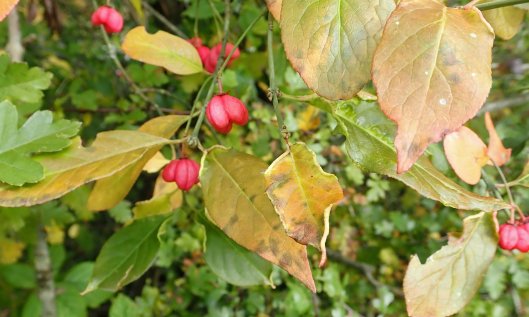
And the second is also a mite, this one called Stenacis euonymi, whose larvae make their homes in the rolled-up edges of leaves on Spindle (Euonymus europaeus). If you have trouble with tree identification, as I often do, this is a good time to look for these as the gloriously obvious fruit of the Spindle are easy to spot.

201028 Stenacis euonymi (1)

Looking on the NBN (Nature Biodiversity Network) Atlas I see there are currently only 112 UK records for this species (113 including mine, which doesn’t show yet) but that’s probably due to it being under-recorded, so if you spot these, please do record your sighting.

201028 Stenacis euonymi (2)
201028 Stenacis euonymi (3)
Like Loading...

301/366 Chatting

27 Tuesday Oct 2020

Posted by sconzani in autumn, birds

≈ Leave a comment

Tags

birding, birding birdwatching, British birds, Saxicola rubicola, Stonechat

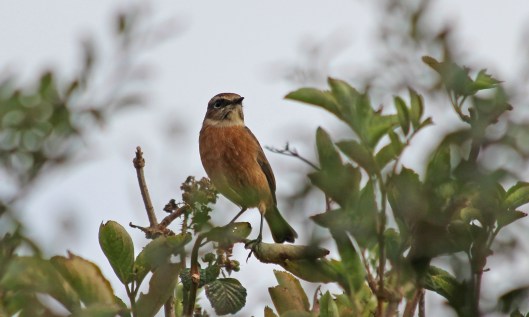
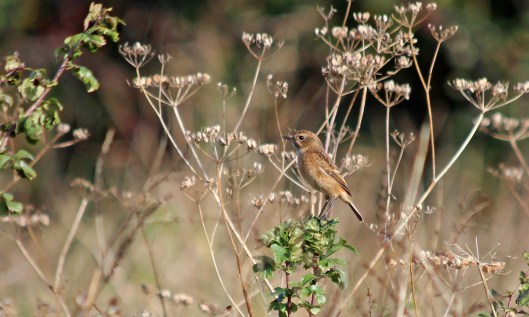
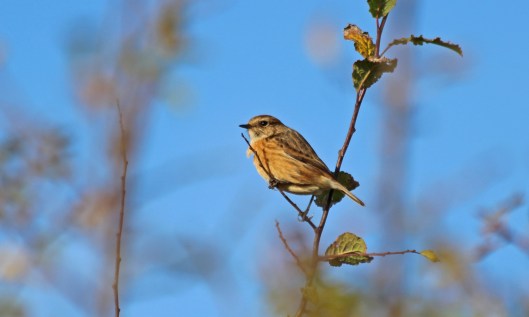
When I can’t arrange to meet up with and chat to friends, due to our Covid-19 lockdown rules, I talk to the birds, usually Robins (as my previous Conversations with Robins blog posts testify) but lately the many Stonechats that have been living in the local fields.

201027 stonechat (1)

If I approach slowly and quietly, then stand still and wait, they’ll often pop up on branches and plant tops quite close to me.

201027 stonechat (2)

I can talk very softly, and they don’t fly off. They watch me – are they just being cautious, keeping an eye on this intruder in their space?

201027 stonechat (3)

Or are they curious? Or maybe they’re just plain cheeky, knowing they can check me out but fly off in the beat of a wing?

201027 stonechat (4)

Spending time with these gorgeous wee chats brings me much joy. And, yes, I am a crazy bird lady!

201027 stonechat (5)

Like Loading...

300/366 Four-spotted orb weaver

26 Monday Oct 2020

Posted by sconzani in spiders

≈ 5 Comments

Tags

Araneus quadratus, British spiders, Cosmeston Lakes Country Park, Four-spotted orb weaver

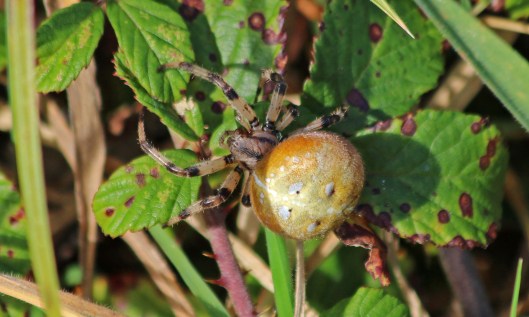
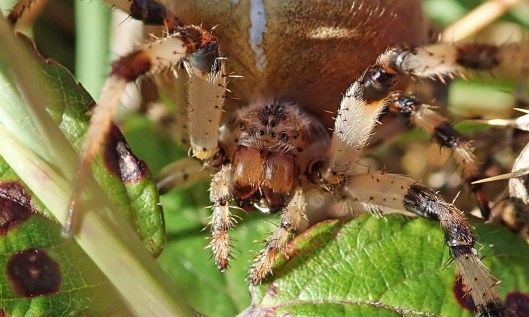
If you suffer from arachnophobia, look away now! This spider, found recently in one of the outer fields at Cosmeston Lakes Country Park, was the biggest spider I’ve seen in Britain. That’s still not big when compared to Tarantulas or Huntsmen or other large species but it was big enough to make me feel both a teeny bit freaked out and totally fascinated at the same time.

201026 four-spotted orb weaver (1)

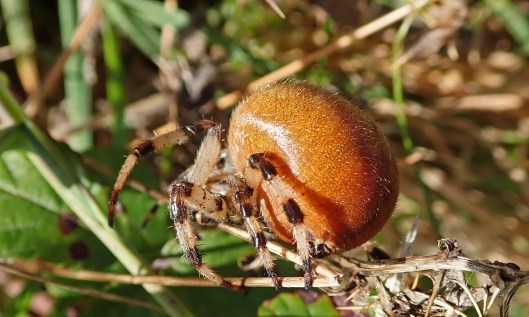
This is a female Four-spotted orb weaver (Araneus quadratus), a species that’s apparently quite common in Britain and can be found in a variety of habitats, from grassland and bogs to gardens and woodlands. As with many spiders, females are larger than males. In this species, females can grow to 17mm long, while the males are only half that size.

201026 four-spotted orb weaver (2)

This beauty was slowly making her way through the long grass at the edge of a bramble patch. Because of the size of her body, she was struggling to stay upright, and several times overbalanced. But those long striped legs are obviously quite strong and she easily managed to pull herself upright again.

201026 four-spotted orb weaver (3)

I spotted this orb weaver because her apricot colour stood out from her surroundings but, according to the Naturespot website, adult females are like chameleons, able to change their colour to coordinate with their surroundings, though that process can take about three days to complete. Fascinating!

201026 four-spotted orb weaver (4)

Like Loading...

299/366 Blooming now

25 Sunday Oct 2020

Posted by sconzani in autumn, wildflowers

≈ Leave a comment

Tags

autumn colour, autumn-flowering wildflowers, British wildflowers, wildflowers in bloom

Today’s blast of colour is brought to you by the colour purple, with splashes of pink and blue and lilac. All these gorgeous wild plants are still flowering in my local area and, on grey days, when we here in Wales are once again in full Covid-19 lockdown, seeing these on my daily exercise walks is a spirit-lifting delight!

201025 buddleja
201025 bush vetch
201025 common knapweed
201025 creeping thistle
201025 devil's-bit scabious
201025 field scabious
201025 hedge woundwort
201025 herb robert
201025 ivy-leaved toadflax
201025 meadow crane's-bill
201025 musk-mallow
201025 purple toadflax
201025 rosebay willowherb
201025 teasel
201025 tufted vetch

For those who want to know, these are: Buddleja, Bush vetch, Common knapweed, Creeping thistle, Devil’s-bit scabious, Field scabious, Hedge woundwort, Herb Robert, Ivy-leaved toadflax, Meadow crane’s-bill, Musk-mallow, Purple toadflax, Rosebay willowherb, Teasel, and Tufted vetch.

Like Loading...

298/366 The last Meadow brown

24 Saturday Oct 2020

Posted by sconzani in autumn, insects

≈ Leave a comment

Tags

British butterflies, butterfly, butterflying, Meadow Brown

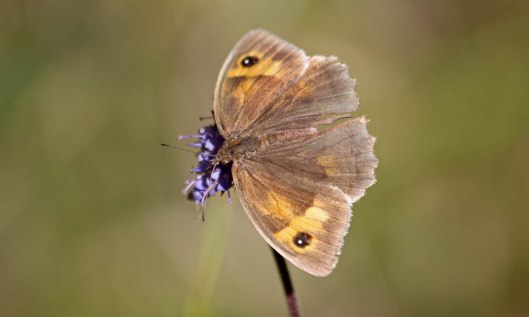
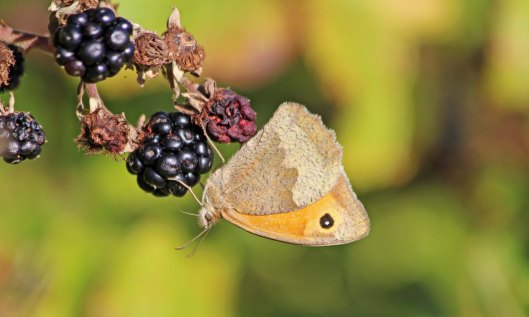
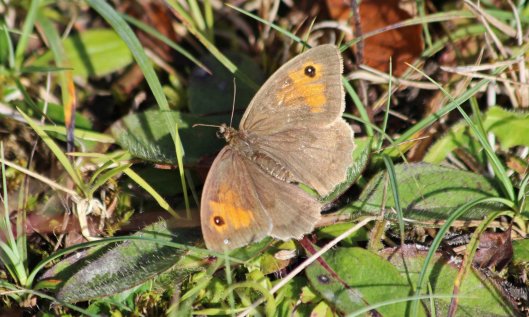
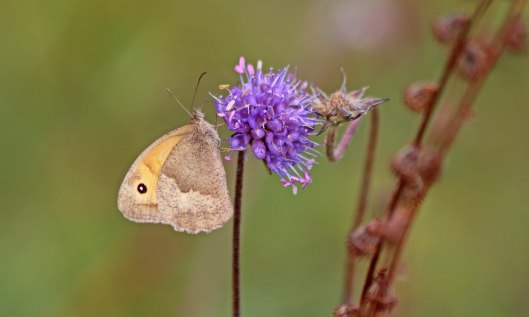
Meadow brown butterflies have a long season, on the wing from early June to the end of October, and those dates are exactly what I’ve observed in my area this year and last.

201024 meadow brown 200918

In 2019, I spotted my first Meadow brown on 5 June and the last was a single butterfly seen on 7 October.

201024 meadow brown 200925

This year, I saw my first Meadow Brown at Cosmeston Lakes Country Park on 1 June.

201024 meadow brown 200927

And, as September was drawing to a close, I kept a special eye out for these lovely butterflies, each time taking a photograph and asking myself, ‘Will this be the last Meadow brown of the year?’

201024 meadow brown 201001

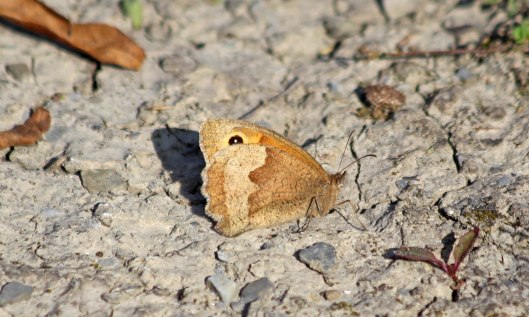
I knew time was fast slipping away for them and, on 5 October, again at Cosmeston, it really was the last time I would see a Meadow brown in 2020. That butterfly is the one shown below … and I’m already looking forward to seeing them again next June.

201024 meadow brown 201005

Like Loading...

297/366 Candlesnuff

23 Friday Oct 2020

Posted by sconzani in autumn, fungi, nature

≈ Leave a comment

Tags

British fungi, Candlesnuff, Candlesnuff fungus, Xylaria hypoxylon

With our weather much wetter and temperatures not too cold, October should be a good month for spotting fungi but I haven’t been finding much during my daily meanders. So, it was good to spot a piece of wood with the early stages of Candlesnuff (Xylaira hypoxylon) fungi growing out of it.

201023 candlesnuff (1)

I’ve blogged about this lovely fungus before so to find out more about it, click on The right snuff, December 2016.

201023 candlesnuff (2)

Like Loading...
← Older posts
Newer posts →

About me

sconzani

sconzani

I'm a writer and photographer; researcher and blogger; birder and nature lover; countryside rambler and city strider; volunteer and biodiversity recorder.

View Full Profile →

Follow earthstar on WordPress.com

Enter your email address to follow this blog and receive notifications of new posts by email.

Recent blog posts

  • Alder flies April 9, 2026
  • Lily beetle April 8, 2026
  • First bee-flies April 7, 2026
  • Bloody-nosed beetle April 6, 2026
  • Gorse and its weevil April 5, 2026

From the archives

COPYRIGHT

Unless otherwise acknowledged, the text and photographs on this blog are my own and are subject to international copyright. Nothing may be downloaded or copied without my permission.

Fellow Earth Stars!

  • Unknown's avatar
  • Unknown's avatar
  • Unknown's avatar
  • Unknown's avatar
  • Unknown's avatar
  • Unknown's avatar
  • Unknown's avatar
  • Unknown's avatar
  • Unknown's avatar
  • Unknown's avatar
  • Unknown's avatar
  • Unknown's avatar
  • Unknown's avatar
  • Unknown's avatar
  • Unknown's avatar
  • Unknown's avatar
  • Unknown's avatar
  • Unknown's avatar
  • Unknown's avatar
  • Unknown's avatar
  • Unknown's avatar
  • Unknown's avatar
  • Unknown's avatar
  • Unknown's avatar
  • Unknown's avatar
  • Unknown's avatar
  • Unknown's avatar
  • Unknown's avatar
  • Unknown's avatar
  • Unknown's avatar
  • Unknown's avatar
  • Unknown's avatar
  • Unknown's avatar
  • Unknown's avatar
  • Unknown's avatar
  • Unknown's avatar
  • Unknown's avatar
  • Unknown's avatar
  • Unknown's avatar
  • Unknown's avatar
  • Unknown's avatar
  • Unknown's avatar
  • Unknown's avatar
  • Unknown's avatar
  • Unknown's avatar
  • Unknown's avatar
  • Unknown's avatar
  • Unknown's avatar
  • Unknown's avatar
  • Unknown's avatar

Blog at WordPress.com.

Privacy & Cookies: This site uses cookies. By continuing to use this website, you agree to their use.
To find out more, including how to control cookies, see here: Cookie Policy
  • Subscribe Subscribed
    • earthstar
    • Join 642 other subscribers
    • Already have a WordPress.com account? Log in now.
    • earthstar
    • Subscribe Subscribed
    • Sign up
    • Log in
    • Report this content
    • View site in Reader
    • Manage subscriptions
    • Collapse this bar
 

Loading Comments...
 

You must be logged in to post a comment.

    %d