Tiny dancer
23 Monday Aug 2021
Posted in insects
23 Monday Aug 2021
Posted in insects
22 Sunday Aug 2021
Posted in flowers, wildflowers
A selection of the wildflowers in bloom during these last weeks of summer – this week, those of more mellow, subtle hues; next week, I’ll feature the brightly coloured flowers.
These are Bramble, Broad-leaved willowherb, Burdock, Daisy, Everlasting pea, Great willowherb, Hedge woundwort, Hemp agrimony, Knapweed, Large bindweed, Marsh woundwort, Meadow crane’s-bill, Mint, Oxeye daisy, Purple loosestrife, Red clover, Red valerian, Rosebay willowherb, Sneezewort, Tufted vetch, White clover, Wild carrot, and Yarrow.
21 Saturday Aug 2021
Posted in insects
20 Friday Aug 2021
Posted in insects
Tags
British moths, Grey dagger, Grey dagger caterpillar, Grey dagger larva, moth caterpillar, moth larva
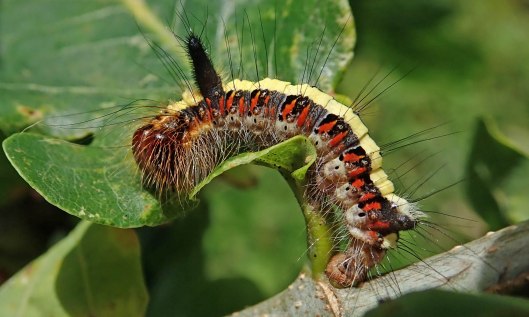
The Butterfly Conservation website says the dagger moths get their name from the dagger-like markings on their wings but check out the hump on the back of this Grey dagger larva – in the infamous words of Lady Macbeth from the Scottish play, ‘is this a dagger I see before me’?

19 Thursday Aug 2021
Tags
autumn migration, birding, birdwatching, British birds, Cosmeston Lakes Country Park, Spotted flycatcher, Willow warbler
These three were hanging out together in a clump of trees at Cosmeston Lakes Country Park yesterday, two Spotted flycatchers flanking a Willow warbler. All are starting their annual autumn migration to Africa, the Willow warbler to southern Tanzania or northern Mozambique, the flycatchers anywhere from the coastal forests of the Gulf of Guinea to South Africa. I hope to get better photos of these birds in the coming weeks but was delighted to get this shot of all three together.

18 Wednesday Aug 2021
Tags
British moths, Buff-tip moth, Buff-tip moth caterpillars, moth caterpillars, moth larvae, Moth larvae on Oak leaves
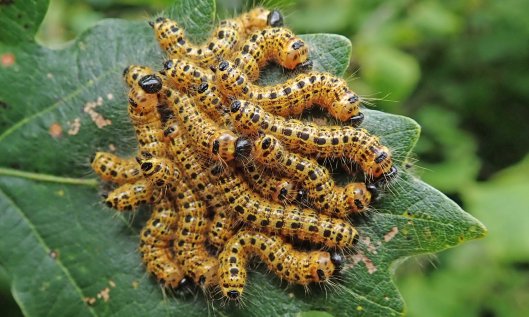
I’ve never seen a Buff-tip moth (Phalera bucephala) except in photographs (they look incredibly like twigs – see images on the Butterfly Conservation website here). But yesterday I found their larvae, lots of them, all huddled together on the top side and underside of an Oak leaf.

The adult moth, which flies from May to early August, lays clusters of eggs under the leaves of the trees their caterpillars feed on, which, as well as Oak, include Hazel and the various birches and sallows, amongst others.

The larvae hatch out after 2-3 weeks and start eating. It takes just a month for them to go through their four instars, after which they move down into the ground to pupate. Come the spring, the whole process begins again.

17 Tuesday Aug 2021
Posted in insects, nature photography
Tags
British butterflies, butterfly, Common blue butterfly, macro photography, Meadow Brown, practising macro photography, Speckled wood
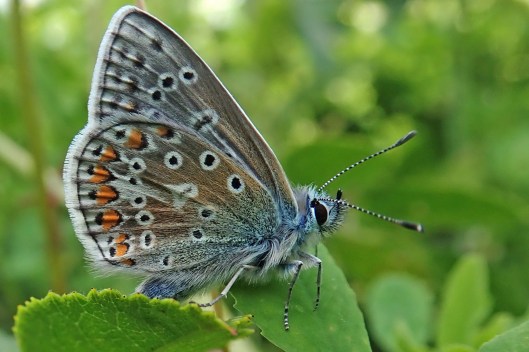
I mostly use my Olympus camera for macro photographs, and to get crisp shots I need to get within an inch or two of the subject. As you can imagine, a lot of little creatures are alarmed by a large animal looming over them with a camera so, from time to time, I use one of my daily walks to practise my stealth. After a couple of false starts yesterday, I was very pleased to get up close to these three butterflies – a Common blue, a Meadow brown and a Speckled wood – as the macro photos give such good detail of the anatomy of these beautiful butterflies.


16 Monday Aug 2021
Posted in nature
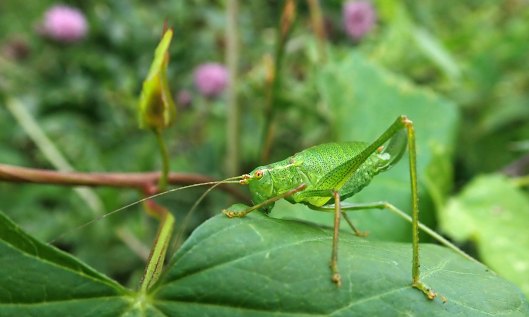
August is the time of the crickets, when many species mature from nymph to adults and the males begin their night-time wing-against-wing-rubbing (called stridulation) to advertise their presence.

I found this Dark bush-cricket sunning itself on a bramble bush. It started to move under a leaf as I approached with my macro-lensed camera but then kindly consented to pose for some images. It’s such a handsome beast, with its dappled brown body armour.

This Speckled bush-cricket also wasn’t sure about me getting so close but somehow sensed I wasn’t a threat. She’s a stunning female – the dagger-like appendage on her rear is her ovipositor, used to lay eggs in tree bark and plant stems.
15 Sunday Aug 2021
Posted in flowers, wildflowers
It fascinates me how many wildflowers vary from their standard colours, often changing from pink to white and vice versa. Here we have Centaury, usually pink but also commonly seen with white flowers; Knapweed, also usually a pinkish lilac, but I occasionally see a white variant; Thistles that are also usually pinky lilac but often flowering white hereabouts; and the usually white Yarrow, which I find growing with quite pink flowers in a local field.


14 Saturday Aug 2021
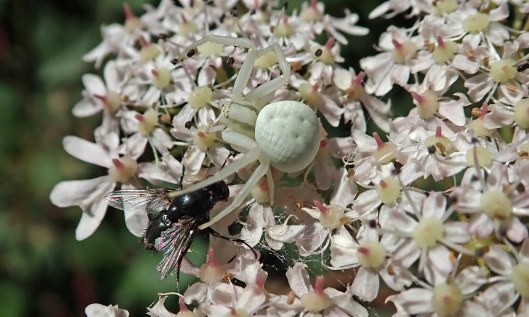
I was watching this well-camouflaged Crab spider (probably Misumena vatia) restraining its prey when a mother and young son came walking along the path towards me. I could see and hear that the woman was pointing out various flowers and insects to her son so, rather than immediately step out of their way, I asked the boy if he wanted to see something cool. I pointed to where he should look and moved away a little, still conscious of maintaining a Covid-safe distance.

He was spellbound as I explained that the spider had been sitting on a white flower so it could use its white colour to trap the fly. He thought the spider was ‘sneaky’, and I could hear him and his mother still talking about the spider and ‘amazing Nature’ as they walked on. Well done to his mum for encouraging the boy’s interest. I think it’s so important that young people are inspired to look closer at the amazing natural world that surrounds them.

You must be logged in to post a comment.