• ABOUT
  • BIRDING 2018
  • Birding 2019
  • BLOG POSTS
  • Butterflies 2018
  • Resources

earthstar

~ a celebration of nature

earthstar

Author Archives: sconzani

The first skipper

04 Thursday May 2023

Posted by sconzani in insects

≈ Leave a comment

Tags

British butterflies, butterfly, Dingy Skipper, skipper butterflies, Skippers

I tend to avoid the local country park on bank holidays, as it can be difficult to find the peace and solitude I prefer during my walks but, luckily, on the May Day holiday, most people were sticking to the walks around the lakes, the children’s playground and those places where they could buy food and drinks. So, a circuitous walk around the various paddocks and through a sheltered woodland clearing turned up my first Small tortoiseshell butterfly of the year and this beauty, my first Dingy skipper. Bank holiday bonuses both!

230504 dingy skipper

Like Loading...

Wild words : extrafloral nectary

03 Wednesday May 2023

Posted by sconzani in insects, plants

≈ Leave a comment

Tags

Bracken, extrafloral nectaries, nectaries on Bracken, nectary, Pteridium aquilinum

Nectary: noun, biology; ‘a nectar-secreting glandular organ in a flower (floral) or on a leaf or stem (extrafloral)’ (Oxford Dictionary).

230503 extrafloral nectaries (1)

Like most people, I knew that most flowers produce nectar as a reward to attract pollinators but I’ve only recently learned that many plants produce nectar through extrafloral nectaries, as the definition explains, on their leaves or stems. I read that these particular nectaries can be found on many species of fern, and I’ve finally found some examples on the stems of Bracken (Pteridium aquilinum) that has just begun to sprout locally. The nectaries are the small smooth pale lumps on the back of the stipe, and, in Bracken, their purpose is apparently to attract ants that will then defend the fern against the insects that might eat it, like some species of bug and fly, and the larvae of various moths, amongst others.

230503 bracken and ant

ant leaving nectary on Bracken

However, I also found a journal article, referenced below, which reported that the ants actually had ‘no significant effect on bracken-specific herbivores’ so, in this case, the plant may be producing nectar for nothing.

Reference: ‘Bracken, Ants and Extrafloral Nectaries. I. the Components of the System’, J. H. Lawton and P. A. Heads, Journal of Animal Ecology, vol. 53, no. 3, October 1984, pp. 995-1014. I do not have access to Jstor so was only able to read the information contained in the article summary.

230503 common froghopper nymphs

Common froghopper nymphs on Bracken

Like Loading...

A damsel dropped in

02 Tuesday May 2023

Posted by sconzani in insects

≈ Leave a comment

Tags

British damselflies, British dragonflies, damselfly, Large Red damselfly

I was scanning an area of low plants and exposed stones on a site that was once a quarry, then rubbish tip, hoping to find my first Dingy skipper butterfly of the year when down dropped this gorgeous beastie, I don’t know from where. This, a week later than last year, was my first dragonfly of the year, at Cosmeston Lakes Country Park last Friday morning, a lovely Large red damselfly.

230502 large red damselfly

Like Loading...

Leafmines: Coleophora lutipennella

01 Monday May 2023

Posted by sconzani in insects, trees

≈ Leave a comment

Tags

British moths, case-bearing larvae, Case-bearing moth, Coleophora, Coleophora lutipennella, Common oak case-bearer, moth larvae on Oak

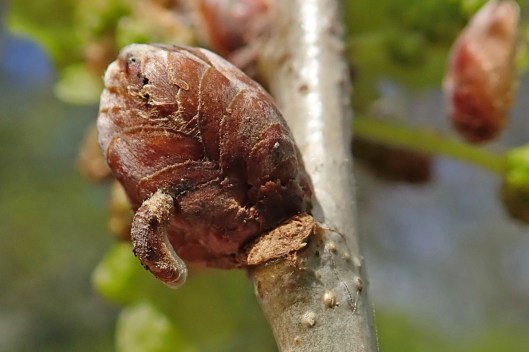
It’s often the way that, while looking for one thing, I find another. In this case, I was checking for eggs or larvae on the newly opening buds and flowers of an Oak tree where I’ve previously seen Purple hairstreak butterflies. No luck with those but I did find this …

230501 Coleophora lutipennella (1)

It’s the larva of the Common oak case-bearer moth (Coleophora lutipennella) – you can see the pretty little adult moth on the UK Moths website here. These case-bearing moths remind me a bit of snails, spending their larval stage in a home they carry around with them, though the moths don’t grow their own – they weave theirs from bits of vegetation and silk. In the photo below, you can see the larva poking its head out from the bottom of its case.

230501 Coleophora lutipennella (2)

It can be difficult to distinguish between the larvae of two very similar case-bearing moths, this one and Coleophora flavipennella. I had my find confirmed by expert Rob Edmunds, who manages the British Leafminers website. The difference between the two cases is minor but fascinating, the presence or not of a small hump of leaf tissue built in to the case – there’s an explanation and some excellent photos on the website’s June 2004 newsletter.

Like Loading...

International Day of the Dandelion

30 Sunday Apr 2023

Posted by sconzani in wildflowers

≈ Leave a comment

Tags

#InternationalDayOfTheDandelion, dandelion, insects on dandelions

We’ve had National Dandelion Day (on 5 April), but today’s flower festivities have gone global. So, happy International Day of the Dandelion (#InternationalDayOfTheDandelion on social media)! I am always happy to celebrate the sunshine cheerfulness and undeniable bounty of the dandelion so here are a few recent flowers and friends finds.

230430 dandelions and critters

Like Loading...

The first of the blues

29 Saturday Apr 2023

Posted by sconzani in insects

≈ 3 Comments

Tags

blue butterfly, British butterflies, butterfly, Holly blue

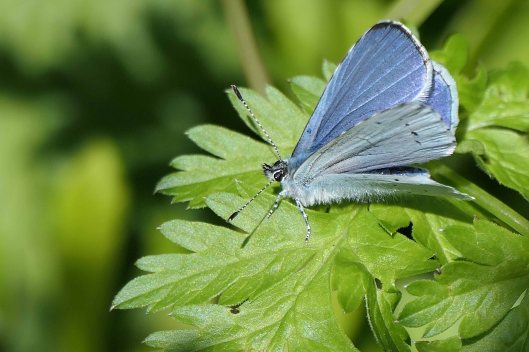
I saw my first Holly blue of the year on 15 April but it took 10 more days to find one, this stunning female, sitting still long enough to take a reasonable photo.

230429 holly blue

Like Loading...

Bee-flies revisited

28 Friday Apr 2023

Posted by sconzani in insects

≈ Leave a comment

Tags

Bombylius major, Dark-edged bee-flies, lifecycle of Dark-edged bee-fly, mining bee predation, mining bees

I blogged about Dark-edged bee-flies earlier this month but, since then, I’ve noticed one doing something odd so thought I’d share what I’ve since found out about what it was doing. I spotted an area of miniature soil volcanoes where mining bees were active, digging out the tunnels in which they would lay their eggs, and, nearby, a sweet little bee-fly flicking its own eggs in to the holes of the bees it predates.

230428 bee-flies revisited (1)

Then, that same bee-fly started hovering in one spot, frantically beating its wings but going nowhere (see video below). What was it doing? I asked on Twitter, and one of my followers suggested ‘It could be filling its rear-end up with sand’ – not a sentence I ever thought I’d read! But this was sort of right.

Someone from the Soldierflies and Allies Recording Scheme referred me to their website entry for bee-flies, which explains that ‘the adult females collect dust or sand at the tip of their abdomen, using it to coat their eggs, which helps protect the eggs from drying out.’ I’m guessing the sandy coating also means the eggs roll more easily into the bees’ tunnels. It was a fascinating insight into what is an extraordinary lifecycle, though I can’t help but feel some sympathy for the hard-working mining bee victims.

Like Loading...

May curlew

27 Thursday Apr 2023

Posted by sconzani in birds

≈ Leave a comment

Tags

bird migration, birding, birdwatching, British birds, spring migration, Whimbrel

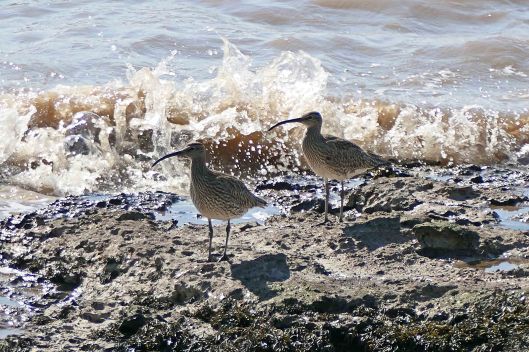
I seem to have a habit of biannual posts about the local Whimbrel migration – see Whimbrel passing, 3 May 2021 – so, today, rather than the migration, let’s talk about some of the names for the Whimbrel (Numenius phaeopus), courtesy of the writing and research of Stefan Buczacki in his massive publication Fauna Britannica.

230427 whimbrel (1)

Some of the vernacular names reflect the time of year these birds pass through on migration: May curlew, May fowl, May whaap (Ireland) and May bird (East Anglia); others their resemblance to their cousin, the Curlew: Curlew Jack (Yorkshire), Curlew knave (Cumberland), Curlew knot (Lincolnshire), and Half curlew (Norfolk, Suffolk).

230427 whimbrel (2)

The name Whimbrel itself comes from the bird’s call, something of a whimper. Another version of this is, in fact, ‘Whimperel’, a name once used in Durham. Whatever you want to call it, this is a beautiful bird well worth spending time watching if you get the chance.

Like Loading...

Flower crab spiders

26 Wednesday Apr 2023

Posted by sconzani in spiders

≈ Leave a comment

Tags

British spiders, Crab spider, Misumena vatia, white spider

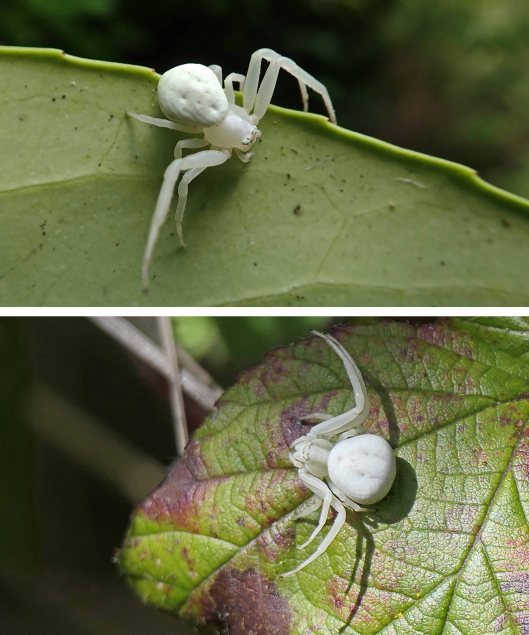
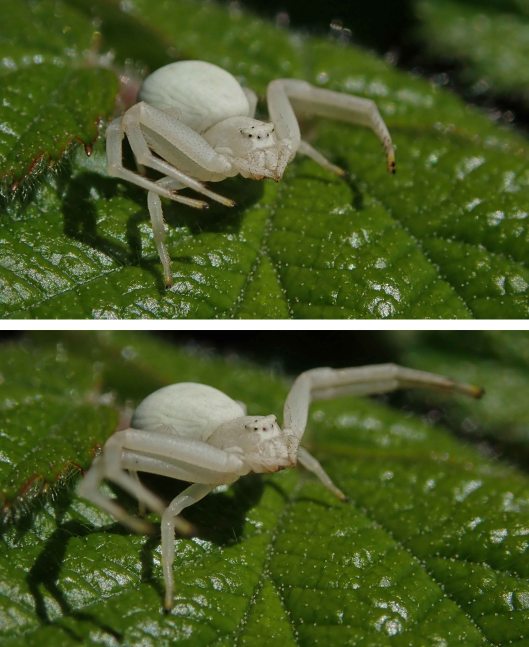
I don’t know whether it’s the time of year or the weather conditions but I’m seeing quite a lot of Flower crab spiders (Misumena vatia), mostly white so presumably male – the females, according to the Wildlife Trust website, are not able to change their colour to match their surroundings.

230426 crab spiders (1)

I was rather tempted to make this blog’s title a pun on their having eight eyes (‘Aye aye aye aye aye aye aye aye’, or ‘The eyes have it’) but resisted – though, as you see, I still couldn’t help but mention them. Just imagine what it must be like to have so many eyes – what do they see?

230426 crab spiders (2)

In an attempt to photograph all those eyes, I managed to get quite close to one particular beastie but quickly backed off when it began to open its legs – they are not the open arms of welcome, but rather the snatch of death!

Like Loading...

Reeling Grasshopper warbler

25 Tuesday Apr 2023

Posted by sconzani in birds

≈ 4 Comments

Tags

birding, birdwatching, British birds, Grasshopper warbler, Grasshopper warbler reeling, Gropper, spring migration

I might have stubby legs but they can move quite quickly when the need arises. And, when I got a message that there was a reeling Grasshopper warbler at Cosmeston Lakes Country Park while I was walking along the local coastal path, the need to move quickly was strong. Luckily, I made it in time to hear, and even more luckily, see this visibly unostentatious little bird (the typical ‘little brown job’), though, as you can see from my photo, it was always partly obscured behind foliage.

230425 grasshopper warbler

If you’ve never heard a Grasshopper warbler reeling, I made a little recording of this one. The reason for the bird’s name will immediately become obvious. And, something I discovered while watching this one, while its mouth was gaping wide uttering its unique song, its tail was quivering in time to the reeling.

Like Loading...
← Older posts
Newer posts →

About me

sconzani

sconzani

I'm a writer and photographer; researcher and blogger; birder and nature lover; countryside rambler and city strider; volunteer and biodiversity recorder.

View Full Profile →

Follow earthstar on WordPress.com

Enter your email address to follow this blog and receive notifications of new posts by email.

Recent blog posts

  • First bee-flies April 7, 2026
  • Bloody-nosed beetle April 6, 2026
  • Gorse and its weevil April 5, 2026
  • Chiffchaffs chiffchaffing April 4, 2026
  • Bearded tit!!! April 3, 2026

From the archives

COPYRIGHT

Unless otherwise acknowledged, the text and photographs on this blog are my own and are subject to international copyright. Nothing may be downloaded or copied without my permission.

Fellow Earth Stars!

  • Unknown's avatar
  • Unknown's avatar
  • Unknown's avatar
  • Unknown's avatar
  • Unknown's avatar
  • Unknown's avatar
  • Unknown's avatar
  • Unknown's avatar
  • Unknown's avatar
  • Unknown's avatar
  • Unknown's avatar
  • Unknown's avatar
  • Unknown's avatar
  • Unknown's avatar
  • Unknown's avatar
  • Unknown's avatar
  • Unknown's avatar
  • Unknown's avatar
  • Unknown's avatar
  • Unknown's avatar
  • Unknown's avatar
  • Unknown's avatar
  • Unknown's avatar
  • Unknown's avatar
  • Unknown's avatar
  • Unknown's avatar
  • Unknown's avatar
  • Unknown's avatar
  • Unknown's avatar
  • Unknown's avatar
  • Unknown's avatar
  • Unknown's avatar
  • Unknown's avatar
  • Unknown's avatar
  • Unknown's avatar
  • Unknown's avatar
  • Unknown's avatar
  • Unknown's avatar
  • Unknown's avatar
  • Unknown's avatar
  • Unknown's avatar
  • Unknown's avatar
  • Unknown's avatar
  • Unknown's avatar
  • Unknown's avatar
  • Unknown's avatar
  • Unknown's avatar
  • Unknown's avatar
  • Unknown's avatar
  • Unknown's avatar

Blog at WordPress.com.

Privacy & Cookies: This site uses cookies. By continuing to use this website, you agree to their use.
To find out more, including how to control cookies, see here: Cookie Policy
  • Subscribe Subscribed
    • earthstar
    • Join 642 other subscribers
    • Already have a WordPress.com account? Log in now.
    • earthstar
    • Subscribe Subscribed
    • Sign up
    • Log in
    • Report this content
    • View site in Reader
    • Manage subscriptions
    • Collapse this bar
 

Loading Comments...
 

You must be logged in to post a comment.

    %d