• ABOUT
  • BIRDING 2018
  • Birding 2019
  • BLOG POSTS
  • Butterflies 2018
  • Resources

earthstar

~ a celebration of nature

earthstar

Category Archives: insects

The scabious and the bee

19 Sunday Oct 2025

Posted by sconzani in autumn, insects, wildflowers

≈ Leave a comment

Tags

British wildflowers, Common carder bee, Common carder on Devil's-bit scabious, Devil's-bit scabious, insects on Devil's-bit scabious

This has been such a strange year for flora and fauna. Usually, in mid autumn, I’d be checking what insects I could find on the Devil’s-bit scabious flowers, as they are one of the last sources of nourishment for many of our flying insects. Not this year. The summer drought seems to have led to a lot of our local insects either failing to breed second and third generations or, perhaps, just dying off earlier than usual due to a lack of food, and the Devil’s-bit scabious flowers are nowhere near as lush as they normally are. When I walked through a local nature reserve this week, I found just one Common carder bee on the scabious … just one! It will be very interesting to see what effect this changing climate has on next year’s flora and fauna when they begin to grow and emerge.

Like Loading...

A wasp but which

18 Saturday Oct 2025

Posted by sconzani in insects, leaves

≈ Leave a comment

Tags

Adelius species, British parasitic wasps, moth larva parasite, parasite of Stigmella trimaculella, parasitic wasp, Stigmella trimaculella, wasp that parasitises leaf-mining moth larvae

Back in July, when the leaves were falling early from the trees due to the hot dry conditions, I noticed several ‘green islands’ in the Poplar leaves at a local park and, as I didn’t have my macro camera with me, brought a few home to photograph.

Once home I realised that two of the leaves still had live larvae in them, larvae of the moth Stigmella trimaculella, happily munching away within their green island homes (see Leafmines: Stigmella trimaculella, 21 October 2024).

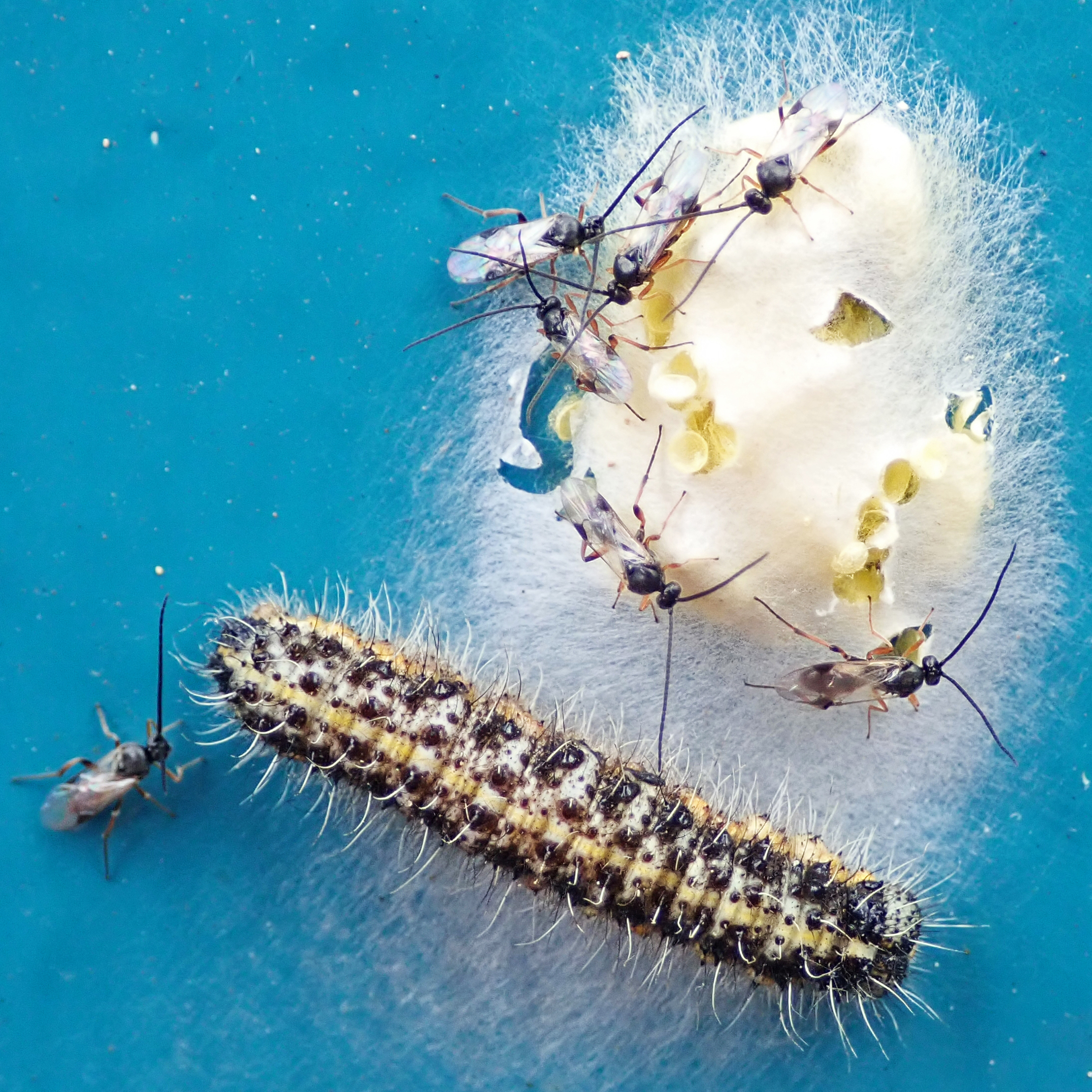
Rather than return them to the park, I put the leaves in a jar to see whether the larvae would go on to pupate and hatch as adult moths. Though I checked the jar regularly, nothing seemed to be happening. The leaves had dried up as expected but, as the larvae usually pupate in leaf debris on the ground, I didn’t think that would be a problem. This week I decided to empty the jar so tipped everything out on to a sheet of white paper … and found this.

It appears that, although the two larvae seemed to be acting and eating as normal, at least one of them had been parasitised by a wasp, and this adult had emerged. It was miniscule, less than 2mms long, more like a speck of dust than a creature. I didn’t expect to get a decisive answer as to what it was but I took some photos and posted them online. Luckily for me, the wasp person I knew was able to connect me with a national parasitic wasp expert. He gave me a tentative identification based on what he could see and referred me to a document I could follow to try to key the wasp to species. The problem is that the key was very specific and, without a microscope, I simply couldn’t see the features clearly enough. So, this little creature would appear to belong to the family Braconidae, the subtribe Adeliinae, one of the Adelius species of parasitic wasp, but I can’t be 100% sure.

Like Loading...

Leafmines: Chrysoesthia sexgutella

06 Monday Oct 2025

Posted by sconzani in insects, plants

≈ Leave a comment

Tags

British leafminers, British moths, leaf-mining moth larvae, leafmines, leafmines on Goosefoot, leafmines on Orache

Last Wednesday evening I got a message from local moth expert George that another local moth-er had found the leafmines of the moth Chrysoesthia drurella, a new find for the county of Glamorgan, in a suburb on the opposite side of Cardiff to where I live. As he knows I’m a keen seeker of leafmines, George just wanted to let me know to keep an eye out for them when I’m out walking.

The moth larvae mine the leaves of Orache (Atriplex sp.) and Goosefoot (Chenopodium sp.), neither of which plants I’m familiar with so that was my first hurdle, being able to recognise the plants and knowing where to find them. Out came my plant books! Sometime later I was fairly confident I’d recognise the plants, though not be able to distinguish one from the other; fortunately, in this case that didn’t matter.

Thursday dawned and, after dealing with some necessary chores, I headed out for a walk, deciding to detour to a local beach in the hope of finding the correct plants. I was in luck, and the plants had mines on their leaves, though they didn’t look like how they should for the moth larvae I was seeking. So, finding a mine that still had a larva in it, I plucked it off the plant and brought it home to take a closer look at it, as the larva’s markings would tell me one way or the other whether I’d found C. drurella. I hadn’t!

However, I had found a closely related species, Chrysoesthia sexgutella, which mines the leaves of the same plants and was a new find for me. This moth breeds twice each year, with the first brood adults flying in May/June and the second on the wing in August. You can see what the adult moth looks like on the UK Moths website. And my search for the rarer Chrysoesthia drurella continues.

Like Loading...

I see red

02 Thursday Oct 2025

Posted by sconzani in autumn, insects, plants, seasons

≈ 2 Comments

Tags

7-spot ladybird, autumn colour, Black Bryony berries, blackberries, Common Darter, Field rose hips, Guelder rose berries, Hawthorn berries, red berries, red colour in nature, Robin's pincushion

When I’m out walking at the moment, it seems that everywhere I look, I see red …

I see red

I see red

I see red

I see re-e-ed

Like Loading...

Lesser emperor

30 Tuesday Sep 2025

Posted by sconzani in insects

≈ Leave a comment

Tags

Anax parthenope, British dragonflies, dragonfly, Lavernock Nature Reserve, Lesser emperor, migrant dragonflies, Odonata

Last Tuesday, though I didn’t realise it until later in the day, I finally saw a stationary Lesser emperor dragonfly (Anax parthenope). My previous encounters with this dragon have been when I’ve seen one, usually fleetingly and at distance, hawking over a body of water. These stunning (ha!) flight shots of the Lesser emperor were taken at Cosmeston’s west lake on 16 August 2023 and looking over the River Ely at Grangemoor Park on 25 July 2025, where I only just managed to catch the dragon before it exited, frame right.

The British Dragonfly Society website reports that this dragonfly was first reported in the UK, in Gloucestershire, in 1996, and first recorded breeding in Cornwall in 1999. I don’t know whether the specimens we see here in south Wales are dragons that have bred here or migrants but I suspect the Lesser emperor I saw last Tuesday was a migrant as I found it at Lavernock Nature Reserve, just a few metres from the sea cliff edge. And, though there is a pond at Lavernock, it routinely dries up during the summer – and certainly did in this year’s drought, so the dragonfly is unlikely to have bred at the reserve.

As I admitted in my opening sentence, I didn’t initially recognise this dragon. ‘It’s just another Migrant hawker’, I thought to myself, and, as it was perched in some scrub and partially obscured by the vegetation, it was difficult to see and photograph. Now, I’m just glad I did take photos or I’d never have realised what I’d seen, nor been able to prove it.

Like Loading...

Leafmines: Acrolepia autumnitella

29 Monday Sep 2025

Posted by sconzani in insects, plants

≈ 2 Comments

Tags

Acrolepia autumnitella, Bittersweet, British leafminers, British moths, leaf-mining moth larvae, leaf-mining moths, leafmines on Bittersweet, Solanum dulcamara

I don’t think I’ve seen leafmines on this plant before – this is Bittersweet (Solanum dulcamara), and the mines can also be found on other members of this plant genus, Tomato (S. lycopersicum) and Potato (S. tuberosum), as well as on Deadly nightshade (Atropa belladonna).

The miners here are the larvae of the moth Acrolepia autumnitella, a very pretty little chestnut-coloured creature, which is shown on the UK Moths website. As you can see in my images, the larvae create quite large blotch mines, and these can be found twice a year, in June and September. I haven’t yet found a pupa but I will keep looking because the silk cocoon that surrounds the pupa looks rather lovely, as a photo on the British Leafminers website shows.

Like Loading...

Leafmines: Coleophora lineolea

22 Monday Sep 2025

Posted by sconzani in insects, plants

≈ Leave a comment

Tags

case-bearing moth larvae, Coleophora lineolea, Coleophora on Hedge woundwort, Coleophora species, leaf-mining moth larvae, leaf-mining moths

When I spotted the spiders I blogged about on Saturday (Spiders: Metellina segmentata), they were spinning their webs on two adjacent plants of Hedge woundwort (Stachys sylvatica) (I was actually looking for Woundwort shieldbugs, which I haven’t seen this year). In the process of photographing those spiders, I spotted some leafmines, something I’d not seen previously on these particular plants.

Noticing what looked like tiny holes in the blotch mines, I suspected the miners must be a species of Coleophora moth and, sure enough, when I turned the leaves over, I found two of the little cases that Coleophora larvae construct to shelter in. There is only one Coleophora moth species whose larvae eat Hedge woundwort so, for once, identification was straight forward: these were Coleophora lineolea. The adult moth is a little cracker, a pale orange-and-white striped beauty, a photo of which you can see on the UK Moths website.

As they’re made from the hairy leaves of the woundwort, the tiny larval cases were themselves very hairy, and rather attractive. This moth uses several other larval plant species – Black and White horehound, Lamb’s ear, and a couple of sages – as well as Hedge woundwort, and the mines and cases can be found between September and May, as they overwinter as larvae, snug in their little cases.

Like Loading...

Leafmines: Coptotriche marginea

15 Monday Sep 2025

Posted by sconzani in insects, leaves, plants

≈ 2 Comments

Tags

British leafminers, British moths, Coptotriche marginea, leaf-mining moth larvae, leaf-mining moths, leafmines on Bramble

Today’s leafminer is one of two I found before I went away on my latest little mini break (I’ll feature the second in next Monday’s blog post). These bright white blotches, shown here on Bramble, but also found on other Rubus species, were made by the larvae of the moth Coptotriche marginea. Here’s a link to the UK Moth website’s entry on this moth, if you want to see what the adult looks like.

The female moth lays her egg on the upper side of a leaf, then, when the larva hatches, it chews into the leaf and initially creates a linear, gallery mine (you can see this in the third of my images, below), before the mine widens out to form a blotch. My photos below show the upper and under sides of each leaf.

This species is bivoltine; the first leafmines can be seen during July, while the second brood feed right through the winter months, from September to March. I guess staying inside a leaf is a cosy enough place to spend the winter, as long as your leaf doesn’t wither and die during the colder months.

Like Loading...

Bug: Megacoelum infusum

12 Friday Sep 2025

Posted by sconzani in insects, trees

≈ Leave a comment

Tags

British miridae, bugs on Oak, Megacoelum infusum, mirid bugs on Oak, Miridae

Here’s another of this year’s new bug finds, a handsome little mirid bug coloured a rich brown and orange, Megacoelum infusum. I found it on a local Oak tree, which was fortunate, as there’s a very similar looking bug (Megacoelum beckeri) that lives on Scots pine (Pinus sylvestris). The British Bugs website entry for this species says it is both vegetarian and carnivorous, supping on Oak sap and tiny insects.

Like Loading...

Fly: Merzomyia westermanni

11 Thursday Sep 2025

Posted by sconzani in insects

≈ Leave a comment

Tags

British flies, British fruit flies, British Tephritidae, flies on Ragwort, fruit fly, Merzomyia westermanni, Tephritidae

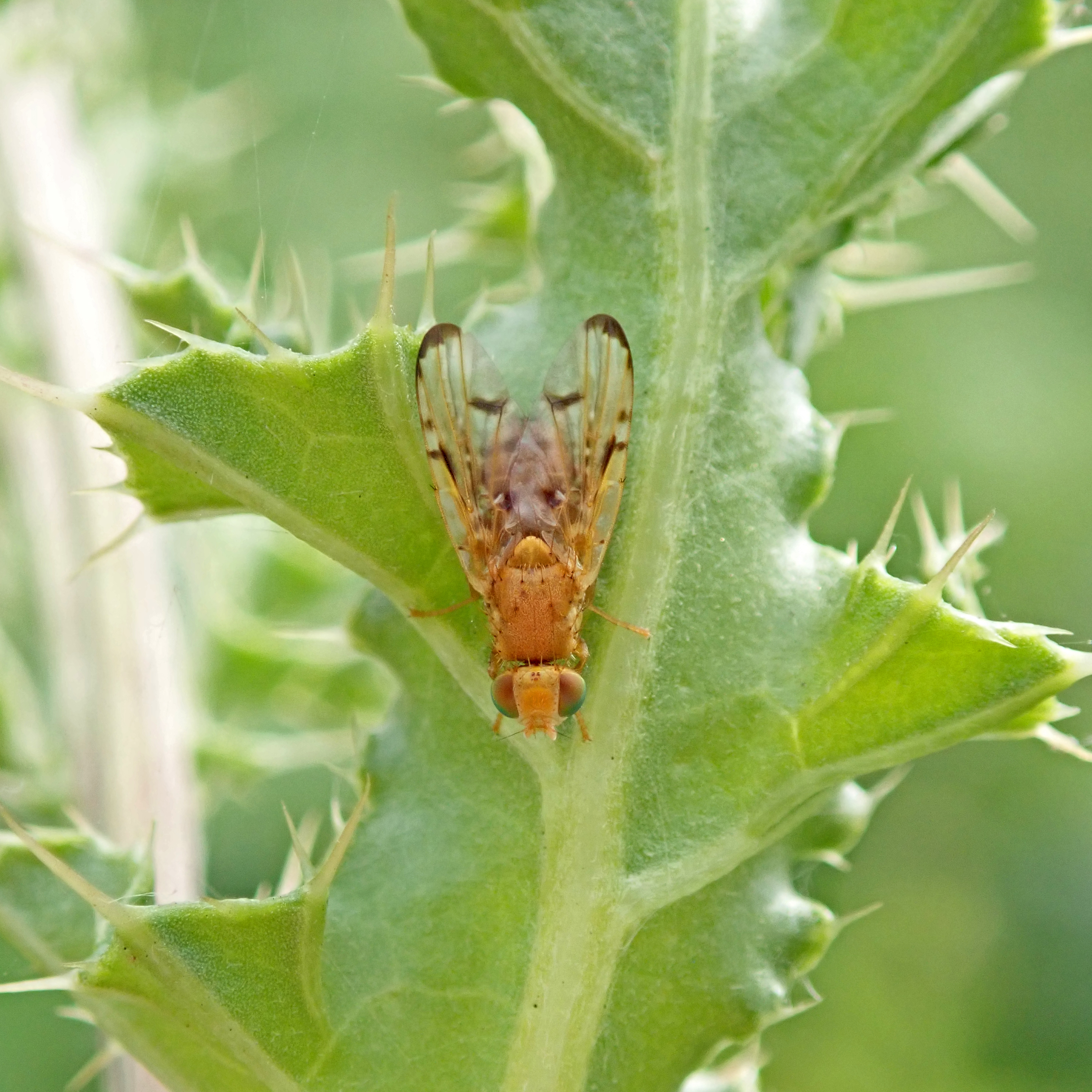
This little beauty is one of the Tephritidae, the fruit flies, and its name is Merzomyia westermanni. As I’m sure you all know by now, flies can be tricky to identify but, fortunately, the patterns on the wings of this creature are unique so, as long as you get a clear photo of its wings, it can be recorded with confidence. Even better, in my brief experience of this species – I’ve only seen them twice, they are more settled, more confiding than many fly species so getting a photo is less difficult. Look for these fruit flies in grassland, particularly around the Ragwort flowers they favour.

Like Loading...
← Older posts
Newer posts →

About me

sconzani

sconzani

I'm a writer and photographer; researcher and blogger; birder and nature lover; countryside rambler and city strider; volunteer and biodiversity recorder.

View Full Profile →

Follow earthstar on WordPress.com

Enter your email address to follow this blog and receive notifications of new posts by email.

Recent blog posts

  • M is for mite December 18, 2025
  • L is for lepidopteran lifers December 17, 2025
  • K is for Keeled skimmers December 16, 2025
  • J is for Jersey tiger December 15, 2025
  • I is for Ichneumon December 14, 2025

From the archives

COPYRIGHT

Unless otherwise acknowledged, the text and photographs on this blog are my own and are subject to international copyright. Nothing may be downloaded or copied without my permission.

Fellow Earth Stars!

  • Unknown's avatar
  • Unknown's avatar
  • Unknown's avatar
  • Unknown's avatar
  • Unknown's avatar
  • Unknown's avatar
  • Unknown's avatar
  • Unknown's avatar
  • Unknown's avatar
  • Unknown's avatar
  • Unknown's avatar
  • Unknown's avatar
  • Unknown's avatar
  • Unknown's avatar
  • Unknown's avatar
  • Unknown's avatar
  • Unknown's avatar
  • Unknown's avatar
  • Unknown's avatar
  • Unknown's avatar
  • Unknown's avatar
  • Unknown's avatar
  • Unknown's avatar
  • Unknown's avatar
  • Unknown's avatar
  • Unknown's avatar
  • Unknown's avatar
  • Unknown's avatar
  • Unknown's avatar
  • Unknown's avatar
  • Unknown's avatar
  • Unknown's avatar
  • Unknown's avatar
  • Unknown's avatar
  • Unknown's avatar
  • Unknown's avatar
  • Unknown's avatar
  • Unknown's avatar
  • Unknown's avatar
  • Unknown's avatar
  • Unknown's avatar
  • Unknown's avatar
  • Unknown's avatar
  • Unknown's avatar
  • Unknown's avatar
  • Unknown's avatar
  • Unknown's avatar
  • Unknown's avatar
  • Unknown's avatar
  • Unknown's avatar

Blog at WordPress.com.

Privacy & Cookies: This site uses cookies. By continuing to use this website, you agree to their use.
To find out more, including how to control cookies, see here: Cookie Policy
  • Subscribe Subscribed
    • earthstar
    • Join 667 other subscribers
    • Already have a WordPress.com account? Log in now.
    • earthstar
    • Subscribe Subscribed
    • Sign up
    • Log in
    • Report this content
    • View site in Reader
    • Manage subscriptions
    • Collapse this bar
 

Loading Comments...
 

You must be logged in to post a comment.

    %d