Juvenile Redstart

Tags

, , , , ,

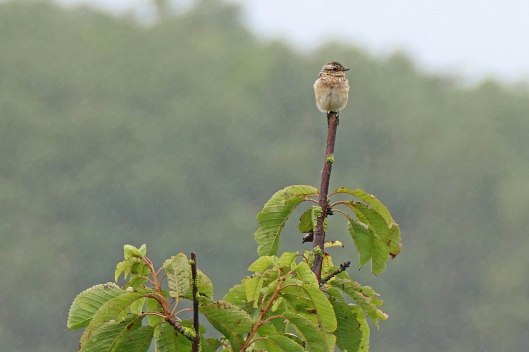
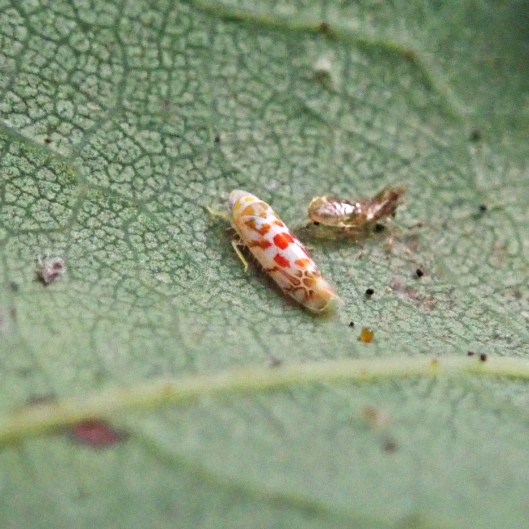
If it’s the same bird, which seems quite likely, then this juvenile Redstart has been dotting around in a hedge at Cosmeston since 26 July, when it was first spotted by another local birder. Hopefully that means it’s been feeding well in preparation for its upcoming journey south to trans-Saharan Africa.

230809 redstart juv

A festival of orange and brown

Tags

, , , ,

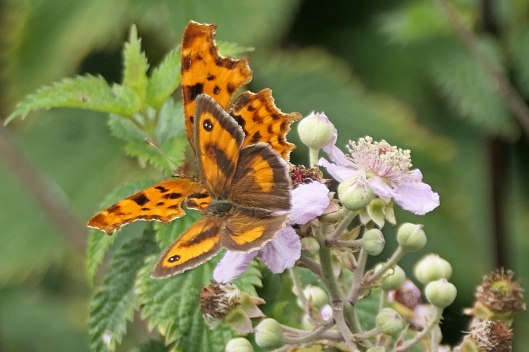
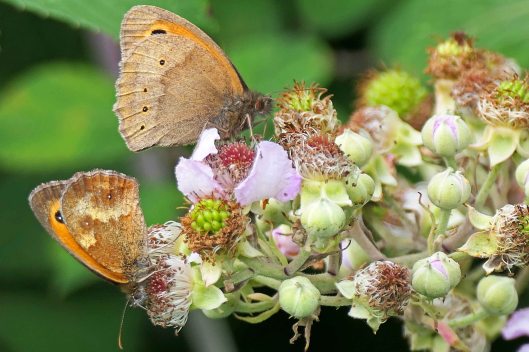
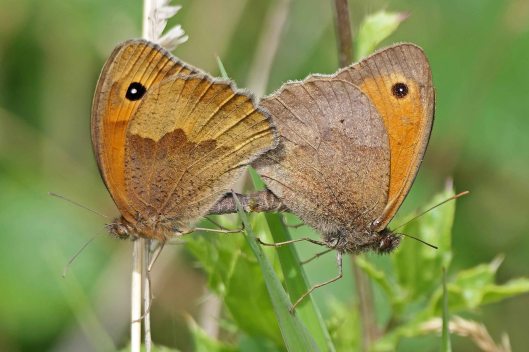
Just a little celebration of some of the beautiful butterflies I’m enjoying seeing during my daily meanders. Though some butterfly species are suffering from this year’s weird weather, these three species seem to be doing very well.

230808 1 comma and gatekeeper

A Gatekeeper in front, a Comma behind

230808 2 gatekeeper pair

A pair of Gatekeepers, the female on the left. The male butterfly has prominent sex brands (brown streaks) on its upper wings.

230808 3 gatekeeper meadow brown

A Gatekeeper below, a Meadow brown above

230808 4 meadow brown

A pair of Meadow browns, creating more Meadow browns. The female is on the left.

Nettle groundbugs

Tags

, , , ,

Considering how much nettle I see, I’m amazed I’d never seen a Nettle groundbug (Heterogaster urticae) before last Thursday, when I saw heaps, at various stages of growth between egg and adult, all out sunbathing in little groups on nettle leaves. And there are only 114 records in the Welsh database of flora and fauna, which also surprised me.

230807 nettle groundbugs (1)

They’re actually very attractive little bugs, rather hairy, with quite diverse markings in their different instars. The British Bugs website reports that they overwinter as adults so, in theory, we should be able to see them all year round. The website also says that, when they mate, the male and female ‘may remain coupled together for several days’ – nothing like making sure they’ve succeeded, I guess.

230807 nettle groundbugs (2)

Sorry my pics aren’t the sharpest – the bugs were moving around a bit – but I wanted to show as many instars as possible.

Field woundwort

Tags

, , ,

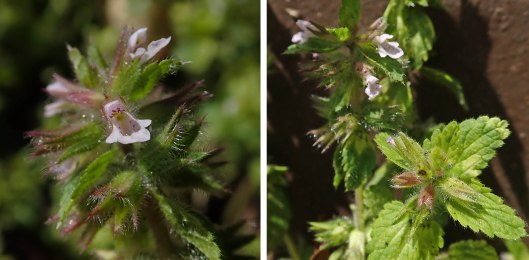
During Friday’s walk I was vaguely hoping to see the Otter that’s been visiting Cardiff Bay wetlands during recent weeks (I didn’t – and I’m not one to stand around for hours on the off chance) but my secondary purpose was to look for pavement plants, those wildflowers that manage to colonise the cracks between bricks or slabs of tarmac and the subject of today’s Wildflower Hour on social media.

230806 field woundwort (2)

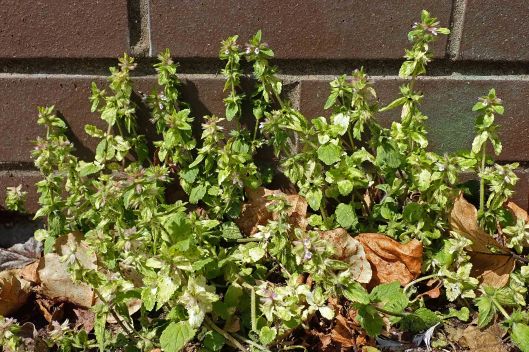
Fortunately, I bumped in to a local birding friend who is also a keen botanist and he was able to point me in the direction of this plant, a new one for me, Field woundwort (Stachys arvensis). Though its natural habitat is fields and hedge edges, especially on sandy soils and mostly in the southern parts of Britain, this plant has extended its range to include some urban locations, like allotments and, as shown here, the tiny cracks between a building and the pavement.

230806 field woundwort (1)

Carrot mining bee

Tags

, , , , , , ,

In August 2020, local entomologist Liam Olds made the amazing discovery of the first Carrot mining bees (Andrena nitidiuscula) for Wales at Lavernock Nature Reserve, and Liam later went on to find a population of the bees at nearby Cosmeston Lakes Country Park. Despite these parks both being relatively near where I live, it’s taken me three years to find my own Carrot mining bee, at Cosmeston on Thursday.

230805 Carrot mining bee (1)

As you might have guessed from the bee’s name, it can usually be found collecting pollen from the flowers of Wild carrot (Daucus carota). And therein lies one of the problem’s for this bee’s future, the preservation of the right habitat to ensure the bee’s conservation. Earlier this year, despite protests against what was happening, the Vale of Glamorgan Council, which operates Cosmeston, went ahead with planting trees across large areas of a wildflower meadow where the bee had previously been found by Liam Olds. Yes, the planet needs more trees, but those trees need to be planted in the right place. When they’re not, they risk destroying important local flora and fauna. Let’s hope the Carrot mining bee can survive the local council’s actions!

230805 Carrot mining bee (2)

Moths matter

Tags

, , , , , , , , , , , , , ,

Some recent mothy goodness …
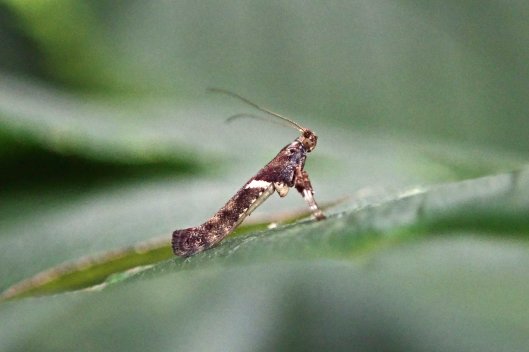
230804 1 Caloptilia semifascia

First, the micro moth Caloptilia semifascia, which I found perched on a leaf during a local meander and which, miraculously, stayed still for some photos.
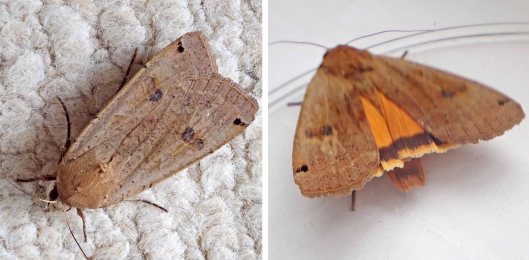
230804 2 large yellow underwing

I grabbed the rain parka I’d left drying on the back of a chair and this beauty flew up. Either I’d brought it home from the previous day’s walk or it had flown in an open window during the night. Whichever it was, this Large yellow underwing (Noctua pronuba) was a welcome visitor.

230804 3 6-spot burnet

I always enjoy watching the Five- and Six-spot burnets during the summer months. This is one of the latter (Zygaena filipendulae).
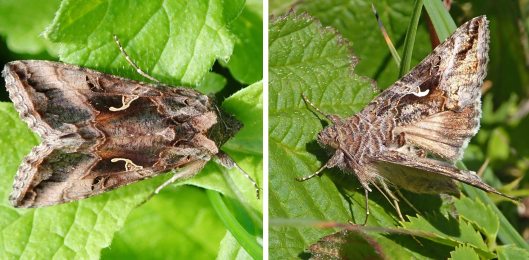
230804 4 silver y

Most of the Silver Ys (Autographa gamma) I see are constantly fluttering about in the long grass but these two were much more cooperative.

230804 5 burnet companion

Burnet companions (Euclidia glyphica) are also frequently camera shy but I got lucky with this beauty that was more intent on feeding than on the lurking photographer.

230804 6 humming-bird hawk-moth

Hummingbird hawk-moths (Macroglossum stellatarum) are most often seem hovering in front of flowers, their long tongues seeking out the tasty nectar within, but this one whizzed past during a recent walk then, luckily for me, settled on the path in front of me.

230804 7 latticed heath

This lovely is another summertime treat. Last but certainly not least, a Latticed heath (Chiasmia clathrata).

The return of the Common sandpipers

Tags

, , , ,

I don’t go down to Cardiff Bay much over the summer months – too many people on the ground and too many boats on the water, all disturbing much of the wildlife I might potentially see. However, as the birds seem to think we’re heading in to autumn already (and the weather does feel like that), I’ve had a couple of strolls along the River Ely embankment this past week. And I’ve been lucky.

230803 common sandpiper (1)

During Monday’s walk, as well as the tens of Mute swans and Coots and a smattering of Great crested grebes and snoozing Mallards, I was treated to close views of these two Common sandpipers, presumably birds that have now completed their summer breeding in more northerly parts of the country and are moving south to settle in their favourite over-wintering areas. Last winter, two birds spent the colder months in and around Cardiff Bay, and it would certainly be nice to have some of these handsome birds around this coming winter as well. Fingers crossed!

230803 common sandpiper (2)

Two little chats

Tags

, , , , ,

We humans may be hoping for a bit more warm weather now that August is here but the birds seem to have decided that summer is over. First up last Wednesday, 26 July, our local expert birder found the first migrating bird of the season, a juvenile Redstart, at Cosmeston Lakes Country Park. And when I went for a look (found it but my photo was poor), I also found a juvenile Stonechat in the same area.

230802 stonechat

And then on Friday, 28 July, I made my own first discovery of the migration season, also at Cosmeston, of a juvenile Whinchat that had begun its journey south. (Later in the day, the same local expert birder who found the Redstart found a second Whinchat, an adult this time.) Enjoy the last of the summer while you can because autumn is definitely in the wind.

230802 whinchat

Three little shieldbugs

Tags

, , , , , , , , ,

When the sun’s shining (which, admittedly, hasn’t been very often in the last couple of weeks), the patches of bramble and low scrub seem to be full of shieldbugs of various sizes and stages, basking in the welcome warmth. Two I’ve seen recently have been new to me:

230801 bronze mid instar

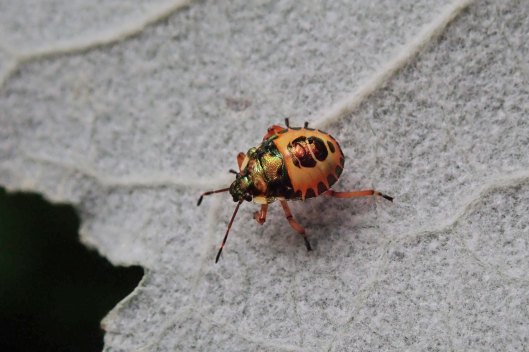
Although I’ve seen Bronze shieldbugs (Troilus luridus) before, I’ve not seen this particular variation, which is a mid instar, halfway between egg and adult.

230801 Eurygaster testudinaria tortoise final instar

You might remember the lesson I learnt back in July 2022 (Blackberries, yum!) to always check a Blackberry before putting it in my mouth. Well, that held true again recently: I was about to pluck this luscious-looking berry when I noticed its occupant. This little critter is the final instar of the Tortoise shieldbug (Eurygaster testudinaria), a new shieldbug for me.

230801 red-legged shieldbug

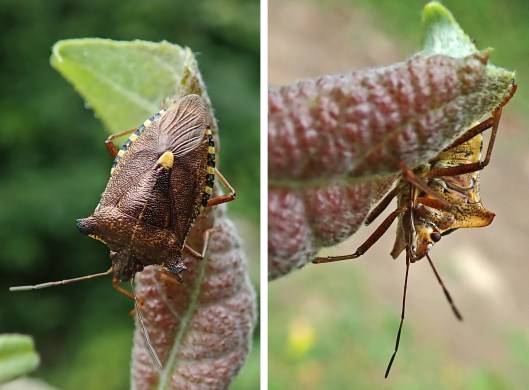
And this last bug is not new at all but I liked the way it was posing, and the fact that I was able to get some shots of the lovely speckling on its belly. This is an adult Red-legged shieldbug (Pentatoma rufipes).