The passing of the Tree pipits

Tags

, , , , , ,

Tree pipits have been heading south in their ones and twos for a couple of weeks already but on Wednesday, with fine weather and a light easterly breeze, their flow increased noticeably. A local birder clocked over a hundred in the hour he watched that morning; another, whose patch is Kenfig NNR, reported a count of 53 during his morning visit; and I noticed similar reports from many locations on social media. Migration magic!

230819 tree pipit

Hygrocybe acutoconica

Tags

, , , ,

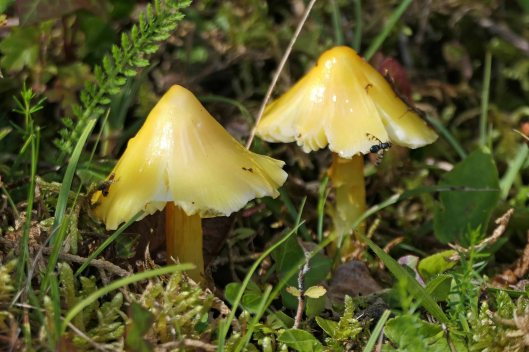
Here’s another sign that autumn’s come early this year. In previous years I’ve not seen these waxcaps in my area until very late September, mostly during October, but this year they’re fruiting now, at least a month earlier than usual.

230818 Hygrocybe acutoconica (1)

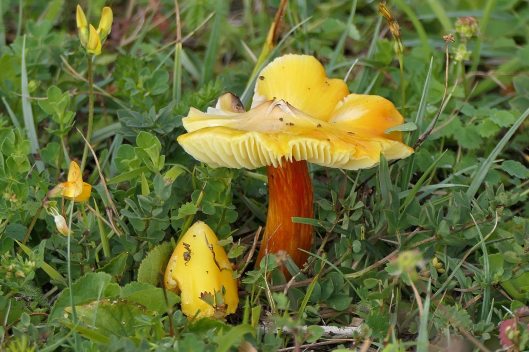
These are Persistent waxcaps (Hygrocybe acutoconica). At first glance, with their conical caps and yellow-orange colour, they look very similar to Blackening waxcaps (Hygrocybe conica) but these don’t blacken. Persistents are the only waxcaps I find locally so it’s always a pleasure to see them, even if it does mean an early autumn.

230818 Hygrocybe acutoconica (2)

The mystery of the white thistles

Tags

, , ,

I’ve noticed in previous years that the top shoots of many Creeping Thistle plants (Cirsium arvense) sometimes turn white at this time of year and I’ve only recently found out that this is caused by Pseudomonas syringae, a bacteria that produces a chemical called tagetitoxin, which poison chloroplasts and causes chlorosis.

230816 white thistle (1)

There’s an excellent article on the Llanelli Naturalists website, entitled ‘The Mystery of the “White” Thistles’, which includes the following explanatory paragraph (nb this article was uploaded in January 2009 so the situation has probably changed since it was written).

This bacterial disease was recorded in the UK for the first time by a retired plant pathologist, Dr John Fletcher, in the vicinity of his home in Canterbury, Kent, only six years ago. The bacterium causing the disease is now thought to be a pathological variety of Pseudomonas syringiae – a complex of bacterial types that affects over 180 species of fruit, vegetable, forage and horticultural plants. The infection on creeping thistle was found for the first time in Canada in 2003. Scientists from Alberta (Zhang et al, 2004) recorded the disease at several locations across Canada and have named it the “White‐colour disease of Canadian Thistle”. Their diseased plants showed apical chlorosis and these symptoms were associated with stunted growth, fewer shoots, inhibition of flowering and/or sterility. These are exactly the same symptoms found on the local populations of Creeping Thistle at Burry Port.


230816 white thistle (2)

That tongue!

Tags

, , , ,

In a recent post (Moths matter, 4 August), I included photographs of a stationary Hummingbird hawk-moth that had flown past me before going to ground on the path in front of me. This week, during a walk along the embankment footpath where the River Ely flows in to Cardiff Bay, I watched spellbound as another of these magical moths hovered, feeding from Red valerian flowers, right in front me. I took rather a lot of photos, clicking almost continuously, hoping I was getting some in focus. This, I think, is the best of those images, and one I’m very pleased with. And, yes, that tongue!

230815 hummingbird hawk-moth

A surprise Silver-washed fritillary

Tags

, , ,

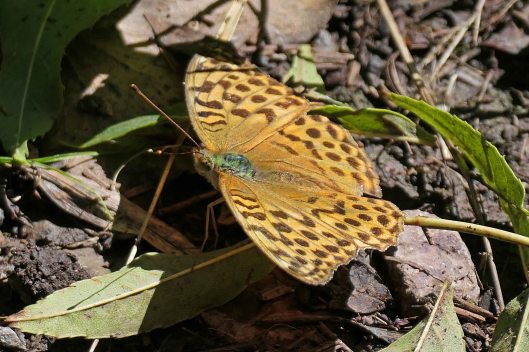
I’d seen a second generation Dingy skipper; got close enough to a migrating Redstart for some reasonable photos; watched Whin- and Stonechats and a Tree pipit insect-catching in the tree plantation; spotted my first Migrant hawker of the year; and was just heading in to the woodland, hot and homeward bound, feeling very pleased with what the day’s walk had turned up, when this happened.

230814 silver-washed fritillary (1)

As if materialising from thin air, this Silver-washed fritillary floated along the path beside me, before settling on the ground almost at my feet. I was amazed! Singles of these butterflies have very occasionally been spotted in Cosmeston’s Cogan Wood but never before by me, despite my having walked every inch of the various paths that thread their way through the trees. It was the perfect end to a perfect day in Nature!

230814 silver-washed fritillary (2)

A slim Spotted flycatcher

Tags

, , , , ,

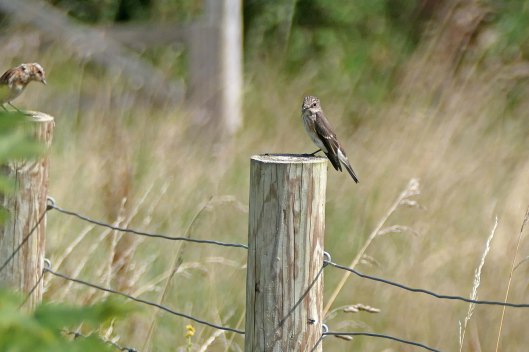
I couldn’t help but wonder if this Spotted flycatcher was looking so slim because of a shortage of insects during the last couple of months. Though the abundance of tiny critters has improved a little now, I’m sure those earlier lifeless months will have affected both adult birds trying to feed their youngsters and the growth – or even the very survival – of those youngsters. (And, yes, that’s a cheeky Whinchat poking its head in at the left of the photo – we’ve been lucky to have both Whinchats and Stonechats visiting the outer fields at Cosmeston Lakes Country Park.)

230812 spot fly whinchat

Another ichneumon

Tags

, , ,

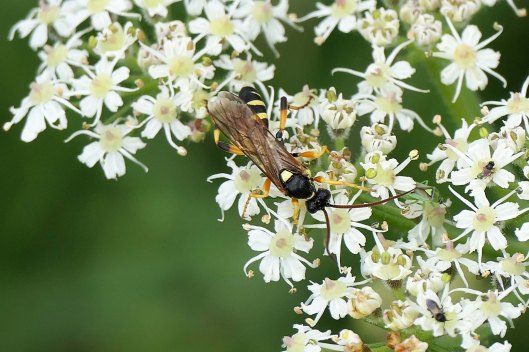
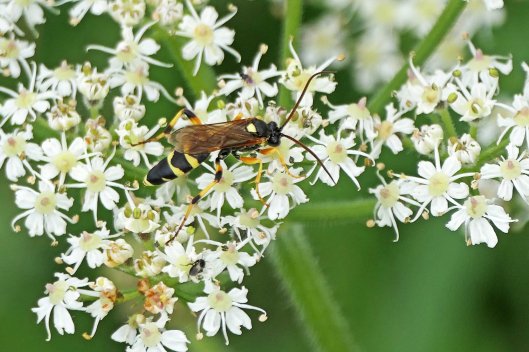
As I mentioned yesterday, I found two ichneumon wasps on neighbouring umbellifers at Cosmeston last week. Their identities haven’t yet been confirmed but I think I’ve got them right, because their characteristics fit exactly the description in the Natural History Museum’s superb downloadable pdf, Beginner’s guide to identifying British ichneumonids. Today’s wasp is, I believe, a male Ichneumon sarcitorius.

230811 Ichneumon sarcitorius male (1)

The guide lists this ichneumon’s characteristics as follows:

Another of the medium to large (female=10mm, male=14mm) black-and-yellow or black-and-red species. The size, shape and precise colour patterns are distinctive to this species. … The males [which have black-and-yellow banding] are longer with broad white bands across the abdomen at the hind edges of the segments, with conspicuous indentations on the bands of the second and third segments. The bands on the first and fourth segments are usually broken. Both sexes have hind femora tipped with black.
Habitat: usually seen nectaring on umbellifers or flying through foliage hunting

230811 Ichneumon sarcitorius male (2)

An ichneumon

Tags

, , ,

I found two ichneumon wasps on neighbouring umbellifers at Cosmeston last week. Their identities haven’t yet been confirmed but I think I’ve got them right, and I’ll explain why in today’s post and tomorrow’s. Firstly, though, I must acknowledge my source for this – the Natural History Museum has an excellent downloadable pdf, Beginner’s guide to identifying British ichneumonids, which I always find very helpful when trying to identify these lovely wasps.

230810 Amblyjoppa fuscipennis fem (1)

Firstly, I believe this is a female Amblyjoppa fuscipennis, which the guide describes as follows:

A large (16–25mm) and beautiful species with a black head. It has a black thorax with a small cream spot and a bright orange abdomen – quite broad and no other colours on it. Can be confused with Protichneumon pisorius, but where P. pisorius has black tips on the hind tibia and tarsus, these features on A. fuscipennis are entirely orange. Flies from June to August.

230810 Amblyjoppa fuscipennis fem (2)