Jersey cudweed

Tags

, ,

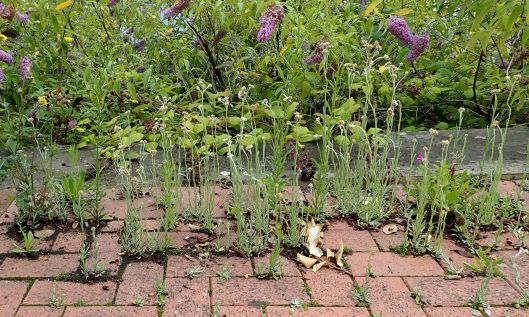
A year ago, one of my local birding acquaintances, who is also a keen botanist, discovered a small area of Jersey cudweed (Gnaphalium luteoalbum) growing along the edge of the Cardiff Bay walking and cycling trail. Though he quickly reported his find to Cardiff Council in an attempt to protect it, their contractors soon obliterated the plants in a typical ‘kill the weeds’ operation. So, I didn’t get to see this new plant then but I made myself a note to check back in a year’s time, which I did, last week, and was very pleased to see the plants have reappeared.
230730 jersey cudweed (1)

The NatureSpot website notes that Jersey cudweed is likely to have been ‘an ancient introduction’ to Britain that then ‘became almost extinct’ but is now bouncing back (despite the anti-weed brigade!). And, though traditionally a plant of sandy fields and dune slacks, it is now adapting to life as a pavement plant in our towns and cities.

230730 jersey cudweed (2)

Lifer: Goshawk

Tags

, , , ,

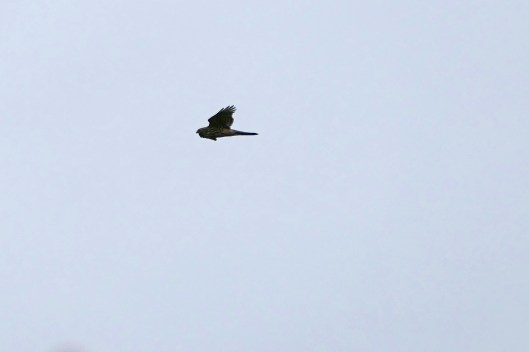
This is probably the worst photo of a Goshawk (Accipiter gentilis) you’ll ever see but it’s my photo of a Goshawk, a raptor that’s been my bogey bird ever since I started birding seriously. I’ve had a lot of false sightings – more hope than skilled identification – but, finally, last Wednesday, my Goshawk time had come. As our county recorder and a local birding expert both told me, the key indicators here are its size (I initially thought Buzzard, then realised it wasn’t flying like a Buzzard), the broad bulging shape of the inner wing, the broad hips, the rounded tail and, finally, the heavily dark-streaked belly of a juvenile Goshawk. Although Goshawks don’t bred locally, the juveniles tend to wander quite widely once they fledge so now is a good time to see/look for them.

230729 goshawk

Awkward oviposition

Tags

, , , , ,

She was my first Southern hawker dragonfly of the year and she wasn’t making life easy for herself. There must have been a male Southern hawker in the vicinity as this lovely lady had already mated and was busy laying her eggs. However, she picked a very difficult location for ovipositing, underneath the wire netting that secures the wooden edge of the dragonfly pond at Forest Farm Nature Reserve. This did mean she was almost a captive subject for my lens, though the wire obscured her quite a bit, and the location wasn’t exactly easily accessible for her – I heard her wings rubbing against the wire as she entered. Her body was also squashed, making it a little difficult for her to manipulate herself in to the best position to place her eggs. I took a few photos and left her to her awkward endeavours.

230727 southern hawker

Four-footed butterflies

Tags

, , , , , ,

I learn something new every single day and this is something so blindingly obvious that I can’t believe it hasn’t occurred to me before now. I was reading the entry about the Nymphalidae family of butterflies in my copy of Peter Eeles’s Life Cycles of British & Irish Butterflies when I came across this

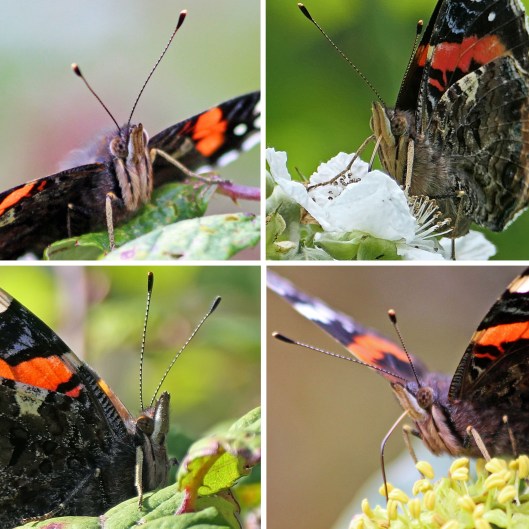
the forelegs in both sexes are vestigial and useless for walking, and this family is sometimes referred to as the four-footed butterflies. The brush-like appearance of the forelegs has also resulted in the other common name for this family – the brush-footed butterflies.

Of course, I’d noticed that many species of butterfly sit on four legs (the skippers, for example, as well as most of the browns and the fritillaries, and the Red admiral pictured below) but I hadn’t realised that their forelegs are essentially useless for locomotion. And, indeed, according to an entry I’ve just read on Ray Cannon’s Nature Notes website, in some species of butterfly those forelegs have, during their long evolution, been adapted to function as sensory organs. Butterflies continue to amaze me!

230725 four-footed butterflies

Fly: Nowickia ferox

Tags

, , , , ,

I found a new fly! Okay, you may not be as excited about that as I am, but I’m always excited when I find something new, and it’s a bonus when I’m able to identify it quite easily because of its distinctive markings. So, meet Nowickia ferox, a bristly brute, with a less-than-appealing endoparasitoid life cycle – its larvae grow inside and eat the larvae of the Dark Arches moth (Apamea monoglypha), emerging only when ready to pupate.

230724 Nowickia ferox

Yellow loosestrife

Tags

, , , ,

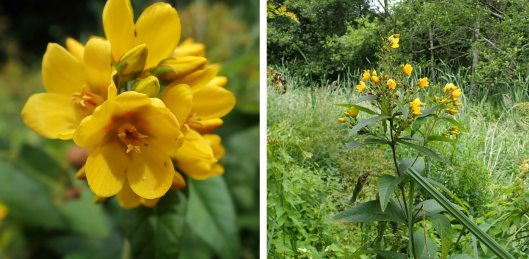
With their roots in the water along the edge of a local canal, these Yellow loosestrife (Lysimachia vulgaris) plants were so exuberant and lush I initially thought they were some other species. They had obviously found the damp niche that suited them best.

230723 yellow loosestrife (1)

Though I would never advocate the use of herbal medicine (just being cautious about matters I don’t understand or have knowledge of), Yellow loosestrife did, apparently, have a large number of traditional uses as a medicinal plant, from treating diarrhoea and haemorrhaging to cleaning wounds and being used as a mouthwash. And the First Nature website reports on other common uses:

Yellow Loosestrife tied around the necks of oxen was reputed to keep irritating flies away from them. In the distant past these and several other kinds of ‘loosestrife’ plants were also used to get rid of infestations of flies in houses. The plants were dried and burned indoors, and toxins in the smoke drove out the flies (and no doubt also any human occupants).

230723 yellow loosestrife (2)

A White-letter hairstreak

Tags

, , , ,

Last Saturday’s weather was rather different to today’s constant rain – there was rain, but interspersed with warmer, sunny spells, and I managed to coincide my visit to local Dingle Park with one of those. This was my third time standing staring at the park’s Wych elms, and it was definitely a case of third time lucky.

230721 white-letter hairstreak (1)

Previously, the White-letter hairstreaks had stayed high in the tree but, this time, one little beauty came down lower, wandering slowly across the leaves, all the while with its tongue out, licking up the tasty honey dew.

230721 white-letter hairstreak (2)

Initially, it was quite distant but my patience paid off as it flitted from one cluster of leaves to another until it was really quite close. White-letter magic!

230721 white-letter hairstreak (3)

Purple sheen

Tags

, , ,

First I saw one distantly in the Oak trees opposite Lavernock Nature Reserve, and I was glad.

230721 purple hairstreak (1)

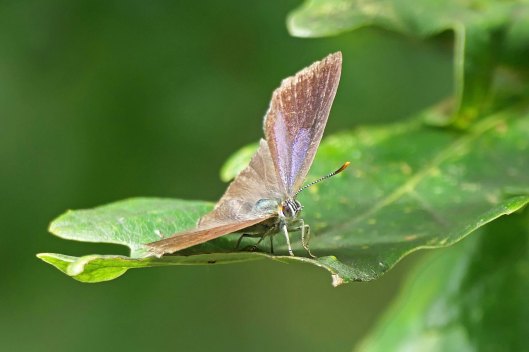
Then I saw one very close in the Oak trees at Casehill Woodland (as it flitted right on to the leaves in front of me), and I was overjoyed.

230721 purple hairstreak (2)

They’re Purple hairstreaks, of course, and they are beautiful, and I was very lucky.

230721 purple hairstreak (3)