• ABOUT
  • BIRDING 2018
  • Birding 2019
  • BLOG POSTS
  • Butterflies 2018
  • Resources

earthstar

~ a celebration of nature

earthstar

Tag Archives: birding

Cardiff’s lovely Little gull

14 Tuesday Aug 2018

Posted by sconzani in autumn, birds, nature

≈ Leave a comment

Tags

autumn migration, autumn passage of birds, birding, birdwatching, British birds, British gulls, Cardiff Bay, gulls, Hydrocoloeus minutus, Little gull

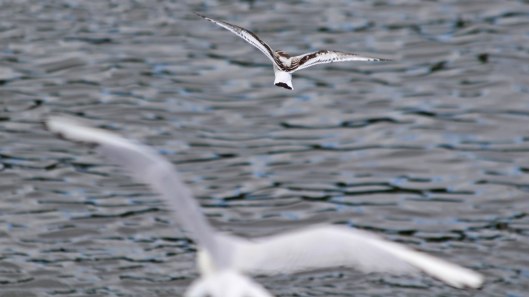
I mentioned a few days ago, in my post about the autumn passage of birds now getting  underway, that a juvenile Little gull has recently been spending time in Cardiff Bay. As it’s such a lovely creature, I thought I’d go back and try for another look and more photos. My camera gear’s not the best so these shots aren’t the crispest you might see but I think you’ll agree this is one beautiful small gull.
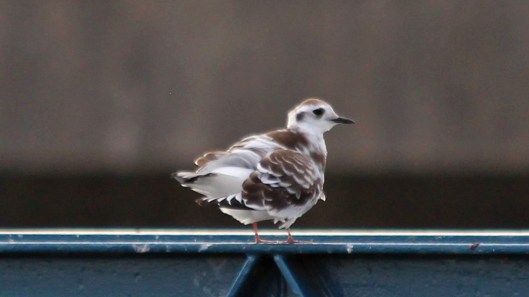
180815 Little gull (1)

The Little gull (Hydrocoloeus minutus) is perfectly named (minutus, as you might have guessed, means small, minute): in the photo below you can clearly see its petite stature in comparison to the Black-headed gulls and Feral pigeon perched near it.
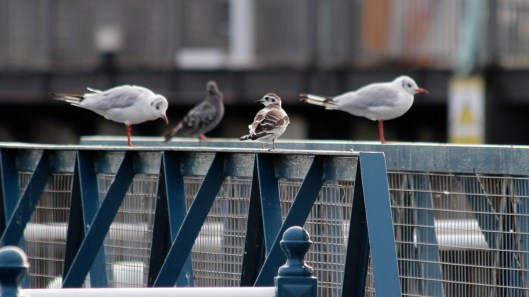
180815 Little gull (2)

According to the RSPB website, between 400-800 Little gulls over-winter in Britain but, locally, here in south Wales, they are uncommon visitors, mostly seen on passage in spring or autumn. My first-ever Little gull sighting was during this year’s spring passage, in Cardiff Bay on 10 April, but that bird spent much of its time flying around in the centre of the bay, visible only through ’scopes and binoculars.

180815 Little gull (3)
180815 Little gull (4)

So, it’s been especially nice that our current visitor has been flying, perching and feeding much closer to shore where I, and many other people, have been able to get a better look at it. Soon, I’m sure, it will head south to meet up with others of its kind who will spend their winter around the coastlines of the Mediterranean and western Europe. Fly well, little beauty!

180815 Little gull (5)

Like Loading...

Encounters with Green woodpeckers

13 Monday Aug 2018

Posted by sconzani in birds, nature

≈ Leave a comment

Tags

birding, birdwatching, British birds, Green woodpecker, juvenile Green woodpecker, Lavernock Nature Reserve, Picus viridis

180813 Green woodpecker (2)

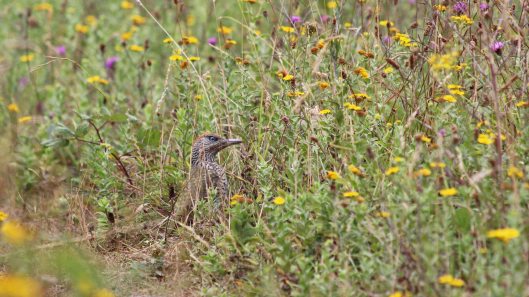
I’m sure I’ve written before on here that Green woodpeckers can be darn tricky to get good views of. They’re very skittish birds, taking fright and flying off at the slightest noise, yaffling as they go.

180813 Green woodpecker (3)

So, I was really thrilled at Lavernock Nature Reserve last Wednesday to get quite close to two of these beautiful birds. Initially, I wasn’t sure if I had seen the same bird in different parts of the reserve, as the sightings were an hour apart, or whether these were two different birds, but a close look at their facial markings has confirmed they are different – a real bonus!

180813 Green woodpecker (1)

I think the reason I did manage to get reasonably near both times is that these are juvenile Green woodpeckers (Picus viridis) – you can tell that from the black mottling in their plumage – so they haven’t yet learnt to fear all humans or, perhaps, their senses aren’t yet as acutely honed as their parents’.

180813 Green woodpecker (4)
180813 Green woodpecker (5)
180813 Green woodpecker (6)

These are both male birds – you can tell from the red feathers in the ‘moustache’ markings on either side of their beaks. And both were intent on feeding on ants from the many anthills that dot the wildflower meadows at Lavernock (as you can see in the very short video below). Perhaps that’s another reason why they were not so concerned about me.

Green woodpecker feeding

Like Loading...

The autumn migration is underway

11 Saturday Aug 2018

Posted by sconzani in autumn, birds, nature

≈ 1 Comment

Tags

Arctic tern, autumn migration, bird migration, birding, birdwatching, British birds, Cardiff Bay, Ely embankment, Little gull, Spotted flycatcher, Turnstone, Willow warbler

It’s that time of year, tinged ever so slightly with sadness but enlivened with occasional moments of great excitement, when bird populations begin their autumn migration. My local Swifts have headed south for the winter and I shall miss their dawn and dusk screaming, the sound of summer for me, and there have been good numbers of Swallows and House martins swirling above Cardiff Bay, in a final feeding frenzy before they too head south.

180811 1 willow warbler
180811 2 willow warbler

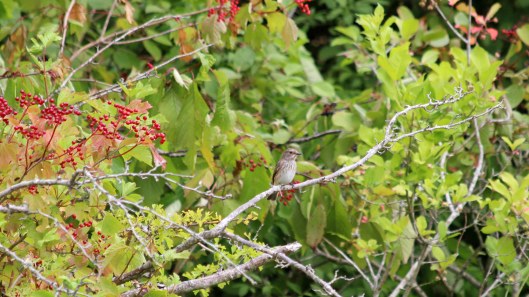
I’ve spotted small flocks of Willow warblers and Chiffchaffs, moving through my local nature reserves and parks, stocking up on nutrients before they also begin their long flights. And, this week, a Spotted flycatcher became my 186th bird species for 2018, when I saw it passing through Cosmeston.

180811 3 Spotted flycatcher

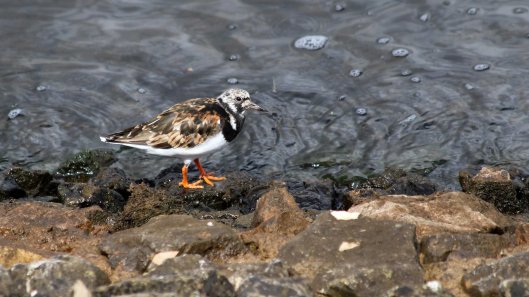
As well as those birds that are departing for sunnier wintering spots, there are also birds returning from their colder breeding locations to spend the winter in Britain’s relatively warm climes. I saw my first two returning Turnstones, still in their summer plumage, during a wander along the Ely embankment on Wednesday.

180811 4 turnstone

Also at Cardiff Bay this week have been a couple of those birds that provide birders, local and distant alike, with a quickening of the heart rate. First, a first summer Arctic tern arrived to join the Cardiff Bay bird population, and then a juvenile Little gull also joined the party, though neither bird has been welcomed by the local gulls.

180811 5 arctic tern

180811 6 little gull
180811 7 little gull

I saw both birds being chased and mobbed on Wednesday, and a little later that same day my friend John caught some amazing shots of a Black-headed gull almost drowning the Little gull – luckily, it escaped. (Bird xenophobia? No one seems to know why the local gulls are being so aggressive.)

180811 8 arctic tern being chased

Above, Arctic tern being chased; below, Little gull also being pursued

180811 9 little gull being chased

Let’s hope further newcomers are given a warmer welcome to our local waters and, indeed, let’s just hope for further newcomers – there’s nothing quite like an exciting sighting to quicken a birder’s pulse!

Like Loading...

A family of Linnets

09 Thursday Aug 2018

Posted by sconzani in birds, nature, plants, wildflowers

≈ Leave a comment

Tags

birding, birdwatching, British birds, Ely embankment, Herb Robert, Linnet, Linnet family, Linnets feeding on Herb Robert

I went for a wander along the Ely embankment yesterday and was delighted to discover a family of five Linnets, two adults and three exceedingly cute juveniles, all feeding on Herb Robert seeds. They started off with Mum and Dad feeding the youngsters but the kids soon got impatient and wanted more food more quickly.

180809 linnet (1)

Mum or Dad has just plucked one of the Herb Robert seed pods while …

180809 linnet (2)

… youngster is watching to see how this food-gathering process works.

180809 linnet (3)

“Now if I can just reach …”

180809 linnet (4)

“Gotcha!”

180809 linnet (5)

“Now I’ve got the idea, I can help myself.”

180809 linnet (6)

Youngster looking rather pleased with itself.

180809 linnet (7)

Like Loading...

Birding along Rumney Great Wharf

07 Tuesday Aug 2018

Posted by sconzani in birds, coastal fauna, nature, seaside, walks

≈ Leave a comment

Tags

birding, birdwatching, British birds, Glamorgan Bird Club, Rumney Great Wharf

It was hot! In fact, it was not just hot, it was scorching but, along with 15 other brave souls, I joined the Glamorgan Bird Club’s outing last Sunday to walk part of the coastal path along Rumney Great Wharf. We started at Parc Trederlerch, where fishermen were trundling their mountains of gear to favourite sites for a day’s fishing, and Swans, Coots, Tufted ducks and Moorhens flocked to be fed by strolling families.

180807a Parc Tredelerch

From there we walked down towards the sea alongside Cors Crychydd Reen. Despite being choked with weed, the reen was home to Little grebes, Coots and Moorhens, all with young, as well as countless, though elusive Reed warblers.

180807b Cors Crychydd Reen

A Buzzard was hunting from a post overlooking the adjacent landfill site, where gulls, Swifts and assorted hirundines were diving and swooping for food.

180807c buzzard

Tucking in to the blackberries as we walked, we were charmed by the sounds of Willow warblers and House sparrows, Goldfinches and Greenfinches, like this one perched high in a tree.

180807d greenfinch.jpg

When we reached the sea wall, we turned left towards Newport. Here’s the view in both directions, firstly looking west over Cardiff Bay towards Penarth Head and then west across the very dry foreshore. The heat shimmer didn’t make bird-spotting easy.

180807e view west twds Penarth180807f view east

Linnets entertained us as they bounced around the bushes and reeds.

180807g linnet

We didn’t see a huge number of waders – maybe it was too hot even for them. A large mixed flock of Redshanks and Dunlins flew east, we had good ’scope views of Ringed plovers and Dunlins at the water’s edge, and gulls abounded. There was one Common gull amongst this lot perched on the posts and a Little egret further along doing the same.

180807h gulls

There were also a ton of dragonflies and hoverflies, bees and butterflies – I’ll post more on two of those lovelies in tomorrow’s blog.

And for those who like the nitty-gritty details – I saw 42 bird species: Black-headed Gull, Carrion Crow, Buzzard, Chiffchaff, Common Gull, Redshank, Swift, Common Whitethroat, Coot, Dunlin, Goldfinch, Great Black-backed Gull, Green Woodpecker, Greenfinch, Grey Heron, Herring Gull, House Martin, House Sparrow, Jackdaw, Kestrel, Lesser Black-backed Gull, Linnet, Little Egret, Little Grebe, Magpie, Mallard, Moorhen, Mute Swan, Lapwing, Oystercatcher, Reed Bunting, Reed Warbler, Ringed Plover, Feral Pigeon, Rock Pipit, Shelduck, Starling, Swallow, Tufted Duck, Willow Warbler, Woodpigeon, and Wren. Also seen by trip participants were Blackbird, Blackcap, Blue tit, Canada goose, Collared dove, Cormorant, Curlew, Great crested grebe, Pied wagtail, Skylark, Robin, Stonechat and Whimbrel, bringing the total club list to a very respectable 55 species.

Like Loading...

Birding at RSPB Dungeness

31 Tuesday Jul 2018

Posted by sconzani in birds, insects, nature

≈ 4 Comments

Tags

birding, birdwatching, British birds, British butterflies, Common tern, Egyptian Goose, Emperor dragonfly, RSPB Dungeness, Snipe, Wood sandpiper

I had never been to RSPB Dungeness until my visit with my friend Jill two weeks ago but, if you can get past the fact that there’s a nuclear power station buzzing away just down the road, then you should be able to appreciate what a wonderful place it is. (British people seem to take nuclear power stations for granted but, as a nuclear-free New Zealander, I still find them quite scary places and really rather menacing!)

180731 Dungeness nuclear power station180731 RSPB Dungeness

This is a unique landscape of low rolling shingle banks, interspersed with patchy areas of low scrub and large shallow pools – it’s water bird heaven!

180731 Common terns (2)
180731 Common terns (1)

180731 Common terns (3)

Our first highlight was seeing the Common terns that breed at Dungeness. Terns are such agile flyers and to see their young fledglings was a real treat.

180731 Egyptian geese

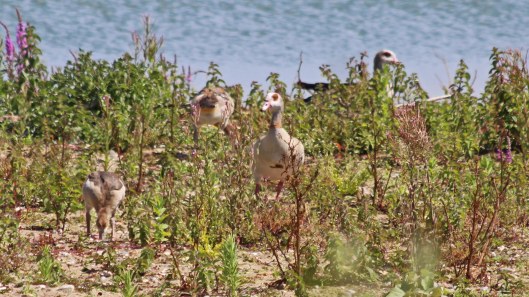
Eqyptian geese have also bred here, and we saw a pair with two well-grown goslings.

180731 snipe

I had my best-ever views of a Snipe that decided to come out and poke around the muddy edges of one of the pools. These are normally such secretive birds so it was a real pleasure to watch this bird foraging.

180731 wood sandpiper

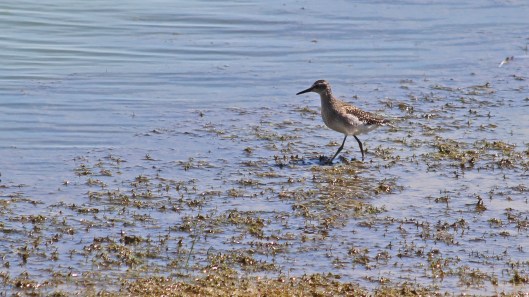
And the Snipe was joined by not one but two Wood sandpipers.

180731 water birds galore

Each of the six hides on the two-mile-long main trail offers different views, different birds, and, after motoring down to a cafe near the lighthouse (and that power station), we also stopped off on our return to check out the two shorter trails and hides on the opposite side of the road. Here we had good, though distant views of a Greenshank and a Bar-tailed godwit. Cracking!

180731 b Painted lady
180731 b peacock
180731 b small copper

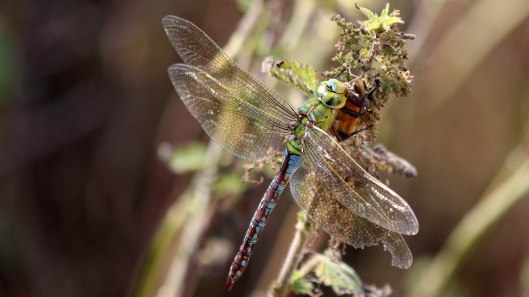
As well as the birds, the wildflowers added lots of pretty colour to our wander, and we were entertained as we walked by large numbers of beautiful butterflies and debonaire dragonflies, though it wasn’t quite so pleasant watching an Emperor dragon biting the wings off a Gatekeeper.

180731 b emperor

Here’s my bird list for the day (not including a lot of smaller birds that were flitting about the bushes while I was marvelling at the butterflies): Teal, Lesser black-backed gull, Tufted duck, Mallard, Herring gull, Common tern (with young), Cormorant, Sandwich tern, Common sandpiper, Wood sandpiper (2), Snipe, Egyptian goose (and goslings), Ringed plover, Pochard, Little grebe, Great crested grebe, Lapwing,Coot, Dunlin, Goldeneye, Reed warbler, Redshank, Woodpigeon, Oystercatcher, Grey heron, Great white egret (2), Greylag goose, Mute swan, Black-headed gull, Shelduck, Shoveler, Carrion crow, Swallow, House martin, Greenshank, Bar-tailed godwit, Pied wagtail, Gadwall and Magpie.

Like Loading...

Kittiwakes

20 Friday Jul 2018

Posted by sconzani in birds, nature

≈ 2 Comments

Tags

birding, birds in Dunbar Harbour, birds on Farne Islands, birdwatching, British birds, Farne Islands, Kittiwake

I realised today, when looking through my folder of photos for prepping blogs, that I have a couple of birds from my trip to Northumberland back in May that I haven’t yet blogged about. So, let’s put that right.

180710 kittiwakes (1)
180710 kittiwakes (3)

180712 kittiwakes (2)

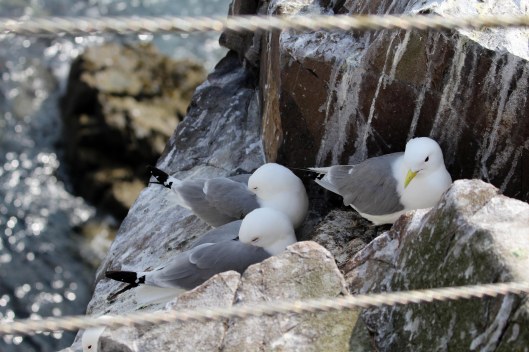
I actually saw – and heard – my first Kittiwakes in Scotland, in Dunbar, where the birds nest on cliffs right on the edge of the town’s harbour. It’s a precarious site but that doesn’t bother these noisy birds, who seem constantly to remind you of their name with their onomatopoeic call.

180712 kittiwakes (4)

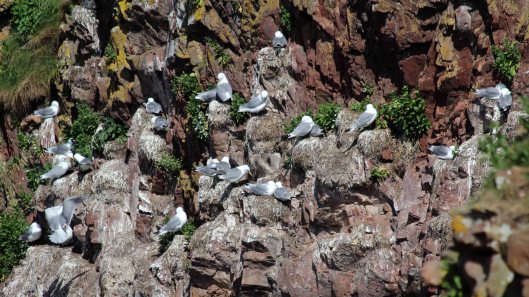
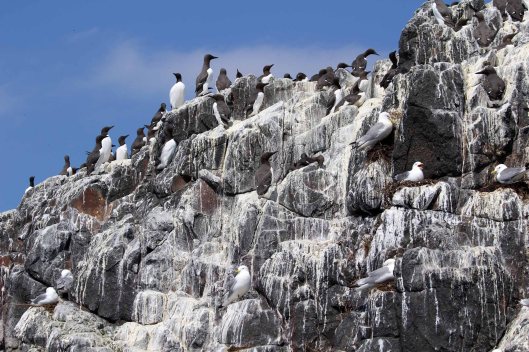
I next saw Kittiwakes when we sailed out to the Farne Islands. Once again, they were perched on impossibly small ledges of rock, sharing these spots on the tall craggy cliffs with Guillemots and Razorbills and Cormorants.

180712 kittiwakes (5)
180712 kittiwakes (6)

On the Farnes, I managed to get a much closer look at these beautiful gulls. Something about their face makes them look softer and more gentle than their Herring gull cousins – perhaps it’s their smaller, less savage-looking beak.

180712 kittiwakes (7)

Kittiwakes only come to the Farnes during the summer months to breed. Once their young are fledged, they’ll all head back to the Atlantic to spend the winter, dipping down into the deep waters for fish and shrimps to eat, then soaring high above the ocean waves.

Like Loading...

Birding at Peterston & Pendoylan Moors

12 Thursday Jul 2018

Posted by sconzani in animals, birds, insects, nature, walks

≈ 2 Comments

Tags

birding, birdwatching, British birds, British butterflies, butterflies, Cinnabar caterpillars, Comma, Cows, Glamorgan Bird Club, Green-veined white, Meadow Brown, Peacock, Red fox, Red kite, River Ely, Sand martin, Small tortoiseshell, Stock dove

Yesterday I enjoyed another wonderful, if rather hot day’s birding with my friends from the Glamorgan Bird Club, this time wandering a trail alongside the River Ely near Peterston-super-Ely and Pendoylan.

180711 2 red kites

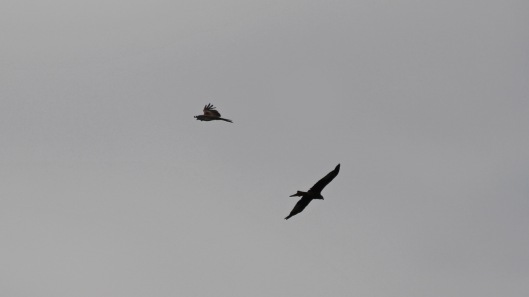
On the way there, my friend John and I had incredibly close views of three Red kites and more of these magnificent birds of prey were gliding overhead during our walk.

180711 1 stock dove

We saw Stock doves (one pictured above) sitting obligingly close to Woodpigeons so we could see the differences in the two species.

180711 2 red fox

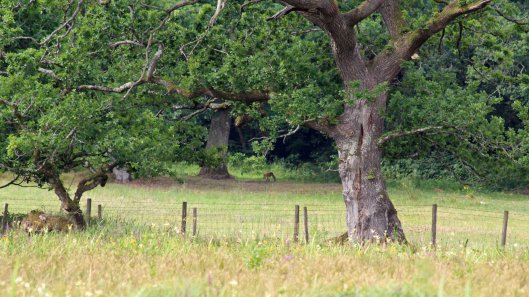
A Red fox was spotted trotting along in a distant field, its lunch in its mouth.

180711 4 meeting the locals

A large herd of large cows moved reluctantly away from the river so we could pass by. You’d have to be crazy to mess with this lady, who was keeping a steady eye on us in case we ventured too close to her calves.

180711 5 participants

The fifteen participants … well, fourteen really, as I was taking the photo.

180711 6 river ely

The meandering River Ely was running low due to the recent drought conditions here in south Wales.

180711 b cinnabar caterpillars
180711 b comma
180711 b green-veined white
180711 b meadow brown
180711 b peacock
180711 b small tortoiseshell

As well as birds, we also saw lots of butterflies, including these: Cinnabar caterpillars, Comma, Green-veined white, Meadow brown, Peacock, and more Small tortoiseshell than I’ve ever seen in one day before.

180711 7 sandmartins

The highlight of the day for me was watching these Sand martins hawking for food over the fields and then returning to their burrows in the river bank to feed their hungry young. Magic!

Like Loading...

A sunbathing Blackbird

07 Saturday Jul 2018

Posted by sconzani in birds, nature

≈ 4 Comments

Tags

bird behaviour, bird sunbathing, birding, birdwatching, blackbird, British birds, Bute Park, sunbathing bird

180707 sunbathing blackbird (3)

I spotted this Blackbird during a wander along the woodland trail in Cardiff’s Bute Park today, and it was concentrating so hard on its sunbathing that it didn’t notice me at first.

180707 sunbathing blackbird (1)

The sun was fierce, which I think accounts for the bird sitting with its mouth open, trying to cool itself down. As for the sunbathing itself, here’s the explanation from the British Trust for Ornithology website:

‘Sunbathing’ is used by some birds as part of their routine feather maintenance and is most commonly seen … in Blackbirds and Robins. The birds invariably adopt a posture in which the body feathers are fluffed up and one or both wings are held out from the body, with feathers spread. It is thought that using the sun in this way does two things. It both helps the preen oil to spread across the feathers and drives parasites out from within the plumage. Some of these parasites feed on the feathers themselves and all are highly specialised, with many only found on a single species of bird.

 180707 sunbathing blackbird (2)

Like Loading...

In a Pengam garden

05 Thursday Jul 2018

Posted by sconzani in birds, nature

≈ 2 Comments

Tags

birding, birdwatching, blackbird, British birds, bullfinch, Carrion crow, Collared dove, garden birds, Goldfinch, Great spotted woodpecker, Woodpigeon

My friend Sharon has a lovely garden: an area of lawn bordered by flowers, shrubs and hedge; a separate area for growing vegies, the glasshouse and the beehives; and a lovely little bit of wild woodland at the end. It’s a paradise for birds, particularly because Sharon also has lots of feeders that she keeps stocked up with seeds of various kinds and suet blocks. As a person who lives in a first-floor flat with no garden, I just love visiting Sharon’s garden. I could sit watching the birds all day long.

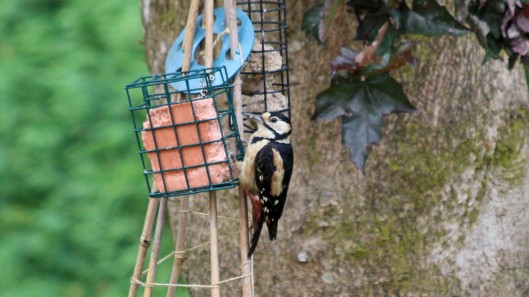
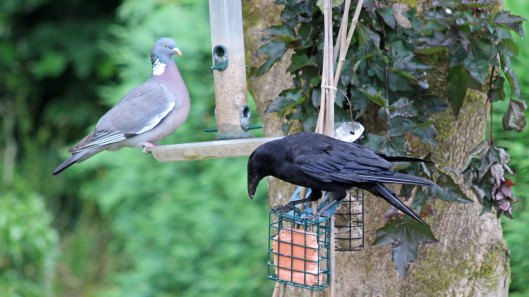
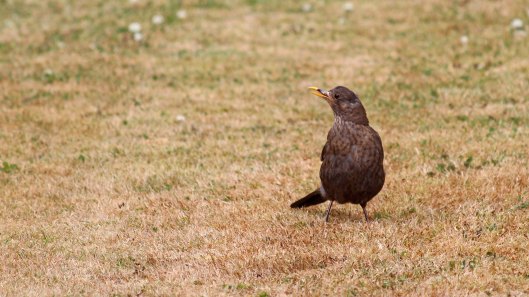
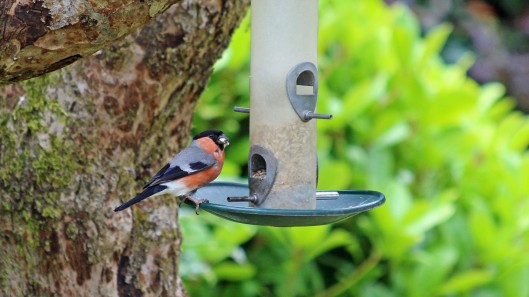
180705 1 Pengam garden birds

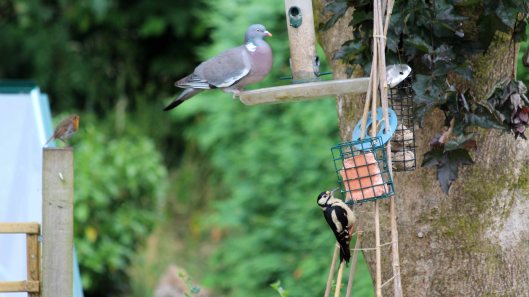
My photos show just a few of the birds that entertained us yesterday – and these 14 species are not the only birds that visit: House sparrow, Blue tit, Great tit, Collared dove, Woodpigeon, Chaffinch, Goldfinch, Bullfinch, Carrion crow, Great spotted woodpecker, Magpie, Robin, Dunnock, and Blackbird.

180705 2 Great spotted woodpecker

The Great spotted woodpeckers have been bringing their offspring to the garden this year

180705 3 Woodpigeon and Carrion crow

The Woodpigeon doesn’t look too happy about the Carrion crow being so close

180705 4 Blackbird

A Blackbird with an odd beak

180705 5 Goldfinches and Bullfinch

‘This is ours’, squawked the Goldfinch to the Bullfinch, but …

180705 6 Bullfinch

… the Bullfinch won out on the day!

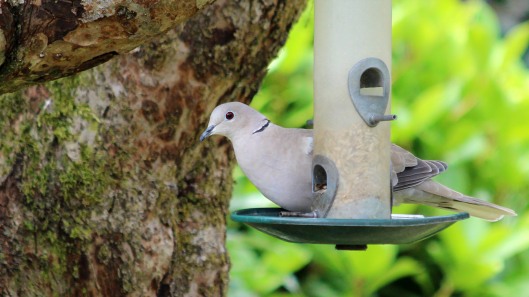
180705 7 Collared dove

A beautiful Collared dove

Like Loading...
← Older posts
Newer posts →

About me

sconzani

sconzani

I'm a writer and photographer; researcher and blogger; birder and nature lover; countryside rambler and city strider; volunteer and biodiversity recorder.

View Full Profile →

Follow earthstar on WordPress.com

Enter your email address to follow this blog and receive notifications of new posts by email.

Recent blog posts

  • The day of the Wheatears March 28, 2026
  • Cetti’s warblers March 27, 2026
  • Goose barnacles March 26, 2026
  • Black-tailed godwits fighting March 25, 2026
  • Singing from every tree top March 24, 2026

From the archives

COPYRIGHT

Unless otherwise acknowledged, the text and photographs on this blog are my own and are subject to international copyright. Nothing may be downloaded or copied without my permission.

Fellow Earth Stars!
  • Unknown's avatar
  • Unknown's avatar
  • Unknown's avatar
  • Unknown's avatar
  • Unknown's avatar
  • Unknown's avatar
  • Unknown's avatar
  • Unknown's avatar
  • Unknown's avatar
  • Unknown's avatar
  • Unknown's avatar
  • Unknown's avatar
  • Unknown's avatar
  • Unknown's avatar
  • Unknown's avatar
  • Unknown's avatar
  • Unknown's avatar
  • Unknown's avatar
  • Unknown's avatar
  • Unknown's avatar
  • Unknown's avatar
  • Unknown's avatar
  • Unknown's avatar
  • Unknown's avatar
  • Unknown's avatar
  • Unknown's avatar
  • Unknown's avatar
  • Unknown's avatar
  • Unknown's avatar
  • Unknown's avatar
  • Unknown's avatar
  • Unknown's avatar
  • Unknown's avatar
  • Unknown's avatar
  • Unknown's avatar
  • Unknown's avatar
  • Unknown's avatar
  • Unknown's avatar
  • Unknown's avatar
  • Unknown's avatar
  • Unknown's avatar
  • Unknown's avatar
  • Unknown's avatar
  • Unknown's avatar
  • Unknown's avatar
  • Unknown's avatar
  • Unknown's avatar
  • Unknown's avatar
  • Unknown's avatar
  • Unknown's avatar

Blog at WordPress.com.

Privacy & Cookies: This site uses cookies. By continuing to use this website, you agree to their use.
To find out more, including how to control cookies, see here: Cookie Policy
  • Subscribe Subscribed
    • earthstar
    • Join 642 other subscribers
    • Already have a WordPress.com account? Log in now.
    • earthstar
    • Subscribe Subscribed
    • Sign up
    • Log in
    • Report this content
    • View site in Reader
    • Manage subscriptions
    • Collapse this bar
 

Loading Comments...
 

You must be logged in to post a comment.

    %d