• ABOUT
  • BIRDING 2018
  • Birding 2019
  • BLOG POSTS
  • Butterflies 2018
  • Resources

earthstar

~ a celebration of nature

earthstar

Category Archives: insects

Moths in the light of day

01 Thursday Jun 2017

Posted by sconzani in insects, nature

≈ 5 Comments

Tags

British moth, Camptogramma bilineata, Euclidia mi, moth, Mother Shipton, Silver-ground Carpet, Spilosoma lubricipeda, White Ermine, Xanthorhoe montanata, Yellow Shell

In the absence of butterflies, I seem to be discovering more moths. (I’m not sure why I’m not seeing many butterflies, though a friend says there’s often a May lull before a June explosion – let’s hope that’s true.)

170601 White ermine (1)
170601 White ermine (2)

White Ermine (Spilosoma lubricipeda)
I found this beauty, wearing the rather regal furry coat that gives it its name, lurking in a clump of tall grass. Flying between May and July, with an occasional second generation appearing in September–October, the White Ermine can be found throughout Britain in a variety of habitats, from heath- and moorland to gardens, hedgerows and woodlands.

170601 Silver-ground Carpet

Silver-ground Carpet (Xanthorhoe montanata)
This pretty member of the carpet group of moths was a lucky find at Cosmeston Lakes Country Park, where I chanced to spot it resting in a clump of grass in a small woodland area. It’s another May to July flier, and its caterpillars enjoy nothing better than a good munch on bedstraws, the plants of the Galium species.

170601 Yellow shell
170601 Mother Shipton

Yellow Shell and Mother Shipton
Both of these images were grab shots from a recent walk around the former rubbish tip that is now Grangemoor Park, in Cardiff. Moths have a habit of not wanting to be disturbed by camera lenses thrust in their direction, I notice, so my apologies that my photos are not very sharp.

I wish the Yellow shell (Camptogramma bilineata) (above left) hadn’t flitted off so quickly as I love its bright markings that resemble the line patterns found on some seashells, hence its name. It’s another common find throughout Britain, though it does have a preference for damper places. Its larvae feed on low-growing plants like sorrel and chickweed so look for it around that type of vegetation, usually between May and August.

Can you see why Mother Shipton (Euclidia mi) (above right) is so named? Those markings on her wings supposedly resemble a witch’s face and she is named for Old Mother Shipton, a 16th-century witch from Yorkshire who produced a series of dire prophecies. The moth, on the other hand, can be found all over Britain and Ireland, though has a particular fondness for the flower-rich meadows where grow the clovers, medics and lucernes its caterpillars like to eat.

Like Loading...

Botanising, with insects

30 Tuesday May 2017

Posted by sconzani in animals, birds, insects, molluscs, nature, slugs

≈ 4 Comments

Tags

Bloody-nosed beetle, Brynna, Click beetle, Glamorgan Botany Group, grasshopper, moths, Nettle weevil, rooster, sheep, slugs

As I mentioned a couple of days ago, I returned from my last Botany Group walk with more photos of insects – and other living creatures – than plants. The Gorse weevil got a blog of its own yesterday; now here are some of our other finds.

170531 1 weevil
170531 2 Nettle Weevil
170531 3 Click beetle

Firstly, a couple more weevils, both on nettle and the second one is definitely a Neetle weevil (Phyllobius pomacues) but I’m not sure about the first. The Click beetle was also found on nettle.

170531 4 sheep
170531 5 rooster

These two were at a farm we passed through; the sheep was lording it over the home paddock and the rooster was king of the farmyard. Both handsome dudes!

170531 6 slugs
170531 7 grasshopper

A nice little grouping of slug species, with their small friend, the Granny Grey, and a grasshopper. There were lots of these hopping round on grass and rushes in a boggy field. It may be a juvenile Meadow grasshopper but I’m not 100% sure.

170531 8 Micropterix calthella
170531 9 Moth Bactra sp
170531 10 spider

A little flock of Micropterix cathella moths were feasting on this grass flower, and there were lots of other small moths, probably one of the Bactra species, plus an unidentified spider with a distinctive striped body.

170531 11 Bloody-nose beetle larva
170531 12 Bloody-nose beetle

And last, but certainly not least, these Bloody-nosed beetles (Timarcha tenebricosa). The photo on the left shows the chubby larva and on the right is the adult beetle munching on a grass stalk.

Like Loading...

Weevil as biological controller

29 Monday May 2017

Posted by sconzani in insects, nature, plants

≈ 6 Comments

Tags

Exapion ulicis, gorse, Gorse weevil, insects on gorse, weevil, weevil as biological control, weevil introduced to New Zealand

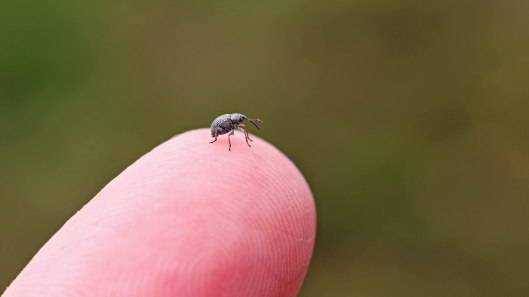
It was lunchtime on our Glamorgan botany group walk and, rather than get a wet bum from sitting on the damp grass, I was eating my roll and cheese while poking around the flowers of a nearby gorse bush. I was looking for Gorse shieldbugs, of which I found not a sign, but I did find this tiny creature and, after a bit more poking, a couple of its friends.

170529 Gorse weevil (2)

It’s a Gorse weevil (Exapion ulicis) and, as you can judge from its size relative to my finger, it’s tiny, only 2 to 3mm long. Its snout is (relatively) enormous, about half as long as its body, making it look like a cross between an elephant (without the ears) and a spider (those legs!). And that snout is its secret weapon – the weevil uses its snout to burrow into the stem and spines of the gorse bush to eat the soft tissue inside.

170529 Gorse weevil (1)

Apparently this little weevil was introduced to my homeland, New Zealand, back in 1931 in an effort to control the introduced (by British migrants as cheap hedging) gorse bushes that were thriving in New Zealand’s favourable climate. The weevil’s larvae live inside and eat gorse seeds, thus preventing the bushes from reproducing. The little gorse weevil has done its job well but it seems the scientists hadn’t banked on the fact that the weevil larvae only eat gorse seeds in the springtime and the gorse also flowers and seeds in the autumn.

170529 Gorse weevil (3)

Like Loading...

Royal Botanic Garden, Madrid

17 Wednesday May 2017

Posted by sconzani in flowers, insects, nature, parks

≈ 2 Comments

Tags

Madrid, Prado Museum, Royal Botanic Garden, Royal Botanic Garden Madrid

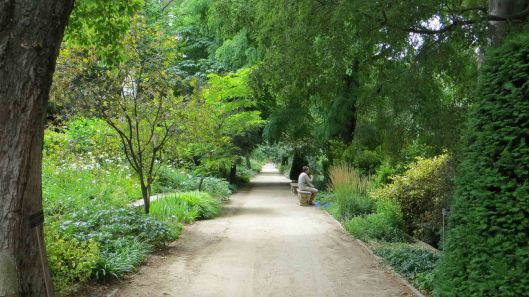
Three years ago I was fortunate to enjoy a short break in the Spanish city of Madrid – and what a beautiful city it is! One of the highlights for me (as well as the fact that King Felipe was kind enough to synchronise his coronation with my visit) was the time I spent wandering in the Royal Botanic Garden. It is situated right next to the incredible Prado Museum and is the perfect dessert to the museum’s main course of artistic masterpieces.

170517 Royal Botanic Garden Madrid (9)

Established by King Charles III in 1781, the Garden is not meant as a park but is rather a museum collection of live plants, a centre for research into historic plants and for the study of plant life, for the preservation of plant species and for the encouragement of the botanical sciences. It is also a feast for the senses!

170517 Royal Botanic Garden Madrid (1)
170517 Royal Botanic Garden Madrid (2)
170517 Royal Botanic Garden Madrid (3)
170517 Royal Botanic Garden Madrid (4)
170517 Royal Botanic Garden Madrid (5)
170517 Royal Botanic Garden Madrid (6)
170517 Royal Botanic Garden Madrid (7)
170517 Royal Botanic Garden Madrid (8)
Like Loading...

The Cuckoos of the bee world

15 Monday May 2017

Posted by sconzani in insects, nature

≈ Leave a comment

Tags

bees, Cuckoo, Cuckoo bees, Nomada bees, Nomada species

You’ve no doubt heard of the Cuckoo bird that lays its eggs in the nests of other birds to get them to do all the hard work of feeding and raising their chicks but have you heard of the Cuckoo bees? These are the Nomada species, a huge group of bees with over 850 species worldwide, though only about 30 of these can be found in Britain. Even so, it is extremely difficult to tell those 30 species apart so I’m not even going to attempt to identify those in my photos.

170509 Nomada sp Cuckoo bees (3)

As you may have guessed, these bees lay their eggs in the nests of other bee species, primarily the Andrena species. When they hatch, the Cuckoo bee larvae eat the eggs of their host and then consume the food the Andrena had gathered for their own young. It’s very cunning if rather nasty behaviour.

170509 Nomada sp Cuckoo bees (1)
170509 Nomada sp Cuckoo bees (5)
170509 Nomada sp Cuckoo bees (2)
170509 Nomada sp Cuckoo bees (4)
Like Loading...

A bumper day for butterflies, and a moth

13 Saturday May 2017

Posted by sconzani in insects, nature, parks

≈ Leave a comment

Tags

Aglais io, Brimstone, British butterflies, British moth, butterflies, butterfly, Common blue, Cyclophora annularia, Dingy Skipper, Erynnis tages, Gonepteryx rhamni, moth, Pararge aegeria, Peacock, Polyommatus icarus, Speckled wood, The Mocha

Blue skies, warm temperatures, wildflowers in bloom – what more could a butterfly want? Not much it seems as they were out in force at Cosmeston Lakes Country Park and I spent several happy hours following them around, trying to get photographs but also just intrigued by their flight patterns, the food plants they were choosing and their general behaviour. The Whites, large and small, eluded my lens, as did several Orange-tips and one Red Admiral but I did manage to snap these six.

170513 (1) Brimstone
170513 (2) Common blue
170513 (3) Peacock

The first is a Brimstone butterfly (Gonepteryx rhamni), not to be confused with the moth of the same name. I saw two flying together, land together and then the male heading purposefully towards the female. Turns out though that her spreading her wings and raising her abdomen in the air was not a ‘come hither’ signal but rather the opposite. She was indicating that she had already mated and was rebuffing the male. I saw several Common blues (Polyommatus icarus), also easily confused with other very similar small blue butterflies. They are so vibrant! And seeing a Peacock (Aglais io) is always a treat, though this one was looking a little battered.

170513 (4) Speckled wood
170513 (5) Dingy skipper
170513 (6) Mocha moth

Speckled woods (Pararge aegeria) seem to be the butterflies I see most often wherever I go but I love their pretty dappling of brown and cream. The next was a new one for me and I saw two of them – it’s a Dingy Skipper (Erynnis tages), a butterfly whose caterpillars feed on Bird’s-foot trefoil so it’s often found on the short impoverished grasslands of former coal tips, rubbish tips and quarries. I’ve just learnt that it’s called Dingy because ‘it loses scales alarmingly as it get older so looks, well, dingy’ (thanks, Steven). The last is not a butterfly but a moth and rather a special moth, The Mocha (Cyclophora annularia). This moth is nationally scarce but more frequent in the woodlands of southern Britain so I was well pleased with this sighting.

Like Loading...

Good things come in small packages

11 Thursday May 2017

Posted by sconzani in insects, nature, spring

≈ Leave a comment

Tags

gorse, gorse flower, Gorse shieldbug, Gorse shieldbug eggs, insect eggs, Piezodorus lituratus, shieldbug

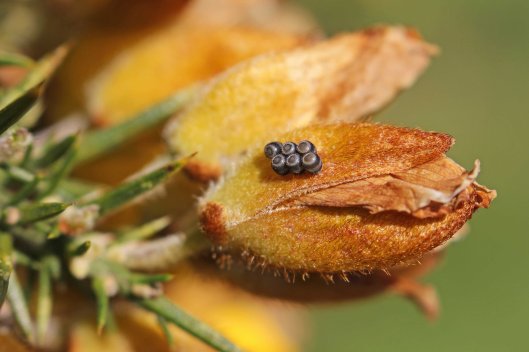
They say ‘Good things come in small packages’ and you couldn’t get much smaller than these tiny packages, the eggs of the Gorse shieldbug (Piezodorus lituratus) sitting on a gorse flower in Lavernock Reserve. I’ll be heading back soon to try to find the hatchlings.

170511 Gorse shieldbug eggs

Like Loading...

More from Merthyr Mawr

09 Tuesday May 2017

Posted by sconzani in insects, nature, wildflowers

≈ Leave a comment

Tags

biodiversity, biological diversity, Blood bee, Common Stork's-bill, Glamorgan Fungus Group, Green dock beetle, Merthyr Mawr National Nature Reserve, Micropterix calthella, Navelwort, Poplar leaf beetle, Red-headed Cardinal beetle

As I wrote yesterday, with very little fungi to be found our Glamorgan Fungus Group foray on Saturday developed into a more general nature ramble. I’m afraid I wasn’t writing down the names of all the various critters and plants we saw so I can’t identify everything in these photos but I can name some.

170509 (2) Pyrochroa serraticornis Red-headed Cardinal beetle
170509 (3) Centipede
170509 (4) Eggs of Gastrophysa viridula Green dock beetle
170509 (5) Micropterix calthella moths
170509 (6) Erodium cicutarium Common Stork's-bill
170509 (7) Two species of snails
170509 (8) Umbilicus rupestris Wall pennywort or Navelwort
170509 (9) Chrysomela populi Poplar leaf beetle
170509 (10) Sphecodes sp Blood bee

The first is a Red-headed cardinal beetle (Pyrochroa serraticornis), a very pretty beetle though this one wouldn’t keep still for me. The centipede was the same and I’m afraid I don’t remember its name, though I was told it’s not particularly common. It tickled! I think the little yellow dots are the eggs of the Green dock beetle (Gastrophysa viridula) as we saw a pair mating nearby. The tiny moths on the buttercup flower are Micropterix calthella. The plant with the pink flower is one I actually remembered from my botany walk on Thursday – a miracle! It’s Common Stork’s-bill (Erodium cicutarium). Then we have two different species of snail cosying up together. Once again, I was told the names but didn’t write them down and have forgotten (must do better next time!). This very pretty plant was a new one for me and it has two common names, so you might know it either as Wall pennywort or Navelwort (scientific name Umbilicus rupestris). Next is another beetle, this time a Poplar leaf beetle (Chrysomela populi). It was a gorgeous wee thing, with metallic green thorax and dark red body, almost like an oversized ladybird. And, last but not least, was this rather angry Blood bee (Sphecodes sp.). It was trying to lay its eggs in the holes of mining bees when it was netted and potted up for a quick close-up look.

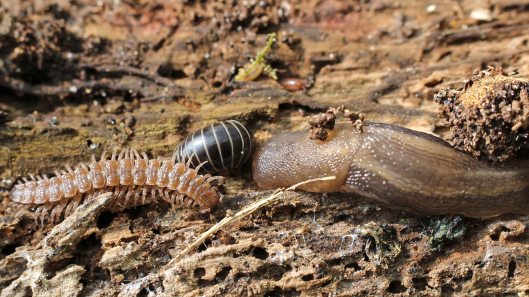
170509 (1) Millipede Pill bug Slug

My favourite moment of the day, though, was when I turned over this log. I particularly loved the little grouping of millipede, pill-bug and slug but these were only a few of the various creatures to be seen. It was just nice to see such biodiversity co-existing happily together. A lesson for us all, I think.

Like Loading...

Praying or preying?

03 Wednesday May 2017

Posted by sconzani in insects, nature

≈ 2 Comments

Tags

#WorldWildlifeWednesday, insects, Mantids, Praying mantis, Praying mantis Cambodia, Praying mantis New Zealand, Preying mantis

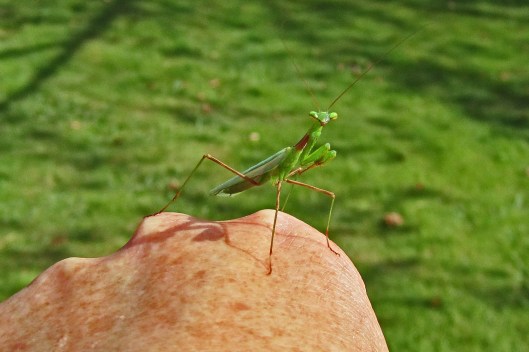
The correct name for this insect is Praying mantis (or, in fact, Praying mantid as my photos were taken in New Zealand (above) and Cambodia (below) and I’m not sure which species these are), the word ‘praying’ coming from its stance – with its large front legs bent and resting together, the insect looks like it’s praying. However, the word ‘preying’ seems equally appropriate for the mantis as it’s a formidable hunter.

170503 Praying mantis New Zealand

Mantids are masters of camouflage and use this ability to change their colouration to blend in with their surroundings, partly as a way to avoid being eaten by their predators but also, as they are mostly ambush predators themselves, as a way to more easily capture their own victims. They are also masters of the rapid pounce and their diet includes living insects like flies and aphids, crickets, moths, grasshoppers and even cockroaches.

170503 Praying mantis Cambodia

But wait, there’s more. The Praying mantis can also be cannibalistic. When food is scarce, they will eat their own kind, though male mantids are most at risk from the females at mating time. It seems hungry females have a tendency to eat their mates if the males don’t dismount and run away as rapidly as possible after copulation.

Like Loading...

Bishy-barnabee & Co

02 Tuesday May 2017

Posted by sconzani in insects, ladybird, nature

≈ 3 Comments

Tags

14-spot ladybird, 18-spot ladybird, 22-spot ladybird, 7-spot ladybird, Bishy-barnabee, harlequin ladybird, ladybird, Orange ladybird, Robert Macfarlane, vernacular names for ladybird

If you’re on Twitter and follow one of my favourite authors, Robert Macfarlane, you’ll know that he tweets a ‘word of the day’. Yesterday’s was ‘Bishy-barnabee’, a vernacular name for the ladybird used by folk who live in the English county of Norfolk. I adore these common names – they are often old, come from a time when folk paid more attention to the natural world, observing the habits and customs of the creatures around them, or they named creatures after concepts and ideas that were important to them. Macfarlane listed other ladybird names too: cushcow, goldie-bird, red-sodger, and kingcollawa. In Fauna Britannica, Stefan Buczacki lists even more: as well as bishie barni-bee, he has bishop barnabee, bishop is burning, bishop that burneth (all from Norfolk); clock-o’clay and cow lady (from Yorkshire); God Almighty’s cow, God’s little cow and King Galowa (from Scotland); and ladycow, lady fly, lady lanners, Mary gold and sodger (from Northumberland). I’m sure there are many many more.

Here is a selection of the Bishy-barnabees I have photographed (using the mostly numerical descriptions we more commonly use these days: two 7-spots, a 14-spot, an 18-spot, a 22-spot, 3 Harlequins and an Orange).

170501 ladybird 7-spot (1)
170501 ladybird 7-spot (2)
170501 ladybird 14-spot
170501 ladybird 18-spot
170501 ladybird 22-spot
170501 ladybird Harlequin (1)
170501 ladybird Harlequin (2)
170501 ladybird Harlequin (3)
170501 ladybird Orange
Like Loading...
← Older posts
Newer posts →

About me

sconzani

sconzani

I'm a writer and photographer; researcher and blogger; birder and nature lover; countryside rambler and city strider; volunteer and biodiversity recorder.

View Full Profile →

Follow earthstar on WordPress.com

Enter your email address to follow this blog and receive notifications of new posts by email.

Recent blog posts

  • Bug: Harpocera thoracica April 22, 2026
  • A female Tawny April 21, 2026
  • NFY: Orange-tip April 20, 2026
  • All the yellows April 19, 2026
  • Spider: Dysdera crocata April 18, 2026

From the archives

COPYRIGHT

Unless otherwise acknowledged, the text and photographs on this blog are my own and are subject to international copyright. Nothing may be downloaded or copied without my permission.

Fellow Earth Stars!

  • Unknown's avatar
  • Unknown's avatar
  • Unknown's avatar
  • Unknown's avatar
  • Unknown's avatar
  • Unknown's avatar
  • Unknown's avatar
  • Unknown's avatar
  • Unknown's avatar
  • Unknown's avatar
  • Unknown's avatar
  • Unknown's avatar
  • Unknown's avatar
  • Unknown's avatar
  • Unknown's avatar
  • Unknown's avatar
  • Unknown's avatar
  • Unknown's avatar
  • Unknown's avatar
  • Unknown's avatar
  • Unknown's avatar
  • Unknown's avatar
  • Unknown's avatar
  • Unknown's avatar
  • Unknown's avatar
  • Unknown's avatar
  • Unknown's avatar
  • Unknown's avatar
  • Unknown's avatar
  • Unknown's avatar
  • Unknown's avatar
  • Unknown's avatar
  • Unknown's avatar
  • Unknown's avatar
  • Unknown's avatar
  • Unknown's avatar
  • Unknown's avatar
  • Unknown's avatar
  • Unknown's avatar
  • Unknown's avatar
  • Unknown's avatar
  • Unknown's avatar
  • Unknown's avatar
  • Unknown's avatar
  • Unknown's avatar
  • Unknown's avatar
  • Unknown's avatar
  • Unknown's avatar
  • Unknown's avatar
  • Unknown's avatar

Blog at WordPress.com.

Privacy & Cookies: This site uses cookies. By continuing to use this website, you agree to their use.
To find out more, including how to control cookies, see here: Cookie Policy
  • Subscribe Subscribed
    • earthstar
    • Join 642 other subscribers
    • Already have a WordPress.com account? Log in now.
    • earthstar
    • Subscribe Subscribed
    • Sign up
    • Log in
    • Report this content
    • View site in Reader
    • Manage subscriptions
    • Collapse this bar
 

Loading Comments...
 

You must be logged in to post a comment.

    %d