The Gadwall that thinks she’s a Mallard

Tags

, , , , , , ,

It’s quite unusual for Gadwall to spend time at Cardiff Bay Wetlands Reserve and for them to be so confiding and so consistently in the company of Mallards rather than their own kind, so this little beauty may well be the same bird that visited the reserve back in March 2021.

220728 gadwall

Yesterday, she was puddling about right next to the boardwalk, which gave me the perfect opportunity to take some comparison shots with a female Mallard: Gadwall images on the left, Mallard on the right. Female ducks can be tricky to tell apart but you can see here that the differences in their body shapes are quite distinctive.

220728 gadwall mallard

Passed on

Tags

, ,

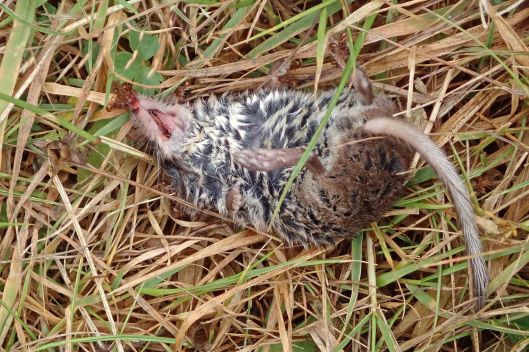
This was one of three dead shrews I saw on Sunday’s walk around a local meadow. These tiny creatures live a fast and furious life so their death may have been from natural causes though I’ve never seen three on one day in one field before. I wonder if last week’s heat wave got them (for non-British readers, Britain recorded temperatures over 40 degrees Celsius last week for the first time ever). I found it intriguing, if gory, to see the ants clustered around the snout and claws.

220726 dead shrew

Blackberries, yum!

Tags

, , , ,

Yesterday’s first tasting of this season’s blackberries nearly ended in disaster – not for me, but for this teeny weeny Dock bug nymph that was hiding on the far side of a berry but managed to scurry quickly on to my hand before I ate it. The berry was still a bit sour but at least it wasn’t crunchy!
*Note to self: always inspect the berries before eating them.

220725 blackberry and dock bug nymph

An opulence of orchids

Tags

, , , , ,

I took these photos of Broad-leaved helleborine (Epipactis helleborine) ten days ago, on 13 July, and even then I had expected them to have shrivelled in the sweltering heat. Now, after the heatwave, I imagine they will have wilted, drooped, possibly died off completely but I will go back soon to check on them as they have such lovely flowers.

220724 broad-leaved helleborine

Agg is for aggregate

Tags

, , ,

Have you ever wondered why the abbreviation ‘agg.’ is used after the scientific names of some flora and fauna? Well, this particular sawfly is a prime example.

‘Agg.’ is short for aggregate and is used where there exists a group of species that are so closely related and difficult to distinguish from each other, that for practical biodiversity recording purposes they are considered one species. As the Nature Spot website explains

The four species within the Tenthredo arcuata complex are problematic to distinguish and the species boundaries are unclear. The complex within Britain and Ireland consists of the species T. arcuata, brevicornis, notha and schaefferi. Unless specimens have been microscopically examined by someone with suitable expertise, we have decided that they should be recorded as part of this aggregate.

So, the scientific name used for this rather cute little sawfly is quite a mouthful: Tenthredo arcuata/brevicornis/notha/schaefferi agg.

220721 Tenthredo arcuata brevicornis agg

Fledged

Tags

, , , , , ,

Last Saturday afternoon, with much screeching and peeping, this year’s Lesser black-backed gull chick fledged from its home amongst a neighbour’s chimney pots – the same location and, presumably, the same pair of gulls as I’ve posted about here before (in The eggs have hatched!, June 2019 and Fledging, July 2020). I’m never sure whether the chicks’ departures from these rooftop nests are deliberate or accidental – some over-jealous wing-flapping, perhaps? But this year it was certainly well timed to miss the scorching heatwave – I can’t begin to imagine what the temperature would be on the rooftops in full sun.

I’m pleased to report the fledgling has made it through its first couple of nights and days. When I headed out early Sunday morning for a walk, it was sitting across the road in the local church grounds, an adult on the roof top keeping an eye on it, and that’s where it seems to have remained, a relatively safe and sheltered spot next to a very busy road. Fingers crossed for its continued survival!

220719 LBB fledgling

p.s. The top two images were taken when it was still in the ‘nest’; the photos are dated 11 and 12 July respectively.